AQA GCSE Biology Year 10: DNA and the Genome
 Call Kai
 Learn
Learn Practice Test
 Spaced Repetition
 Match
Match Flashcards
 Knowt Play
1/38

There's no tags or description
Looks like no tags are added yet.
Name | Mastery | Learn | Test | Matching | Spaced | Call with Kai | Chat |
|---|
No analytics yet
Send a link to your students to track their progress
39 Terms
What is DNA?
. Chemical
. Polymer made up of 2 strands forming double helix
. Contained in chromosomes
What is a gene and what does it do?
. Small section of DNA on a chromosome
. Each gene codes for a particular sequence of amino acids to make a specific protein
What is the genome?
The entire genetic material of an organism
Why is understanding the human genome important? (What does it allow us to do?)
. Search for genes linked to different types of disease
. Understand and treat inherited disorders
. Used in tracing human migration patterns from the past
Describe the structure of DNA
. Polymer made up of repeating nucleotide units
. Consist of alternating deoxyribose sugar and phosphate sections
. 1 base attached to the sugar
. 4 bases: A, C, G, T
Describe the structure of a nucleotide
. Deoxyribose sugar group and phosphate group
. 1 base attached to the sugar
. 4 bases: A, C, G, T
Which base is linked to which in complementary strands of DNA?
. A to T
. C to G
What do bases in DNA control?
. Sequence of 3 bases is the code for a particular amino acid
. Order of bases controls order in which amino acids are assembled to produce a particular protein
Describe protein synthesis
. Proteins are synthesised on ribosomes according to a template
. Carrier molecules bring specific amino acids to add to the growing polymer chain in the correct order
. When the protein chain is complete it folds up to form a unique shape
. Shape enables proteins to do their job as enzymes, hormones, or forming structures in the body such as collagen
How often do mutations happen and what do they generally do?
. Mutations occur continuously
. Most do not alter the protein, or alter it slightly so its appearance or function is not changed
What can some mutations do?
. A few mutations code for an altered protein with a different shape
. An enzyme may no longer fit the substrate binding site or a structural protein may lose its strength
What do parts of DNA that don't code for proteins do?
. Called non-coding parts of DNA
. Can switch genes on and off
. Variations in these areas may affect how genes are expressed
What are alleles?
Different forms of the same gene
Define genotype
The genetic makeup of an individual for a particular characteristic e.g hair colour
(The alleles present)
Define phenotype
the physical appearance / biochemistry of an individual for a particular characteristic
What is a dominant allele?
An allele that will always be expressed, even if only 1 copy is present
What is a recessive allele?
An allele that is only expressed if 2 copies are present
What do you call an organism in which the 2 alleles present are the same?
Homozygous
What do you call an organism in which the 2 alleles present are different?
Heterozygous
What are most characteristics a result of?
Multiple genes interacting rather than a single gene
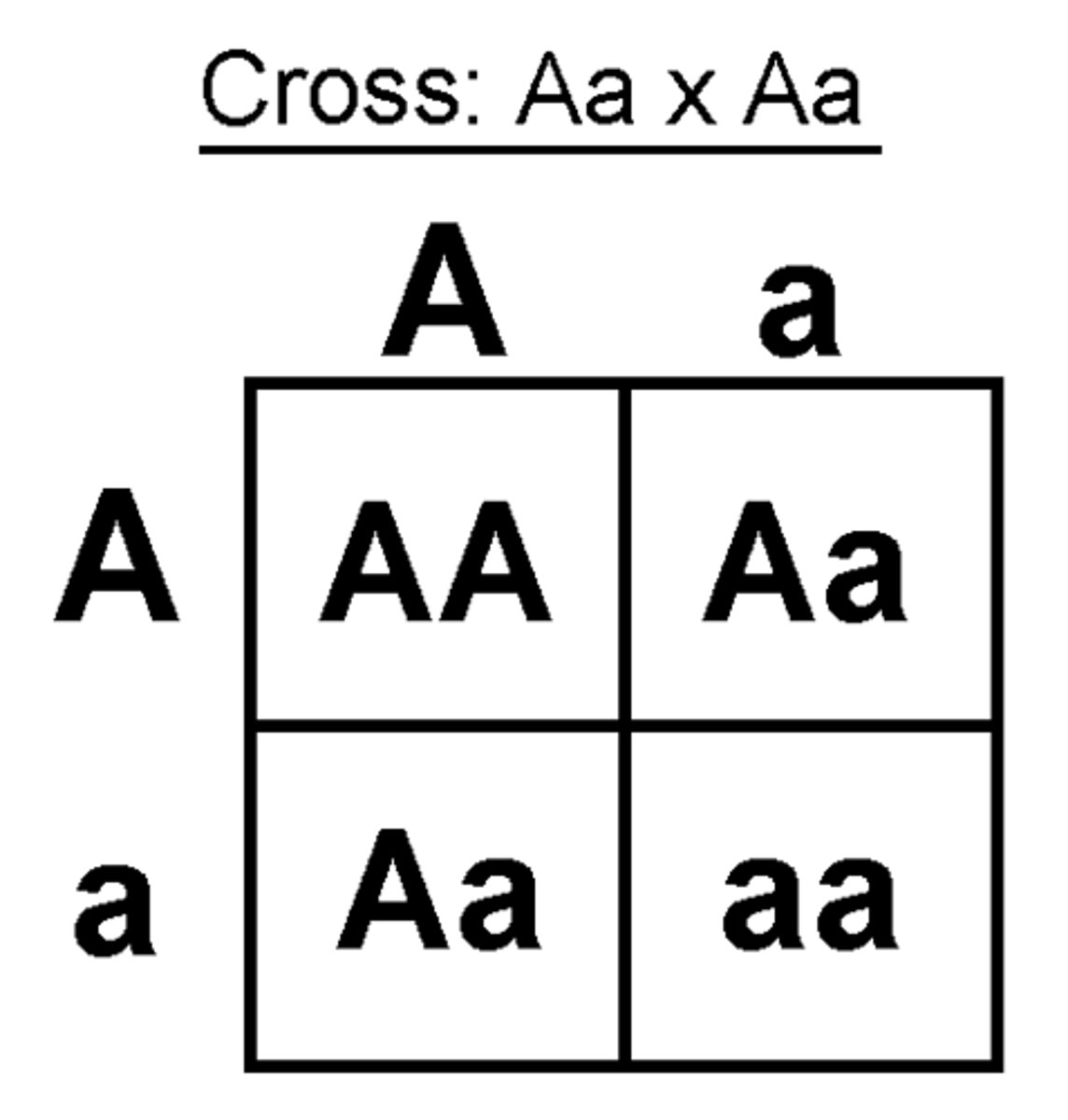
How do you perform a genetic cross?
. Find the 4 gametes and represent them by drawing a circle round each letter
. Capital = dominant allele, lowercase = recessive allele should use same letter in diagram to represent them
. Draw a Punnett square (see picture)
. Find ratio of each genotype
. Find ratio of each phenotype
. Convert to percentage probability
Who carried out the first known experiments on DNA and when?
. Gregor Mendel
. Mid-19th century
What did Mendel do?
Carried out breeding experiments on his plants
What did Mendel observe?
The inheritance of each characteristic is determined by 'units' that are passed on to descendants unchanged
What was observed in the late 19th century?
The behaviour of chromosomes during cell division
What was observed in the early 20th century?
. That chromosomes and Mendel's 'units' behaved in similar ways
. Led to the idea that the 'units', now called genes, were located on chromosomes.
What was worked out in the mid 20th century?
. Structure of DNA was determined
. Mechanism of gene function was worked out
What are 2 examples of inherited disorders?
. Polydactyly
. Cystic fibrosis
What is polydactyly and which type of allele is it caused by?
. Having extra fingers or toes
. Caused by a dominant allele
What is cystic fibrosis and which type of allele is it caused by?
. A disorder of cell membranes
. Caused by a recessive allele
Pros of embryo screening
. Prevents birth of a child with a serious condition / alleviates their suffering
. Embryo screening is less expensive for the NHS than treating the disorder in future
. Future generations are less likely to suffer from disorder
Cons of embryo screening
. Killing embryos that weren't implanted creates ethical issues
. Embryo may be harmed which may cause miscarriage
. Mother may be harmed due to the operation
. May give false positive or false negative so healthy embryo may be terminated
How many chromosomes do ordinary human body cells contain?
23 pairs
What determines the sex of humans?
. The genes on one of the pairs of chromosomes
. Females the chromosomes are the same (XX)
. Males the chromosomes are different (XY)
Define variation
Differences in the characteristics of individuals of a population
What factors might cause variation?
Differences in:
. The genes they've inherited (genetic causes)
. The conditions in which they have developed (environmental causes)
. A combination of genes and the environment
How much variation is there usually in a population?
There is usually extensive variation within a population of a species
What does variation arise from and how much does this change the organism?
. Mutations
. Most have no effect on the phenotype
. Some influence the phenotype
. Very few determine the phenotype
What can happen if a mutation leads to a new phenotype?
. Happens very rarely
. If new phenotype is suited to an environmental change it can lead to a relatively rapid change in the species