NUKE VARIABLES
 Call Kai
 Learn
Learn Practice Test
 Spaced Repetition
 Match
Match Flashcards
 Knowt Play
1/169

There's no tags or description
Looks like no tags are added yet.
Name | Mastery | Learn | Test | Matching | Spaced | Call with Kai | Chat |
|---|
No analytics yet
Send a link to your students to track their progress
170 Terms
Ax
average atomic mass of the element; found using Equation 1 when the element contains multiple isotopes; units are typically atomic mass units (amu)
γᵢ
atomic fraction of isotope i; tells you what fraction of the atoms are isotope i; found from the isotope abundance usually given as a percentage and converted to a decimal
Aᵢ
atomic mass of isotope i; the mass of the specific isotope; found on a chart of nuclides or from the nuclear data provided in the problem
Σᵢ
sum over all isotopes or species i; means you add the contribution from every isotope present
Ax = ∑ᵢ γᵢAᵢ
average atomic mass of an element; multiply each isotope’s atomic fraction by its atomic mass and add all of the isotope contributions together
wₓ
weight fraction of element x; represents the fraction of the total mass of a compound that comes from element x; calculated from the chemical formula using Equation 2
n
number of atoms of element x in the chemical formula; found by looking at the subscript of x in the chemical formula
Ax
atomic mass of element x; found on the periodic table
m
number of atoms of element y in the chemical formula; found by looking at the subscript of y in the chemical formula
Ay
atomic mass of element y; found on the periodic table
nAx
total mass contribution of element x in the chemical formula; multiply the number of x atoms by the atomic mass of x
mAy
total mass contribution of element y in the chemical formula; multiply the number of y atoms by the atomic mass of y
wₓ = nAx/(nAx + mAy)
weight fraction of element x in a compound; divide the mass contribution of x by the total mass of the compound
wᵢ
weight fraction of isotope i; represents the fraction of the total mass that comes from isotope i; found from the isotope abundance when the abundance is given by mass or weight
Aᵢ
atomic mass of isotope i; mass of the specific isotope; found on a chart of nuclides or in the problem
Σᵢ
sum over all isotopes; means you perform the calculation for every isotope and add the results together
Ax
average atomic mass of the element; the overall average atomic mass after accounting for the weight fractions of all isotopes
Ax = [∑ᵢ(wᵢ/Aᵢ)]⁻¹
average atomic mass from weight fractions; calculate wᵢ/Aᵢ for every isotope add the values then take the inverse of the result
Nᵢ
number density of isotope i; number of atoms of isotope i per unit volume; typically units of atoms/cm³ or atoms/m³; this is what the equation is solving for
γᵢ
atomic fraction of isotope i; fraction of all atoms that are isotope i; found from the isotope abundanceusually given as a percentage and converted to a decimal
ρₓ
mass density of the element or material; mass per unit volume; given in the problem or a reference table; typically g/cm³ or kg/m³
Nₐ
Avogadro’s number; number of particles in one mole; 6.022 × 10²³ particles/mol; a constant
Ax
average atomic mass of the element; found using Equation 1 if multiple isotopes are present; can also be provided in a problem or reference table
Nᵢ = γᵢρₓNₐ/Ax
number density of isotope i; uses the isotope’s atomic fraction, material density Avogadro’s number and average atomic mass to determine the number of atoms of that isotope per unit volume
ρᵢ
mass density of isotope i; the mass of isotope i per unit volume; typically units of g/cm³ or kg/m³; this is what the equation calculates
wᵢ
weight fraction of isotope i; fraction of the material's total mass that comes from isotope i; given in the problem or calculated from isotope information
ρₓ
total mass density of the element or material; mass per unit volume of the entire material; given in the problem or a reference table
ρᵢ = wᵢρₓ
mass density of isotope i; multiply the isotope’s weight fraction by the total material density to determine the density contributed by that isotope
Nᵢ
number density of isotope i; number of atoms of isotope i per unit volume; typically atoms/cm³ or atoms/m³; this is what the equation calculates
wᵢ
weight fraction of isotope i; fraction of the total mass belonging to isotope i; given in the problem or calculated from isotope abundance information
ρₓ
total mass density of the material; mass per unit volume; given in the problem or a reference table
Nₐ
Avogadro’s number; 6.022 × 10²³ particles/mol; a constant
Aᵢ
atomic mass of isotope i; mass of the specific isotope; found on a chart of nuclides or given in the problem
Nᵢ = wᵢρₓNₐ/Aᵢ
number density of isotope i; uses the isotope’s weight fraction, total material density, Avogadro’s number, and isotope atomic mass to calculate how many atoms of that isotope exist per unit volume,
γᵢ
atomic fraction; find from isotope abundance; convert percentage to decimal
wᵢ
weight fraction; find from mass/isotope abundance information or calculate from the material composition
Aᵢ
isotope atomic mass; find on the chart of nuclides
Ax
average atomic mass; find on the periodic table for a naturally occurring element or calculate with Equation 1/3 when isotope information is provided
ρₓ
material mass density; find in the problem statement or a reference table
Nₐ
Avogadro’s number; constant; 6.022 × 10²³ particles/mol
n
number of atoms of an element in a chemical formula; find from the chemical formula subscript
m
number of atoms of the other element in a chemical formula; find from the chemical formula subscript
Nᵢ
number density; usually the variable you are solving for; units are atoms/volume
ρᵢ
isotope mass density; usually the variable you are solving for in Equation 5; units are mass/volume
alpha decay
add a helium atom to the other side

beta decay (B minus)
add a beta particle with a minus one protron charge and also add an antineutreon
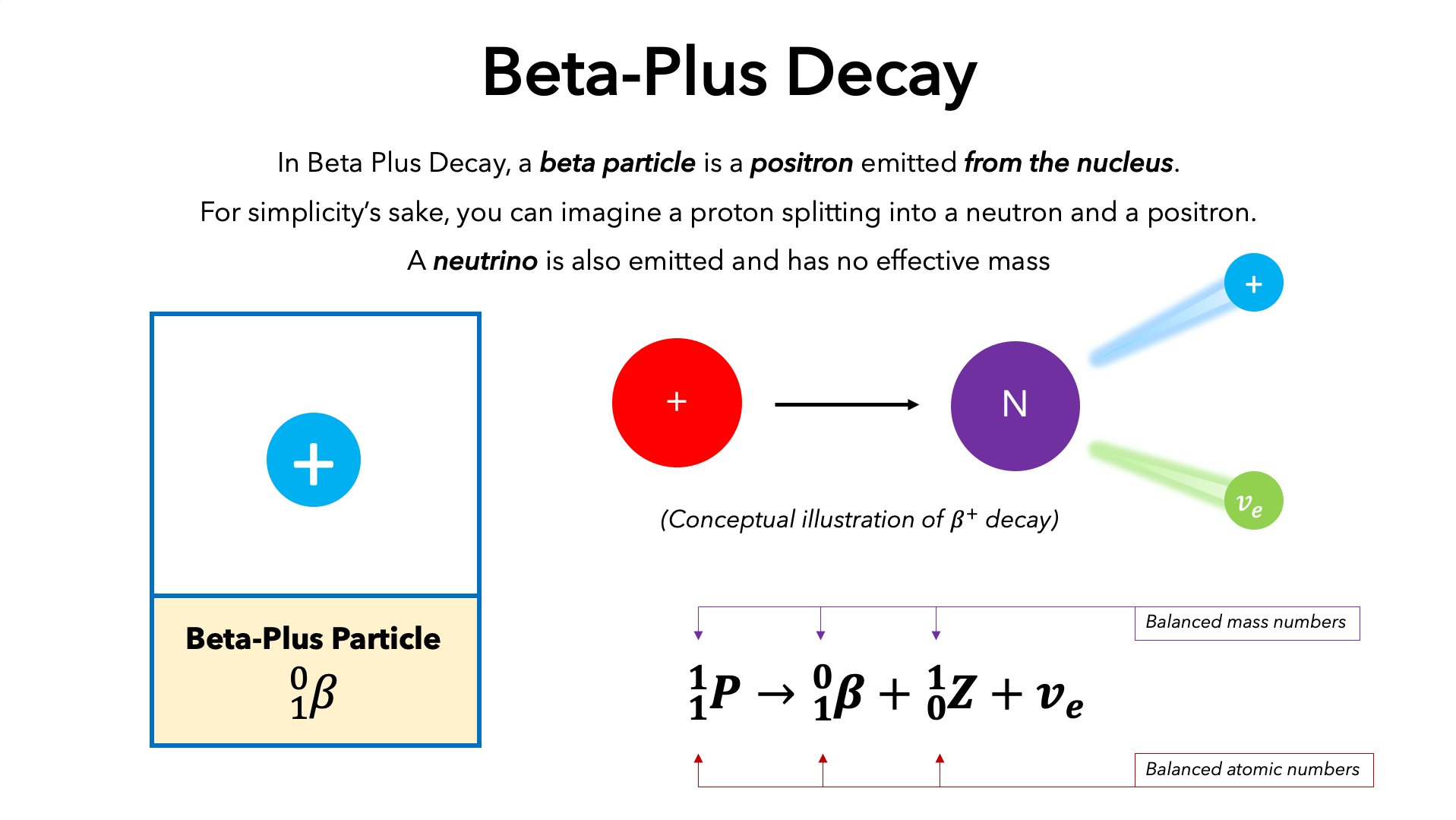
positron decay
add a beta particle as well as a antineutro. Then subtract one from the protrons of the atom
gamma decay(Y)
the nucleas is in an excited state and it transfers over to its regular state plus the funky y

neutron emission
a type of radioactive decay where an unstable atomic nucleas ejects one or more free neutrons to become more stable. Happens on the far left of the chart of the nuclides.
proton emission
in the top left boundary where a protons is ejected from the nucleus.
internal conversion
an excited atomic nucleas transfers its energy directly to an orbital electron which ejects it from the atom. Dominant in heavy nuclei in the lower right regions of the chart.
electron capture
where an unstable nucleai absorbs an innner orbital electron, converting a protron into a neutron and emmiting a neutron. Below and to the right of the parent.
what does it mean if the mass number is greater than the average atomic mass
the nucleus has too many neutrons and to become more stable with mostly undergo beta minus decay
What does it mean if the average atomic mass is greater than the mass number
this means that the isotope is nutrient deficient and will likely undergo weather positron decay or electron capture
what form of decay is likey to happen if the average atomic mass and the mass number are equal
there is no specific form for decay
what does binding energy show? What does a large binding number mean
binding energy shows how much force it takes to hold the nucleus. A large binding number means that it would require more energy to dissasoicate the nucleus making it more stable
what does a protron seperation energy versus a neutron seperation energy mean?
protron shows how much energy it takes to remove a protron from the nucleas. Vice versa for neutrons. Protrons seperation energy is usually lower than the neutron seperation in stable nuclei. This is because neutrons like to pair and to remove them from the nucleas you have to break them first.
what are the magic numbers and why do scientisits believe they indicate aytpical nuclear stability
Magic numbers are (2,8,20,28, 50, 82, and 126) since these fill a shelll of a neutron. This means that the atom is not trying to gain or lose an electron which makes it more stable. These are also more likey to be natural abundance of these atoms.
origin of the unit electron volt
it is the kinetic energy imparted to an electron accelerated through a potential difference of 1V.
exoergic
means that the Q value is greater than 0 and is therefore a release of energy.
endoergic
the Q value is negative meaning that the reaction absorbs energy from its surroundings.
Atomic structure,
The nucleus contains approximately 99.9% of an atom's total mass
The electron cloud occupies approximately 99.999999999% of the atom's volume
Approximately 1.0014:1; the neutron is slightly more massive than the proton
N=A-Z
A, Z [ X] where x is the elemental symbol, A is the mass number, and Z is the atomic number
A chart that organizes nuclides according to their number of protons \(Z\) and neutrons \(N\) showing information such as stability, radioactive decay, half-life, and decay modes
M=[sum] fiMi wher fi is the fractional abundance and Mi is the isotopes mass
A unit of mass defined as \(1/12\) the mass of a neutral carbon-12 atom; 1 amu= 1.66054×10^-27 kg
Mega-electron volt; I MeV =10^6 eV common unit of nuclear energy
1 amu c² = 931.5 MeV
The number of atoms, nucleai, or particles per unit volume, N/V, typically in atoms/cm³ or atoms/m³
N=pNa/M p is density, Na is avogradros numbers, and M is molar mass
Ni = pNa/ M fi where fi is the isotopes fractional abundance.
Na= 6.022 ×10²³ particles/mole
Time dilation
A moving clock is measured to run slower relative to a stationary observer; delta t= gamma change in time not
gamma= 1/root(1-v²/c²)
An object's measured length in the direction of motion decreases as its speed approaches L= Lnot/ lorenz factor
In the traditional formulation relativistic mass increases with velocity according to m=γm0 Modern physics generally uses invariant/rest mass m0m_0 and treats the additional energy as relativistic energy rather than an increase in rest mass.
c=3.0 × 10^8 m/s
KE = (gamma -1)m0c²
The kinetic energy increases enormously and approaches infinity as v→c this manifests as an increase in relativistic energy/momentum
Volume surface, Coulomb, asymmetry, and pairing terms.
Each nucleon interacts with nearby nucleons providing an attractive contribution to binding energy; larger nuclei gain more binding from this effect.
Nucleons at the surface have fewer neighboring nucleons, reducing their binding compared with nucleons inside the nucleus.