Ch.8-Patterns of Inhertience
 Call Kai
 Learn
Learn Practice Test
 Spaced Repetition
 Match
Match Flashcards
 Knowt Play
1/28

There's no tags or description
Looks like no tags are added yet.
Name | Mastery | Learn | Test | Matching | Spaced | Call with Kai | Chat |
|---|
No analytics yet
Send a link to your students to track their progress
29 Terms
Mendel’s experiements
inheritance patterns in honeybees and plants, ultimately settling on pea plants as his primary model system (a system with convenient characteristics that is used to study a specific biological phenomenon to gain understanding to be applied to other systems). In 1865, Mendel presented the results of his experiments with nearly 30,000 pea plants to the local natural history society. He demonstrated that traits are transmitted faithfully from parents to offspring in specific patterns. In 1866, he published his work, Experiments in Plant Hybridization,1 in the proceedings of the Natural History Society of Brünn. As stated earlier, in genetics, "parent" is often used to describe the individual organism(s) that contribute genetic material to an offspring, usually in the form of gamete cells.
Mendel’s work went virtually unnoticed by the scientific community, which incorrectly believed that the process of inheritance involved a blending of parental traits that produced an intermediate physical appearance in offspring. This hypothetical process appeared to be correct because of what we know now as continuous variation. Continuous variation is the range of small differences we see among individuals in a characteristic like human height. It does appear that offspring are a “blend” of their parents’ traits when we look at characteristics that exhibit continuous variation. Mendel worked instead with traits that show discontinuous variation. Discontinuous variation is the variation seen among individuals when each individual shows one of two—or a very few—easily distinguishable traits, such as violet or white flowers. Mendel’s choice of these kinds of traits allowed him to see experimentally that the traits were not blended in the offspring as would have been expected at the time, but that they were inherited as distinct traits. In 1868, Mendel became abbot of the monastery and exchanged his scientific pursuits for his pastoral duties. He was not recognized for his extraordinary scientific contributions during his lifetime; in fact, it was not until 1900 that his work was rediscovered, reproduced, and revitalized by scientists on the brink of discovering the chromosomal basis of heredity.
Hybirdizations
-involves mating two-true breeding individuals that have different
Mendel’s crosees
Plants used in first-generation crosses were called P, or parental generation, plants (Figure 8.3). Mendel collected the seeds produced by the P plants that resulted from each cross and grew them the following season. These offspring were called the F1, or the first filial (filial = daughter or son), generation. Once Mendel examined the characteristics in the F1 generation of plants, he allowed them to self-fertilize naturally. He then collected and grew the seeds from the F1 plants to produce the F2, or second filial, generation. Mendel’s experiments extended beyond the F2 generation to the F3 generation, F4 generation, and so on, but it was the ratio of characteristics in the P, F1, and F2 generations that were the most intriguing and became the basis of Mendel’s postulates.
trait
defined as a variation in the physical apperence of hertiable charcterstic
reciprocal cross
a paired cross in which the respective traits of the male and female in one cross become the respective traits of the female and male in the other chractersitcs
dominant and recessive
Dominant traits are those that are inherited unchanged in a hybridization. Recessive traits become latent, or disappear in the offspring of a hybridization. The recessive trait does, however, reappear in the progeny of the hybrid offspring.
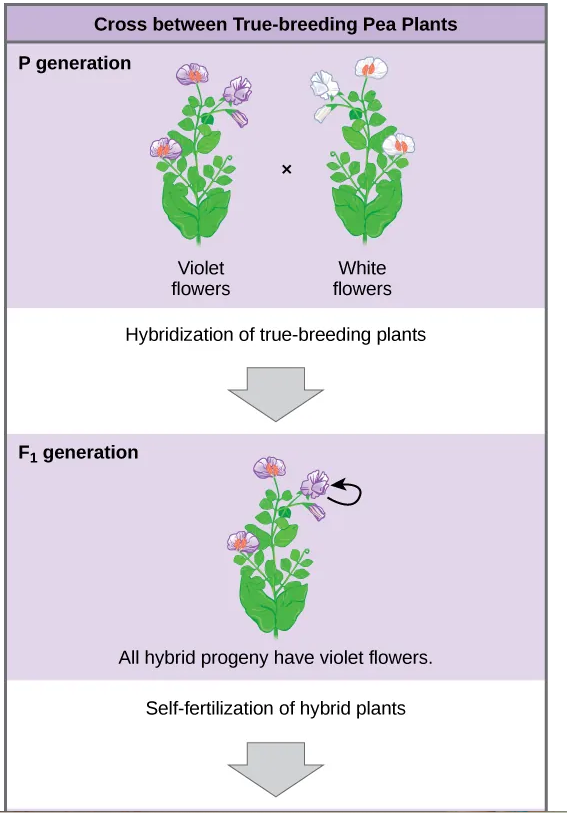
alleles
gene variants that arise by mutation and exist at the same relative locations on homologous chromosomes
difference between phenotype and genotype
phenotype- the observeable traits expressed by organism
genotype- an organism’s underlying genetic makeup, consists of both physically visible and the non-expressed aleles
hetrozygous and homozygouse
having two different alleles for a given gene on the homologous chromosomes
homozygous-having two different alleles for a given gene on the homologous chromosomes
law of domiance
in a heterozygote, one trait will conceal the presence of another trait for the same characteristic
Monohybird
the result of a cross between two true-breeding parents that express different traits for only one characteristic
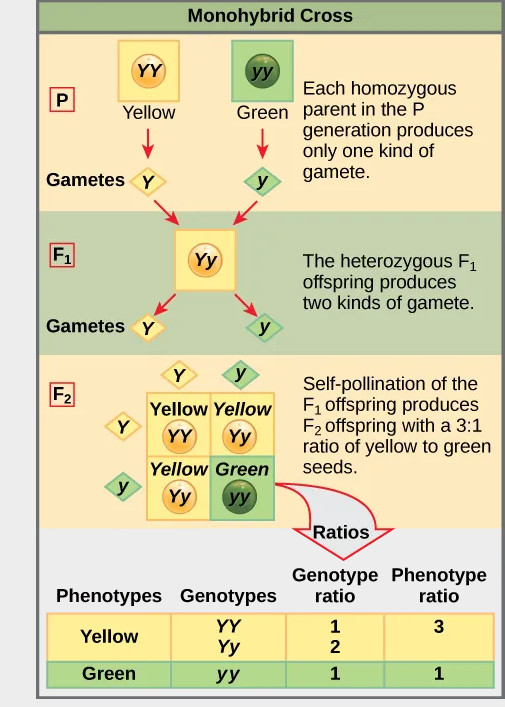
Punmet square
a visual representation of a cross between two individuals in which the gametes of each individual are denoted along the top and side of a grid, respectively, and the possible zygotic genotypes are recombined at each box in the grid
law of segregation
paired unit factors (i.e., genes) segregate equally into gametes such that offspring have an equal likelihood of inheriting any combination of factors
test cross
a cross between a dominant expressing individual with an unknown genotype and a homozygous recessive individual; the offspring phenotypes indicate whether the unknown parent is heterozygous or homozygous for the dominant trait
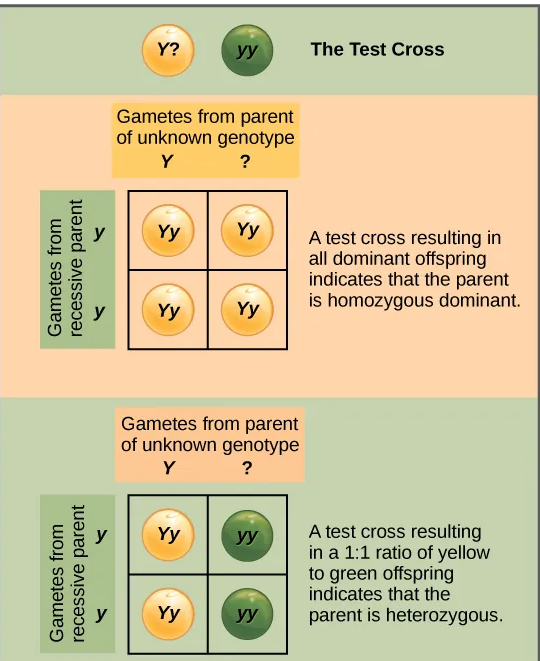
dihybird cross
the result of a cross between two true-breeding parents that express different traits for two characteristics
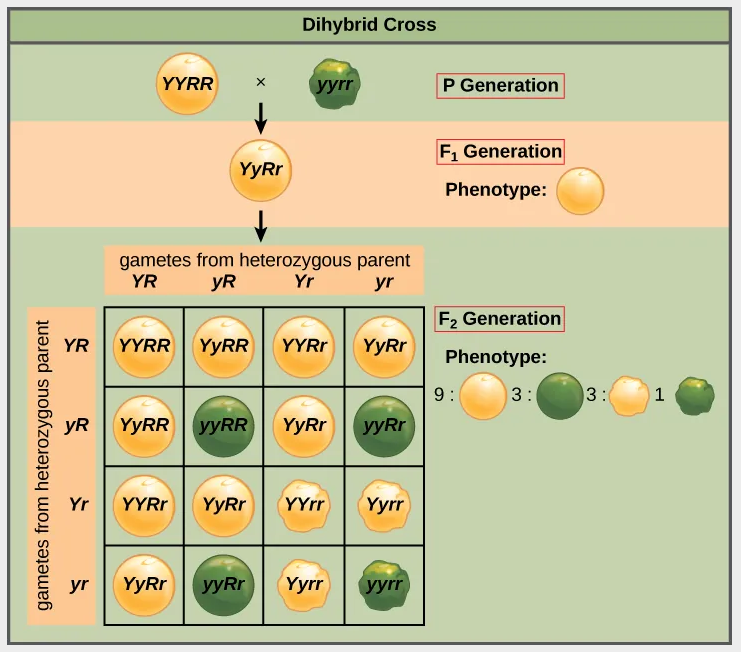
law of independent assortment
genes do not influence each other with regard to sorting of alleles into gametes; every possible combination of alleles is equally likely to occur
incomplete domiance
in a heterozygote, expression of two contrasting alleles such that the individual displays an intermediate phenotype
codomiance
in a heterozygote, complete and simultaneous expression of both alleles for the same characteristic
X-linked
a gene present on the X chromosome, but not the Y chromosome
hemizygous
the presence of only one allele for a characteristic, as in X-linkage; hemizygosity makes descriptions of dominance and recessiveness irrelevant
Linkage
a phenomenon in which alleles that are located in close proximity to each other on the same chromosome are more likely to be inherited together
recombination
the process during meiosis in which homologous chromosomes exchange linear segments of genetic material, thereby dramatically increasing genetic variation in the offspring and separating linked genes
test cross
epistasis
an interaction between genes such that one gene masks or interferes with the expression of another
Imagine that you are performing a cross involving seed color in garden pea plants. What traits would you expect to observe in the F1 offspring if you cross true-breeding parents with green seeds and yellow seeds? Yellow seed color is dominant over green.
-only yellow seeds
Imagine that you are performing a cross involving seed texture in garden pea plants. You cross true-breeding round and wrinkled parents to obtain F1 offspring. Which of the following experimental results in terms of numbers of plants are closest to what you expect in the F2 progeny?
610:190 round seeds:wrinkled seeds
What are the types of gametes that can be produced by an individual with the genotype AaBb?
AB, Ab, aB, ab
What is the reason for doing a test cross?
to determine which allele is dominant and which is recessive
If black and white true-breeding mice are mated and the result is all gray offspring, what inheritance pattern would this be indicative of?
incomplete domiance 4