Sympathetic vs Parasympathetic Overview
 Call Kai
 Learn
Learn Practice Test
 Spaced Repetition
 Match
Match Flashcards
 Knowt Play
1/10

There's no tags or description
Looks like no tags are added yet.
Name | Mastery | Learn | Test | Matching | Spaced | Call with Kai | Chat |
|---|
No analytics yet
Send a link to your students to track their progress
11 Terms
Dual innervation
almost all visceral organs are served by both the sympathetic and parasympathetic division, but they cause opposite effects
What are exceptions to dual innervation (3)
Sweat glands, arrector pili, adrenal medulla → only have sympathetic innervation
What are the two subdivisions of the ANS
Sympathetic and parasympathetic
Parasympathetic
rest and digest system → maintenance
promotes maintenance activities (homeostasis) and conserve body energy
A person relaxing, reading, after a meal is an example of what division
what happens to heart blood respiratory and gastrointestinal tract activity
what happens to pupils / eyes
Parasympathetic → blood pressure heart rate and respiratory rates all all low,
gastrointestinal tract activity is high
pupils are constricted aned lenses are accommodated for close vision (relaxed = close vision no need to be alert for danger)
Sympathetic division
fight or flight system → mobilizes body during activity, exercise, and stress/danger
What happens to bloodflow, bronchioles (lungs), liver, and pupils during sympathetic
Blood flow to skeletal muscles and heart
bronchioles dilate (expand)
liver release glucose for fuel
pupils dilate → see environment
Origin of sympathetic fibers
thoracolumbar region of spinal cordOr
orgin of parasympathetic fibers
brain and sacral spinal cord (craniosacral)
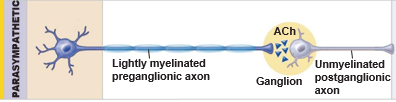
Length of fibers for sympathetic and why
short preganglionic and long post ganglionic
because ganglion is close to CNS spinal cord (short trip before ganglion, long trip after)
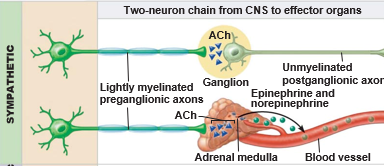
Length of fibers for parasympathetic and why
long preganglionic and short post ganglionic because ganglion is in or near effector organs (so long trip before ganglion and short trip after ganglion)