Phonics vocab quiz 1
 Call Kai
 Learn
Learn Practice Test
 Spaced Repetition
 Match
Match Flashcards
 Knowt Play
1/31

There's no tags or description
Looks like no tags are added yet.
Name | Mastery | Learn | Test | Matching | Spaced | Call with Kai | Chat |
|---|
No analytics yet
Send a link to your students to track their progress
32 Terms
Simple View of Reading
A theory stating that reading comprehension is the product of word recognition and language comprehension
Five Pillars of Science of Reading
The five essential components necessary for effective reading instruction, which include phonemic awareness, phonics, fluency, vocabulary, and comprehension (Peter Prefers Flying Very Carefully).
Automaticity
Fluent performance without the conscious deployment of attention.
Digraphs
A two-letter combination that spells a single speech sound. Examples include "sh", "ch", and "th".
Phoneme Awareness
The conscious awareness that words are made up segments of our own speech that are represented with letters in an alphabetic orthography.
Intuit
To understand or know something instinctively without the need for conscious reasoning.
Pre-alphabetic Phase
A phase of reading development characterized by lack of awareness that letters represent speech sounds; also called the logographic phase.
Early Alphabetic Phase
A phase of reading development in which the alphabetic principle is first understood and sounds represented by letters are partially known.
Later Alphabetic Phase
The phase of reading development characterized by full phonemic awareness and reasonable, complete mapping of phonemes to graphemes.
Phoneme
A speech sound that combines with others in a language system to make words.
Consonant
A phoneme that is not a vowel and is formed with obstruction of the flow of air with the teeth, lips or tongue; English has 40 or more of these.
Vowel
An open phone name that is the nucleus of every syllable and is classified by tongue, position and height, such as high/ low or front/mid/back.
Stops
Consonant speech sound that is articulated with a stop of the air stream.
Nasals (stop)
Spoken with the airstream directed through the nasal cavity.
Fricatives
A class of speech sounds articulated with a hiss or friction.
Affricates
Consonant phoneme articulated as a stop before a fricative, such as /ch/ or /j/.
Glides
A consonant phoneme that glides immediately into a vowel.
Liquids
Speech sound in which air is obstructed, but not enough to cause friction.
Diphthongs
Vowels that have a glide, and they feel as though they have two parts, especially the vowels /ou/ as in house and /oi/ as in oil.
Schwa
A non-distinct vowel found in unstressed syllables in English.
Tense vowels
Linguistic term for a long bow, spoken with tension in the vocal cords. Ex. /iː/ as in see and /uː/ as in food.
Lax vowels
Short vowels produced with little tension in the vocal chords. Ex. /æ/ as in cat and /ɛ/ as in bed.
R controlled vowels
Pertaining to a vowel immediately followed by the consonant /r/, such that it's pronunciation is affected or even dominated by the /r/.
Onset
The part of a syllable before the vowel.
Rime
A linguistic term for the part of a syllable that includes the vowel and what follows it.
Phonological awareness
Metalinguistic awareness of all levels of the speech, sound system, including word boundaries, stress patterns, syllables, onset-rime units and phonemes.
Grapheme
A letter or letter combination that spells a single phoneme. Ex. e, ei, igh, or eigh.
Consonant blend
In syllable structure, 2 or 3 adjacent consonant graphemes before or after a vowel.
Morphology
The study of meaningful units of language and how they are combined in word formation.
Science of Reading
A vast, interdisciplinary body of research that explains how humans learn to read. It combines over 50 years of studies from cognitive psychology, neuroscience, and linguistics to inform the most effective, evidence-based methods for literacy instruction.
Balanced Literacy
An instructional approach to teaching reading and writing that aims to bridge explicit phonics instruction with immersive whole-language learning.
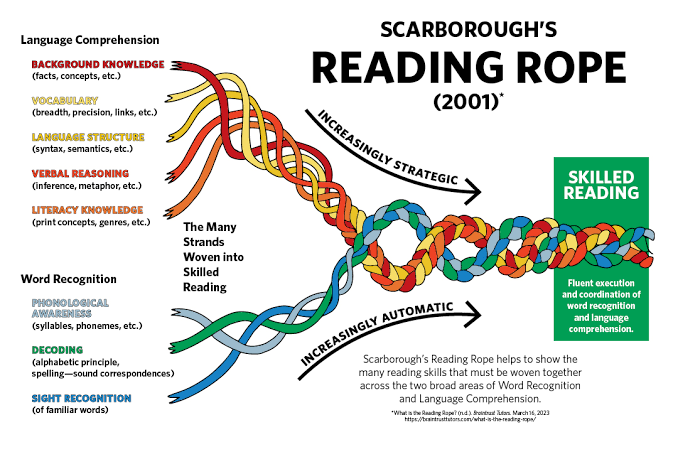
Reading Rope
A conceptual model that illustrates the intertwined skills and processes necessary for proficient reading, integrating word recognition and language comprehension.The model highlights how vocabulary, background knowledge, and decoding work together for successful reading acquisition.