Anatomy I: Cell Polarization
 Call Kai
 Learn
Learn Practice Test
 Spaced Repetition
 Match
Match Flashcards
 Knowt Play
1/73

There's no tags or description
Looks like no tags are added yet.
Name | Mastery | Learn | Test | Matching | Spaced | Call with Kai | Chat |
|---|
No analytics yet
Send a link to your students to track their progress
74 Terms
asymmetric
Cell polarization is _________ distribution of proteins, organelles, and cytoplasm.
1. Apical
2. Lateral
3. Basal
What are the three geometric domains of epithelial cells?
Apical domain
What domain is exposed to the lumen or external environment that may display apical membrane differentiations?
Lateral domain (walls)
Which domain faces neighboring cells and links to each other by cell adhesion molecules and junctional complexes?
Basal domain
Which domain is associated with the basement membrane?
Basal domain
Which domain separates cells from connective tissue and needs to be maintained?
1. Cilia
2. Flagella
3. Microvilla
4. Pseudopods
5. Glycocalyx
What structures are found in the apical domain?
1. Tight junctions
2. Adhering Junctions (Macula adherens and Zonula adherens)
3. Gap junctions
What structures are found in the lateral domain?
1. Hemidesmosomes
2. Focal adhesions
What structures are found in the basal domain?
Cilia are found in the apical domain
Cell movement is from microtubules driven by ATPase activity of dynein arms
Where are cilia found and what is responsible for their cell movement?
Basal body: is an organized structure made of nine sets of microtubule triplets arranged in a ring, lacking a central pair.
Microtubule: is an organized strucutre made of nine sets of microtubule doubletes arranged in a ring with a central pair in the middle
How does the structure of microtubules and basal bodies differ?
1. Found in the apical domain
2. Made of MT
3. Cilia move in synchrony
4. Use ATP for movement
What are the 4 important things to know about cilia?
1. Found in apical domain
2. Made of Actin filaments
3. DONT MOVE
4. Function is to increase SA of membrane
What are the 3 important things to know about microvilli?
microvilli
What structure is finger-like cytoplasmic projections in the apical domain?
cilia
What structure are hair-like extensions of the apical plasma membrane?
Apical domain
What is the pink border?
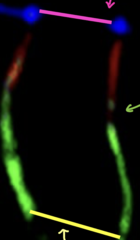
Lateral domain
What red/green border?
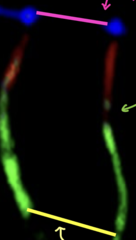
Basal domain
What the yellow border?
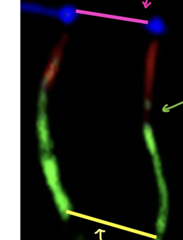
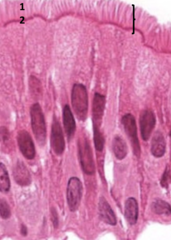
cilia
What is #1?
Microtubules
What is the structure pictured?

Basal Body
What is the structure pictured?
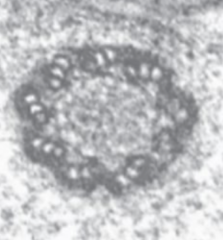
Microvilli
What is the structure pictured?
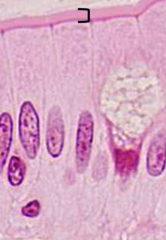
Microvilli
What is the structure pictured?
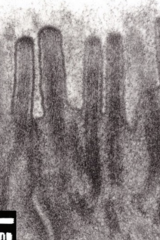
Microvilli
Which structure increases the SA of the apical membrane?
polysaccharide-base gel-like
What is glycocalyx?
1. Interface between the extracellular matrix and cellular membrane
2. Medium for cell-recognition, cell-cell communication (cell signaling) and cell attachment
What are the 2 functions of glycocalyx?
Glycocalyx
Which structure functions as cell recongition and communication?
Basal body
What is #2?
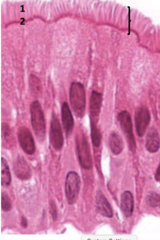
Cilia
What is A?
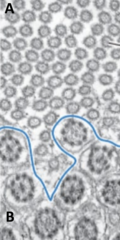
Microtubules
What is B?
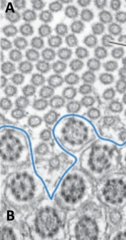
Cell junctions
What general structure is mainly found in the lateral domain?
1. Occluding/Tight
2. Anchoring
3. Communicaiting/Gap
What are the 3 types of junctions?
Occluding/Tight junctions
What junction separates the basal and lateral apical domains?
Anchoring junctions
What junction has its main function of providing strength?
Communicating/Gap junctions
What junction allows the diffusion of small molecules and allows cells to function synchronously?
tight junction
What type of junction is zonula occludens?
They are tight junctions located at the apical end of the lateral membranes of adjacent cells
Where are zonula occludens found?
responsible for making a good barrier and restricting movement
What is the function of zonula occludens?
ZO proteins, occludin, Claudin and Jam
What are the components of zonula occludens?
1. Found in the apical end of the lateral region
2. Responsible for making a good barrier
3. Restrict movement (Tight Junctions)
What are the 3 important things about Zonula Occludens?
tight junctions (zonula occludens)
What is pictured?

tight junctions (zonula occludens)
What is pictured?
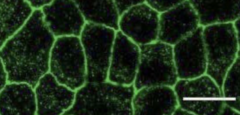
Zonula adherens (belt desmosome)
Which junction is used for adhesion and mechanical strength?
Zonula adherens (belt desmosome)
Which junction has complexes that interact with actin filaments?
1. Responsible for mechanical strength
2. Made of microfilaments (actin)
3. Wraps around the cell (belt desmosome)
What are the 3 things to know about Zonula adherens?
Macula adherens (Desmosomes)
Which junction is made of intermediate filaments?
Macula adherens (Desmosomes)
What is located below the belt desmosome junction?
Zonula adherens (belt desmosomes)
What is pictured?
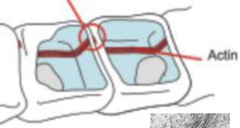
Zonula adherens (belt desmosomes)
What is pictured?
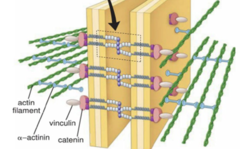
Macula adherens (Desmosomes)
What is pictured?
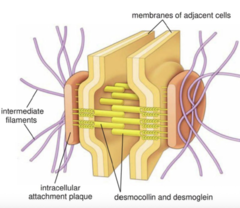
1. Provide stability
2. Located below the belt desmosome junctions
3. Anchored using intermediate filaments
4. Found in the lateral domain
What are the 4 important things about macula adherens?
Cadherins
What cell adhesion proteins binding requires calcium?
1. Found in the lateral domain
2. Made of connexin
3. Allows exchange of ions and molecules (can open/close)
What are the important things to know about gap junctions?
1. Post-translational modifications
2. Redox potential
3. Voltage
What are the 3 controls of opening/closing gap junctions?
Gap junctions
What junction is made of transmembrane channels?
Gap junction
What junction is made of connexin?
Gap junction
What is pictured
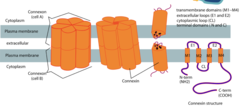
Hemidesmosomes
What anchors intermediate filaments to the basement membrane?
Integrins bind the basal laminate
Plectins bind intermediate filaments
What are the 2 critical components of hemidesmosomes?
1. Anchor the intermediate filaments to the basement membrane
2. Found in the basal domain
3. Integrin binds basal lamina, plectins bind intermediate filaments
What are the 3 key takeaways for hemidesmosomes?
Zonula adherins (belt desmosomes; bind actin)
What are these structures?
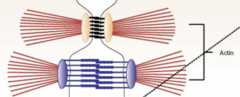
Macula adherens (desmosomes; bind IFs)
What are these structures?

Hemidesmosomes
What are these structures?
basement membrane
Where is the collagen type VI found?
No, depends on cell type
Are all basement membranes the same?
1. laminate lucida (laminin)
2. Laminate dense (collagen IV)
3. reticular lamina (collagen I and III)
What is the basal lamina composed of?
Serves as an attachment site of epithelia to connective tissue
What is the main purpose of the basement membrane?
lamina lucida
1
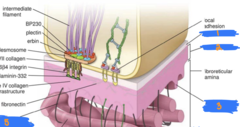
lamina densa
2

Collagen Type VII
5

Fibrillin microfibril
4
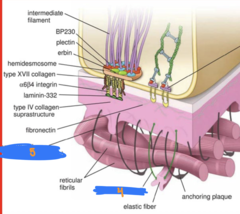
laminate densa
Where is collagen IV found in the basement membrane?
reticular laminate
Where is collagen I and III found in the basement membrane?
1. Cell binds to the basal lamina (determines which side of the cell is basolateral and which is apical
2. Neighboring cells form a tight junction to establish and maintain this polarization, regulating protein trafficking
How does a cell become polar?