Anatomy Lab
 Call Kai
 Learn
Learn Practice Test
 Spaced Repetition
 Match
Match Flashcards
 Knowt Play
1/49

There's no tags or description
Looks like no tags are added yet.
Name | Mastery | Learn | Test | Matching | Spaced | Call with Kai | Chat |
|---|
No analytics yet
Send a link to your students to track their progress
50 Terms
anatomical position
A standard posture used in anatomy where the body is standing upright, facing forward with arms at the sides and palms facing forward, providing a clear reference for directional terms.
thoracic region
The part of the body located between the neck and abdomen, often referred to as the chest area. It contains the ribs, sternum, and organs such as the heart and lungs.
Abdominal region
The part of the body located between the thoracic region and the pelvis, containing organs such as the stomach, intestines, liver, and kidneys.
Pelvic region
The part of the body located below the abdominal region and above the legs, containing structures such as the bladder, reproductive organs, and parts of the large intestine.
Which pair of regional terms describes structures found on opposite sides of the same body part?
Patellar and Popliteal
A physician notes tenderness in the sural region. The pain is located in the:
calf (back of the leg)
A patient notices a wart growing on his left plantar surface. The wart is located on the:
Sole of the foot
The ______ region is the upper arm, and the ______ region describes the forearm.
brachial; antebrachial
Which pair of regional terms refers to structures located on opposite sides of the same joint?
Antecubital and olecranal
During a physical examination, a physician notes tenderness in the left scapular region. This area is located:
On the posterior side in the shoulder blade region
Ventral
toward the front or belly
Anterior
toward the ventral side
Dorsal
toward the back or spine
posterior
toward the dorsal side
inferior
below, toward the feet
medial
nearer ti the midline of the body
lateral
farther away from the midline
proximal
closer to the point of attachment
distal
farther from the point of attachment
superficial
closer to the surface of the body
deep
farther from the surface of the body
Ipsilateral
on the same side of the body
contralateral
on the opposite side of the body
supine
lying face up
prone
lying face down
The wrist is _____ to the elbow
distal
The knee is _____ to the ankle
Proximal
The eyes are _____ to the mouth
superior
The belly button is ____ to the sternum
inferior
The ears are ______ to the nose
lateral
The sternum is ______ to the ribs
midial
The skin is ________ to the muscles
superficial
The chest is ______ to the spine
anterior
The right arm is _________ to the left arm
contralateral

Frontal (coronal) plane
seperate front and back
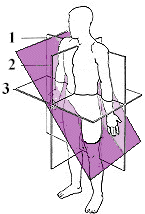
Oblique Plane
separate by a angle

Sagittal plane
seperate from left to right
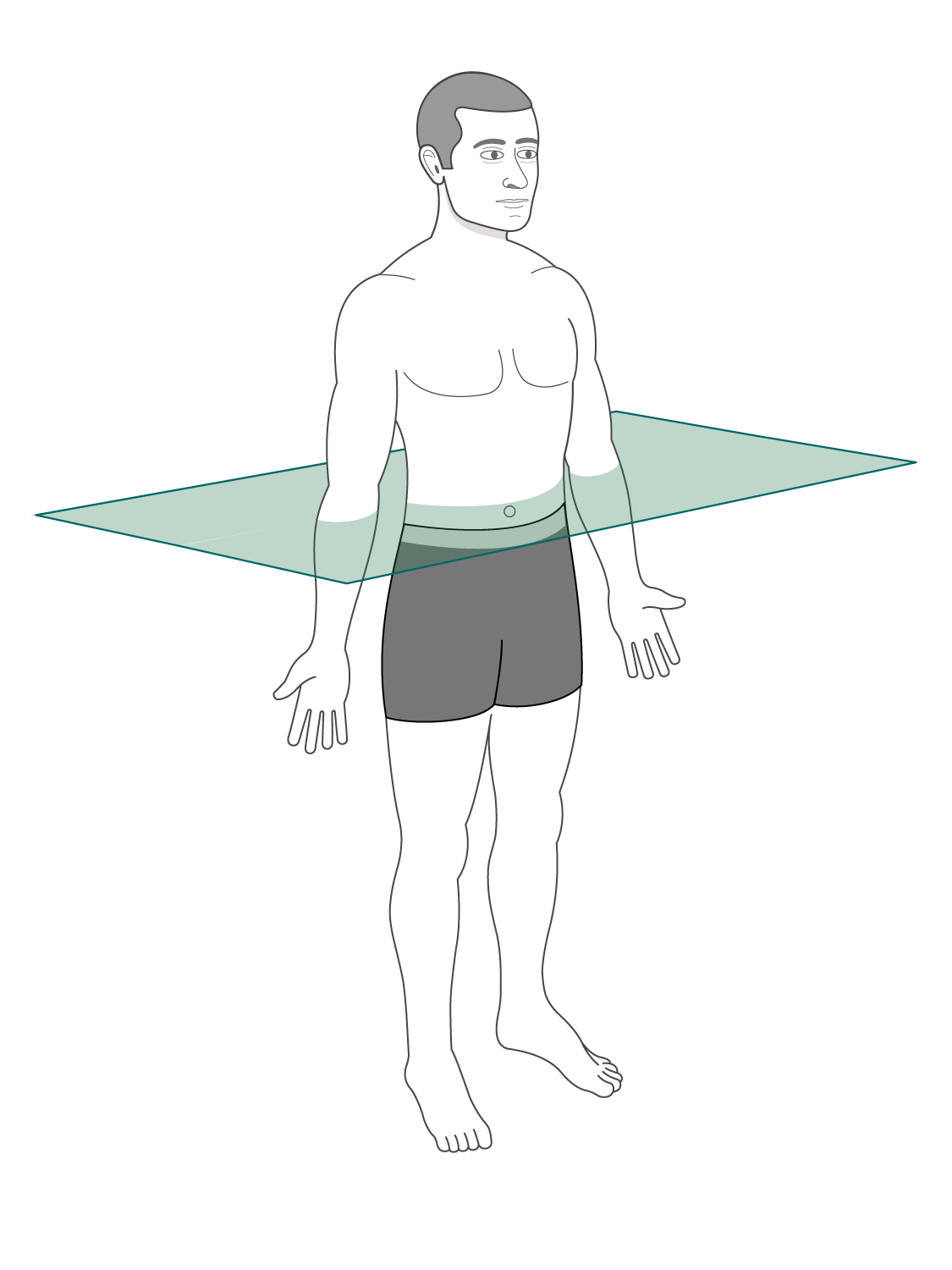
Transverse Plane
seperated from top to bottom
Dorsal body cavity
contains the cranial and vertebral cavities
Cranial cavity
enclosed by the skull, and contains the brain
Vertebral cavity
enclosed by the vertebral column and contains the spinal cord
Ventral body cavity
on the ventral side of the body, and contains the thoracic and abdominopelvic cavities
Thoracic cavity
contains the pericardial and pleural cavities, and the mediastinum
Pericardial cavity
contains the heart
Pleural cavities
each pleural cavity surrounds one lung
Mediastinum
A space between the lungs, vertebral column, and sternum, which contains the heart, great vessels, the esophagus, the trachea and bronchi of the lungs, the thymus gland, and other structures (Midline area of thoracic cavity)
Abdominopelvic cavity
contains the abdominal cavity superiorly and the pelvic cavity inferiorly
Abdominal cavity
contains many of the organs of the digestive, lymphatic, and urinary systems
pelvic cavity
contains organs of the reproductive system as well as some organs of the digestive and urinary systems
The diaphragm
serves as the boundary between the thoracic and the abdominal cavities