Week 7 - cooperation
 Studied by 1 person
 Call Kai
 Learn
Learn Practice Test
 Spaced Repetition
 Match
Match Flashcards
 Knowt Play
1/20

There's no tags or description
Looks like no tags are added yet.
Name | Mastery | Learn | Test | Matching | Spaced | Call with Kai |
|---|
No study sessions yet.
21 Terms
Outline Hamilton’s (1964) payoff matrix
involves mutualism, selfishness, altruism and spite
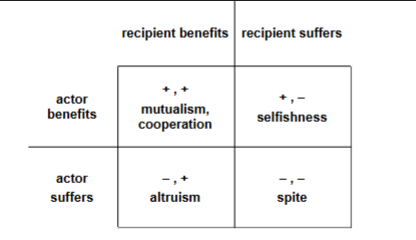
which of hamilton’s payoff matrix ‘shouldn’t have evolved’?
Altruism - because actor suffers a fitness cost for others
why is there a problem in cooperation?
free-riders share the benefits but not the costs, this is true for mutualism and altruism
what is inclusive fitness made up of?
total fitness of an individual’s genes =
direct fitness (personal reproduction)
indirect fitness (additional reproduction by relatives, e.g. brothers share same amount of DNA)
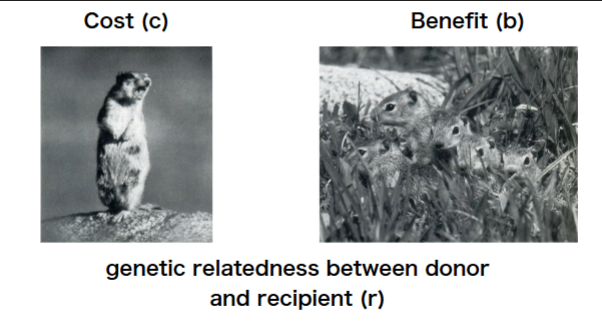
Hamilton’s rule
an act has a cost for the donor and benefits for the recipients
cost/benefit analysis
spread of a gene for altruism occurs when
c (cost for actor) < coefficient of relatedness (r ), benefit to recipient (b)
why are we kind to kin?
kin selection can explain a great deal of altruistic behaviour, including the evolution of sterile worker castes (e.g. honey bees)
why are we kind to strangers?
for the good of the species
classical group selection (Wynne-Edwards) → but benefits have to go the individuals gene too
reciprocal altruism (Trivers 1971)
direct reciprocity, costs should be lower than the benefits, benefits should be delayed
Requirements:
Interact often
Be able to recognise one another and keep accounts
Be able to act contingently
Direct reciprocity very rare in nature even though cognitive demands are often met
Wilkinson (1984)/Carter & Wilkinson (2013)
Vampire bats regurgitate blood to colony mates
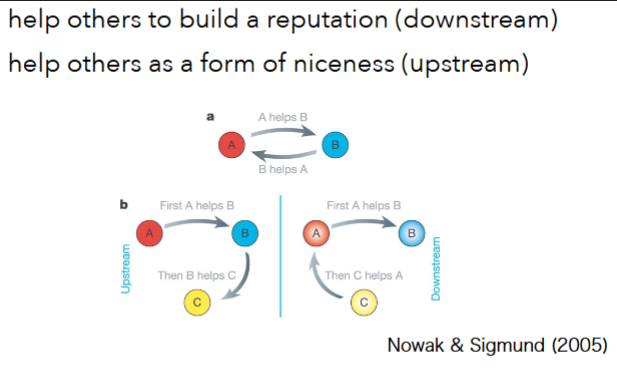
indirect reciprocity
help others to build a reputation (downstream), help others as a form of niceness (upstream)
means maybe someone will be nice to you
generalised reciprocity
Altruism without expectation of return, also called attitudinal reciprocity or 'warm glow' altruism
negative reciprocity
Punishment
Inflicting harm for harm done
Important for deterring free-riders
Third-party punishment particularly important and possibly uniquely human (chimps don’t do it but human children do)
strong reciprocity
Cooperate with others and punish noncooperators
cultural group selection of altruism
Groups with altruists do better than groups without
Between group competition can lead to the evolution of altruism under certain conditions
game theory
would predict to hoard as that is the best outcome
maximising sucess depends on the fact that you assume other players are rational
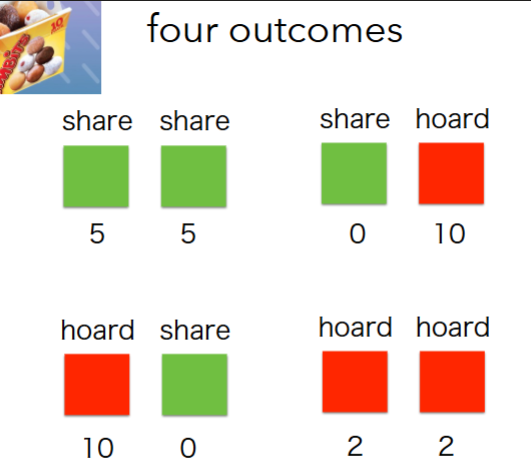
How can cooperation arise from a prisoner’s dilemma
repeated games, iterated prisoner’s dilemma, winning strategy was tit-for-tat → kind retaliatory and forgiving
BUT if number of rounds is known, backwards induction leads rational players to always defect
what is ‘cold’ cognition
reasoning →recognise one another, keep accounts, keep track of relationships of others
what is ‘hot cognition’
short cuts (heuristics) might guide our decisions, emotions can serve as ‘themostats’ of our social decisions
measurement of whether we have achieved a desired outcome
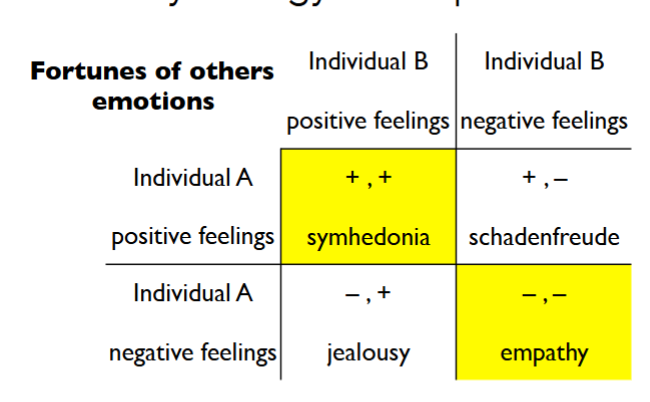
what are the fortunes of others emotions? (Ortony, Clore & Collins, 1988)
symhedionia - when both are feeling positive emotions
schadenfreude - when someone is feeling positive and you are feeling negative
jealousy - when someone is happy and you are sad
empathy - both feeling negative
Einfühlung
empathy → feeling others emotions can motivate prosocial behaviour
what is tragedy of the commons?
‘increasing the herd without limits’ - in a world that is limited
what is an example of the tragedy of commons in real life?
climate change → free-riding means that public resources are lessened