Experiment 4 - Isolation of Caffeine from Tea
 Call Kai
 Learn
Learn Practice Test
 Spaced Repetition
 Match
Match Flashcards
 Knowt Play
1/12

There's no tags or description
Looks like no tags are added yet.
Name | Mastery | Learn | Test | Matching | Spaced | Call with Kai | Chat |
|---|
No analytics yet
Send a link to your students to track their progress
13 Terms
why does the crude caffeine isolated from the tea have a yellowish or greenish tinge (colour)?
because the presence of small amounts of flavonoid pigments and chlorophyll (which have a brown colour) are also extracted
There is an alternative procedure for removing the tannins and gallic acid which involves heating the tea leaves in an aqueous mixture containing calcium carbonate. Calcium carbonate reacts with the tannins and gallic acid to form insoluble calcium salts of these acids. If this procedure were used which of the following additional steps would be needed in order to obtain an aqueous tea solution?
filter the extract to isolate an aqueous tea solution from the insoluble salts
because tannis and gallic acid react with calcium carbonate to form insoluble salts
The extraction of 8.0 g of a particular organic compound dissolved in 100 ml of water into diethyl ether proceeds with a distribution coefficient of 5. How much of the compound is extracted after three separate extractions using 50 ml of diethyl ether each time?
7.8 g of solute is extracted from the aqueous phase
The extraction of 8.0 g of a particular organic compound dissolved in 100 ml of water into diethyl ether proceeds with a distribution coefficient of 5. How much of the compound is extracted after one extraction using 150 ml of diethyl ether?
one extraction with 150mL of diethyl ether extracts 7.1 g of solute
tannins (and 2 major types)
a water soluble component of tea leaves
have 2 major types:
group with esters of gallic acid and glucose
group of condensation polymers of catechin of varying sizes
is ethyl acetate a low or high boiling point liquid
low boiling point
why was sodium carbonate added? (give 3 reasons why)
as a base, sodium carbonate converts tannins and gallic acids to salts so they are more soluble in water
caffeine can be extracted into the organic phase in a purer form
a base ensures the caffeine is non-protonated so that it will be more organic soluble for the extraction
salting out
by saturating the aqueous phase with any salt, extraction efficiency of the organic solvent for an organic solute will be increased
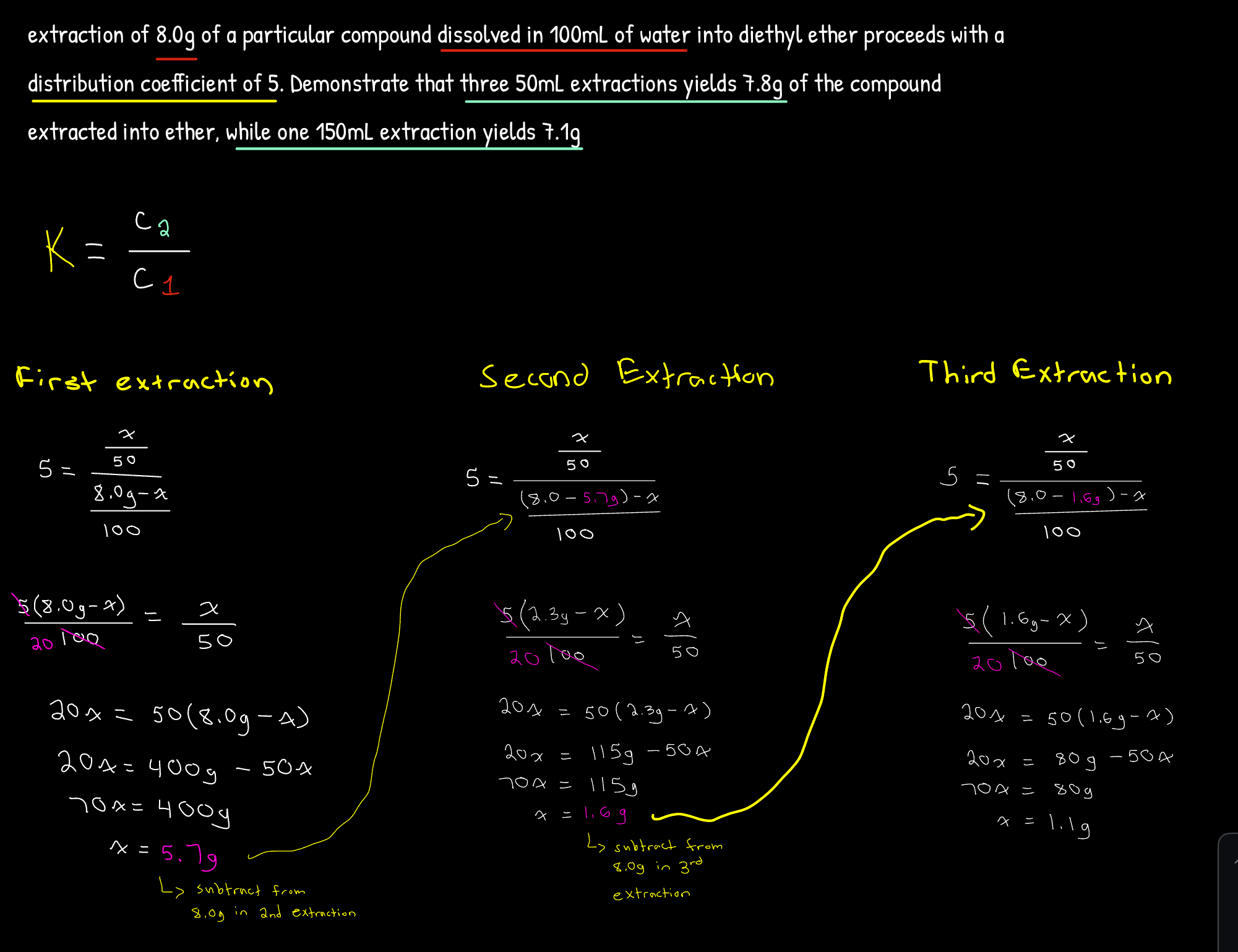
formula for calculating for partition (distribution) coefficient
K = C2 / C1
example of calculating distribution coefficient
extraction of 8.0g of a particular compound dissolved in 100mL of water into diethyl ether proceeds with a distribution coefficient of 5. Demonstrate that three 50mL extractions yields 7.8g of the compound extracted into ether, while one 150mL extraction yields 7.1g
(FLIP CARD FOR ANSWER)
check photo
general equation for the hydrolysis of the tannins that are esters of gallic acid and glucose
(DONT NEED TO BALANCE THE EQUATION)
indicated reactants and products by structure
check photo

caffeine structure
check photo

draw structure of tannins of esters of gallic acid and glucose (and draw catechin)


what does this graph tell us about extraction of caffeine
shows us that caffeine' is extremely soluble at boiling temp. (100*C)
caffeine’s solubility in water is temp, dependent
which is why we boil the compound in water in order to dissolve caffeine