MNGT 300 - Exam 1 (August 24 - September 21)
 Call Kai
 Learn
Learn Practice Test
 Spaced Repetition
 Match
Match Flashcards
 Knowt Play
1/154

Earn XP
Description and Tags
Covers chapter 1-4 and 12-13
Name | Mastery | Learn | Test | Matching | Spaced | Call with Kai | Chat |
|---|
No analytics yet
Send a link to your students to track their progress
155 Terms
What is management?
The attainment of organizational goals in an effective and efficient manner through planning, organizing, leading, and controlling of organizational resources
True/False: There are certain elements of management that are timeless but environmental shifts may also influence the practice of management
True
What is the role of managers?
Learn to “design the rules of the game without specifying the action of the players” while simultaneously shaping cultures, systems, and conditions while allowing people freedom to move the organization in certain directions
What accurately describes traditional management competencies?
Using a command-and-control leadership style, they focus on individual tasks and a standardization of procedures to maintain stability
What accurately describes new management competencies?
Acting as an enabler rather than a controller, they use an empowering leadership style to encourage collaboration, leading of teams, and mobilizing for change and innovation
What are the five tasks of a manager?
Set objectives, organize, motivate and communicate, measure, and develop people
What does it mean for a manager to set objectives?
They establish goals for the group and decide what must be done to achieve them
What does it mean for a manager to organize?
They divide work into manageable activities and select people to accomplish tasks
What does it mean for a manager to motivate and communicate?
They create teamwork via decisions on pay, promotions, etc., and through communication
What does it mean for a manager to measure?
They set targets and standards while appraising performance
What does it mean for a manager to develop people?
They recognize the value of employees and develop a critical organizaiton asset
What are the four fundamental management functions?
Planning (setting goals and deciding activities), organizing (organizing activities and people), leading (motivating, communication with, and developing people), and controlling (establishing targets and measuring performance)
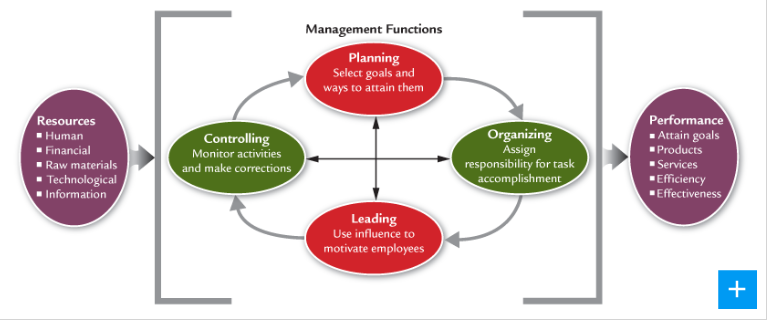
What does this illustration illustrate?
The process of how managers use resources to attain organizational goals through the functions of planning, organizing, leading, and controlling
What does planning mean?
Identifying goals for future organizational performance and deciding on the tasks and use of resources needed to attain them (i.e., where the organization wants to be in the future and how to get there)
What does organizing involve?
Assigning tasks, grouping tasks into departments, delegating authority, and allocating resources across the organization
What is leading?
The use of influence to motivate employees to achieve organizational goals; creating a shared culture and values, communicating goals, and infusing employees with the desire to perform at a high level
What does controlling mean?
Monitoring employees’ activities, determining whether the organization is moving toward its goal, and making corrections as necessary
True/False: Ineffective control cannot damage a company
False
What is an organization?
A social entity that is goal-directed and deliberately structured
What does it mean to be a social entity?
Being made up of two or more people
What does being goal directed mean?
Designed to achieve some outcome, such as make a profit, win pay increases for members, meet spiritual needs, or provide social satisfaction
What does it mean to be deliberately structured?
Tasks are divided, and responsibility for their performance is assigned to organization members
What is organization effectiveness?
The degree to which the organization achieves a stated goal, or succeeds in accomplishing what it tries to do (i.e., providing a product or service customers value)
What does organizational efficiency refer to?
The amount of resources used to achieve an organization goal based on how much raw material, money, and people are necessary for producing a given volume of output
What generally describes efficiency?
The amount of resources used to produce a product or service
What may managers utilize to increase efficiency and effectiveness?
Mobile apps
Representing the ultimate responsibility of managers, what is perfomance?
The attainment of organizational goals by using resources in an efficient and effective manner; managers want this high
What are the three categories a manager must have skills in?
Conceptual, human, and technical
What are technical skills?
Skills that include the mastery of the methods, techniques, and equipment involved in specific functions of engineering, manufacturing, or finance, including specialized knowledge, analytical ability, and the competent use of tools and techniques to solve problems in that specific discipline
True/False: Technical skills are particularly important at lower organization levels but become less important as managers move up the hierarchy
True
What does human skills involve?
The manager’s ability to work with and through other people and to work effectively as a group members; this includes relating to other people, such as ability to motivate, facilitate, coordinate, lead, communicate, and resolve conflicts
What are humans skills essential for?
Frontline managers who work with employees directly on a daily basis
True/False: Studies have found that human skills are significantly more important than technical skills for predicting manager effectiveness
True
What do conceptual skills include?
The cognitive ability to see the organization as a whole system and the relationships among its part, such as knowing where one’s team fits into the total organization and how the organization fits into the industry, the community, and the broader business and social environment (i.e., think strategically)
Who are conceptual skills most important to?
Managers at the top of hierarchy
What can many factors of manager failures be attributed to?
Poor human skills, such as the inability to develop good work relationships, a failure to clarify direction and performance expectations, or an inability to create cooperation and teamwork
What are the two major reasons for manager failure?
Ineffective communication skills and practices (i.e., poor communication) and poor interpersonal skills
When do a manager’s weaknesses become more apparent?
During stressful times of uncertainty, change, or crisis
What are the three levels of managers?
Top managers, middle managers, and first-line managers
What accurately describes top managers?
They are at the top of the hierarchy and are responsible for the entire organization (i.e., president, chairperson, executive director, CEO, and executive vice president)
What are some things top managers are responsible for?
Setting organizational goals, defining strategies for achieving them, monitoring and interpreting the external environment, and making decisions that affect the entire organization
What accurately describes middle managers?
Working at the middle level of organization, they are responsible for business units and major departments, such as department heads, division heads, managers of quality control, and directors of research labs
What are some jobs of the middle managers?
Implementing the overall strategies and policies defined by top managers; they are concerned with the near future rather than long-range planning
What is a project manager?
A manager responsible for a temporary work project that involves the participation of people from various functions and levels of organization and (sometimes) outside the company as well
What accurately describes first-line managers?
Managers that are responsible for the production of goods and services, such as supervisors, line managers, section chiefs, and office managers
What are some roles performed by first-line managers?
The application of rules and procedures to achieve efficient production, provide technical assistance, and motivate subordinates by focusing on teams and nonmanagement employees
What are functional managers?
Managers who are responsible for departments that perform a single functional task and have employees with similar training and skills, such as advertising, sales, finance, human resources, manufacturing, and accounting
What are staff managers in charge of?
Departments, such as finance and human resources, that support line departments
What accurately describes general managers?
Managers that are responsible for several departments that perform different functions, particularly in a self-containing division with all the functional departments in it (ex: manager of a Macy’s department store)
What can becoming a manager mean?
Experiencing a profound transformation in the way people think of themselves, called personal identity, which includes letting go of deeply held attitudes and habits and learning new ways of thinking
What accurately describes manager activities?
Characterized by variety, fragmentation, and brevity, managers perform a great deal of work at an unrelenting pace
As the most valuable resource to a manager, what does time management refer to?
The use of techniques that enable you to get more done in less time and with better results, be more relaxed, and have more time to enjoy your work and your life
What is a role?
A set of expectations for a manager’s behavior that are divided into three conceptual categories: information (managing by information), interpersonal (managing through people), and decisional (managing through action)
What accurately describes informational roles?
The activities used to maintain and develop an information network, including monitoring (seek and receive info), disseminating (forward info to other organization members), and acting as a spokesperson (give info to outsiders)
What accurately describes interpersonal roles?
Pertaining to relationships with other and related to human skills, it can involve handling ceremonial and symbolic activities for the department or organization (figurehead), directing and motivating subordinates (leader), and maintaining information links inside and outside the organization (liaison)
What accurately describes decision roles?
Pertaining to those events about which the manager must make a choice and take action, it can involve initiating improvement projects (entrepreneur), taking corrective action during conflicts (disturbance handler), decide who gets resources (resource allocator), and represent a team or department’s interests (negotiator)
True/False: managers at every level perform ten roles, which are grouped into informational roles, interpersonal roles, and decisional roles
True
What is true of managers in a small business?
They tend to emphasize roles different from those of managers in large corporations, often seeing their most important role as that of spokeperson because they must promote the small company to the outside world as they simultaneously act as an entrepreneur
What is different between nonprofit managers and business managers?
One focuses on earning money for the company while the other directs their effort towards generating social impact
Where do financial resources for government and charity nonprofit typically come from?
Taxes, appropriations, grants, and donations rather than from the sale of products or service to custoemrs
In some nonprofit organizations, such as hospitals and private universities, what is true of the bottom line?
They have to generate enough revenues to cover expenses, so managers often struggle with what constitutes results and effectiveness
What ability does studying history allow managers to do?
Achieve strategic thinking, see the big picture, and improve conceptual skills
What struggle balance has continued from the nineteenth century to today for managers?
“The things of production” with the “humanity of production”
What are management and organizations shaped by?
Forces in the larger society
What does it mean to have a classical perspective?
To take a rational, scientific approach to management and seeks to turn organizations into efficient operating machines
What are the four components of the classical perspective?
Scientific management, bureaucratic organizations, administrative principles, and management science
What accurately describes scientific management?
A subfield of the classical perspective that emphasizes scientifically determined changes in management practices as the solution to improving labor productivity; can lead to increased conflict and clashes between managers and employees (but the most significant innovation)
What accurately describes the bureaucratic organizations approach?
Emphasizes management on an impersonal, rational basis through elements such as clearly defined authority and responsibility, formal recordkeeping, and separation of management and ownership; generally has a negative connotation in today’s society
What are the characteristics of an ideal bureaucracy?
Division of labor w/ clear definitions of authority and responsibility, positions organized in a hierarchy of authority, managers subject to rules and procedures that will ensure reliable, predictable behavior, management separate from the ownership of the organization, administrative acts and decisions recorded in writing, and personnel selected and promoted based on technical qualifications
What accurately describes the administrative principles approach?
A subfield of the classical perspective that focuses on the total organization rather than the individual worker and delineates the management functions of planning, organizing, commanding, coordinating, and controlling.
What does the unity of command mean?
Each subordinate receives orders from one and only one superior
What is division of work?
Managerial work and technical work are amenable to specialization to produce more and better work with the same amount of effort
What does unity of direction mean?
Similar activities in an organization should be grouped together under one manager
What is a scalar chain?
A chain of authority that extends from the top to the bottom of the organization and should include every employee
Who is known as the “father of scientific management?”
Frederick Winslow Taylor
Who introduced most concepts about bureaucratic organizations?
Max Weber
What accurately describes management science (i.e., quantitative perspective)?
A science that uses mathematics, statistical techniques, and computer technology to facilitate management decision making, particularly for complex problems
What accurately describes information technology (IT), a recent subfield of management science?
The hardware, software, telecommunications, database management, and other technologies used to store, process, and distribute information
What accurately describes quants?
Refers to financial managers and others who make decisions based primarily on complex quantitative analysis; often makes aggressive traders and managers taking enormous risks
What accurately describes the humanistic perspective?
A perspective that emphasizes understanding human behavior, needs, and attitudes in the workplace; involves three fields including the human relations movement, the human resources perspective, and the behavioral sciences approach
Who were the early advocates of a more humanistic approach?
Mary Parker Follett and Chester I. Barnard
What accurately describes the human relations movement?
Stresses the satisfaction of employees’ basic needs as the key to increased productivity
What are the Hawthorne studies?
A series of research efforts that was important in shaping ideas concerning how managers should treat workers
What does the human resources perspective suggest?
That jobs should be designed to meet people’s higher-level needs by allowing employees to use their full potential
What accurately describes the behavioral sciences approach?
Draws from psychology, sociology, and other social sciences to develop theories about human behavior and interaction in an organizational setting
What can many current management ideas and practices be traced to?
The behavioral sciences approach
What is systems thinking?
Looking not just at discrete parts of an organizational situation, but also at the continually changing interactions among the parts
What is a system?
A set of interrelated parts that function as a whole to achieve a common purpose
What are subsystems?
Parts of a system that depend on one another for their functioning
What is synergy?
A concept that says that the whole is greater than the sum of its parts.
What is the contingency view?
Tells managers that what works in one organizational situation might not work in another; managers can identify important contingencies that help guide their decisions regarding organization
What are big data analytics?
Technologies, skills, and processes for searching and examining massive, complex sets of data that traditional data processing applications cannot handle to uncover hidden patterns and correlations.
What is supply chain management?
Managing the sequence of suppliers and purchasers, covering all stages of processing from obtaining raw materials to distributing finished goods to consumers; can create many challenges for managers, such as exposing bad working conditions when incidences occur
True/False: In a bossless work environment (which is increasing in popularity), accountability falls on the customer and team rather than a manager
True
What is engagement?
An emotional and mental state in which employees enjoy their work, contribute enthusiastically to meeting goals, and feel a sense of belonging and commitment to the organization
What is social business?
Using social media technologies for interacting with and facilitating communication and collaboration among employees, customers, and other stakeholders
What is true of social media programs?
They include online community pages, social media sites, microblogging platforms, and company online forums that enable managers to interact electronically with employees, customers, partners, and other stakeholders
What are two recent trends in management?
The transition to a more technology-driven workplace and a corresponding emphasis on a people-driven workplace
What are two ideas related to a people driven workplace?
The bossless work environment and the employee engagement
What is true of the external organizational environment?
It includes all elements existing outside the boundary of an organization that have the potential to affect it: includes competitors, resources, technology, and economic conditions that influence the organization