5. Colloidal interaction and surface forces
 View linked note
 Call Kai
 Learn
Learn Practice Test
 Spaced Repetition
 Match
Match Flashcards
 Knowt Play
1/20

There's no tags or description
Looks like no tags are added yet.
Name | Mastery | Learn | Test | Matching | Spaced | Call with Kai | Chat |
|---|
No analytics yet
Send a link to your students to track their progress
21 Terms
Stability of colloidal dispersions
Almost always thermodynamically unstable systems
Kinetics and interaction determine stability
Time is important – stability from minutes to 100s of years (for example Italian salad dressing is short)
Colloidal interactions
Interactions between colloidal particles → forces between particles
Attraction (if it comes close enough) and repulsion
Range of interaction (how close can two particles get before anything happens) is important!
Flocculation
a process where a solute comes out of solution in the form of floccules or flakes
van der Waals interactions
• Caused by molecular dipole interactions (impermanent, permanent and induced)
• Comparably long-ranged, but weak at long distances.
• Strong at short distances (smooth surfaces tend to get closer to each other)
Attractive force between surfaces is always present

Van der Waals force between surfaces
It decays were fast with larger distances

A=Hamaker constant (J)
L=separation between surfaces
P=attractive pressure (N/m2)
Electrostatic repulsion
• Caused by charge at surfaces
• In low dielectric media → coulomb interaction (continuous phase typically air and oil/apolar solvents)
– Charge level could be very high and operating distance very long
– Important in clouds (thunder)
– Sparks
• In dielectric media (polar solvent, typically water) a diffuse counter-ion cloud is formed
– Neutralising the long range character of the coulomb forces.
Electrical field and charge densities
• A charged surface gives rise to an electric potential in a dielectric medium (such as water)
• The electric potential decays from the surface – depends on the charge density in the solution (i.e. ionic strength)
• Ions in solution ”screen” the charge of the surface
• Creation of the double layer (one charge on the surface and another a bit further away from surface (diffused ion cloud of counter ion, not every ion on surface has it own counter ion))

Double layer
Counter-ions are attracted to the charged surface and a “double layer” is formed. The counter ion concentration decreases with distance from the surface

Debye-Hückel length
By assuming symmetrical electrolytes we obtain the Debye-Hückel screening length
Higher charge (valence)→ shorter Debye-Huckel length
Increasing concentration → shorter Debye-Huckel length

LD=Debye-Huckel length
Electric potential
• Can be interpreted as the thickness of the electric double layer → the range of electrostatic repulsion
• Depends strongly on valence and also on concentration
What happens when two layer of different surface overlap?
Higher osmotic pressure → repulsion between the surfaces → solvent goes in
Electrostatic repulsion
• Osmotic repulsion between overlapping clouds of counter ions (double layers)
• Resulting pressure:

• Range of the force depends on the thickness of the double layer (electric potential)

DLVO theory
• van der Waals interaction dominates at very short distances → primary minimum
• van der Waals interaction dominates at long distances → secondary minimum
• The electrostatic repulsion may dominate at intermediate distances. This causes the electrostatic repulsive barrier.

Example of Loss of electrostatic repulsion (salt water)
The high ionic strength in the ocean causes a loss of repulsion between particles (higher ionic strength —> reduce thickness of double layer). The particles gradually flocculate and as size increases they sediment out of dispersion.
Steric repulsion between macromolecules
• Osmotic repulsion between protruding (utstickande )chains of adsorbed macromolecules.
• Caused by adsorbed (stuck to the surface) macromolecules

Steric repulsion between macromolecules requires:
• Adsorption of the macromolecule
• Sufficient coverage of the interface
• High solubility of the macromolecule (better than θ solvent)
• Larger polymer → more efficient
High and low solubility of macromolecule
Low solubility → try to get away from water
High solubility → protein will stretch out
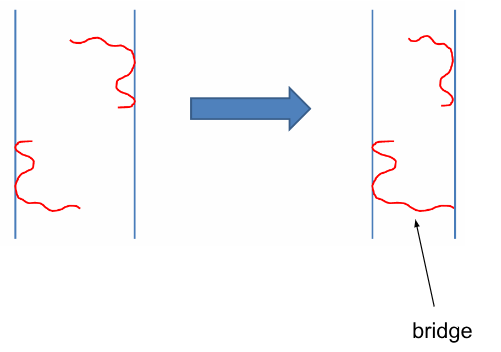
Bridging (attraction)
• Partial coverage of surfaces can lead to the formation of macromolecular bridges between the surfaces.
• Attractive (destabilizing) force
Depletion (attraction)
• Caused by non-adsorbing polymers → no or low affinity for surface
• Polymers avoid contact with surfaces
• As polymers are depleted → osmotic gradient is created
• Occurs at intermediate polymer concentrations and large polymer size (high molar mass)
• Examples in aqueous dispersions are, dextran, PEG and other non-ionic polymers

Hydration forces (repulsion)
• Hydrated surfactants at the interface
• Caused by the interaction between the emulsifier layer and the aqueous phase
• Empirically described force

Hydrophobic interaction (attraction)
• Between hydrophobic macroscopic surfaces
• Experimentally observed but, fundamentally, poorly understood force