SysSig - Week 3 to 4 Rehash - 8.1 to 8.4
 Call Kai
 Learn
Learn Practice Test
 Spaced Repetition
 Match
Match Flashcards
 Knowt Play
1/22

There's no tags or description
Looks like no tags are added yet.
Name | Mastery | Learn | Test | Matching | Spaced | Call with Kai |
|---|
No analytics yet
Send a link to your students to track their progress
23 Terms
Define a natural response
power is suddenly removed
Define a step response
power is suddenly applied
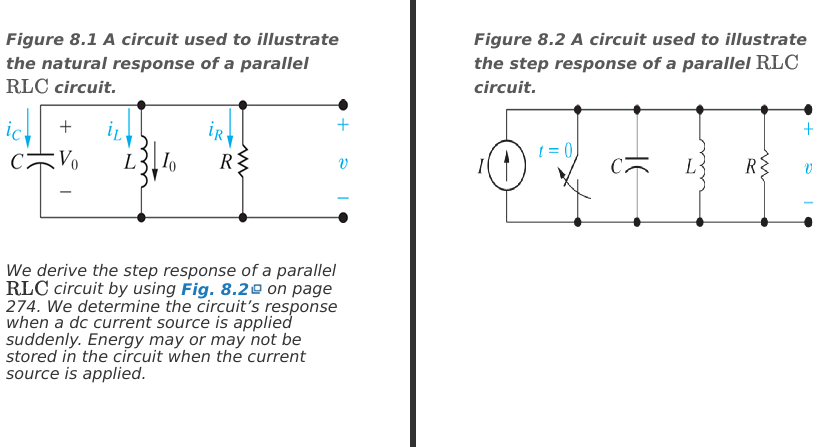
Draw a basic parallel RLC circuit undergoing either responses
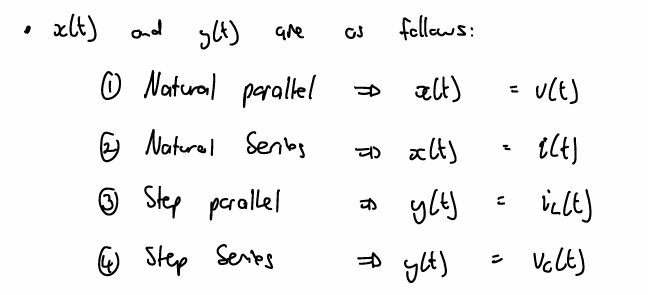
State the property measured when analyzing:
Natural parallel
Natural Series
Step Parallel
Step Series
Nat Par = x(t) = v(t)
Nat Ser = x(t) = i(t)
Step Par = y(t) = iL (t)
Step ser = y(t) = vc(t)
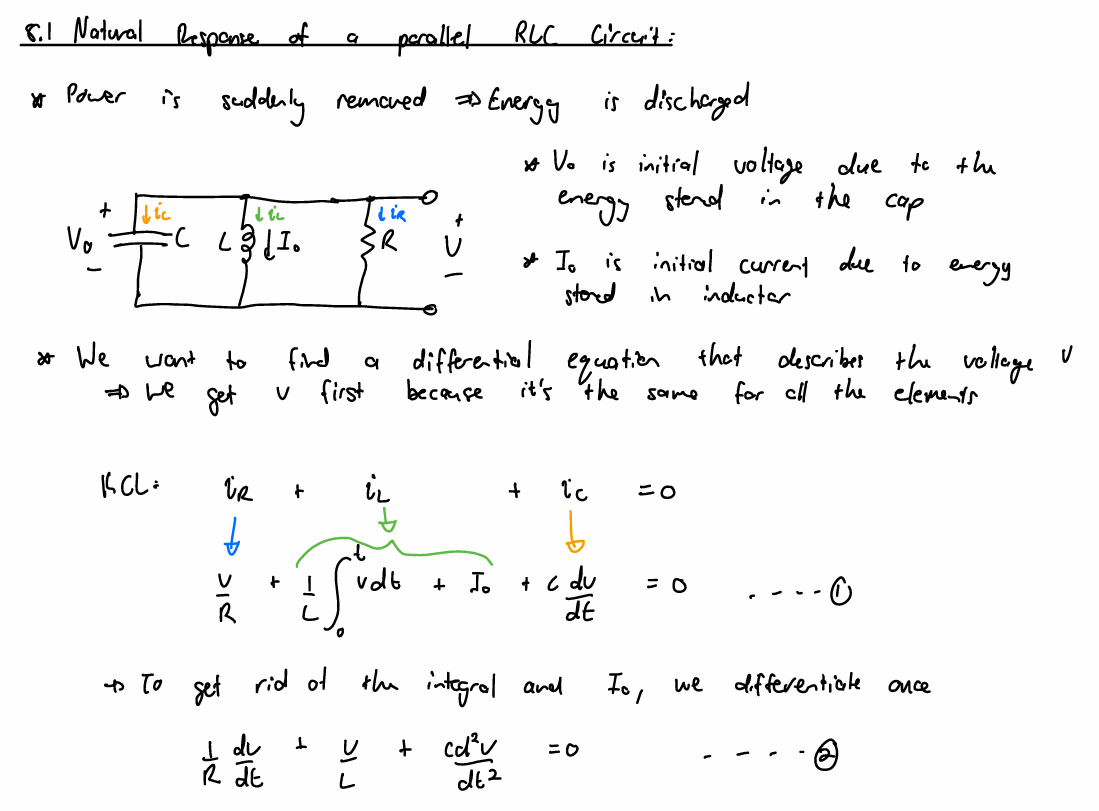
Derive the natural response of a parallel RLC circuit
Vo = initial voltage of capacitor
Io = inital current of inductor
We find an equation that describes the change in voltage over tiem
v is the same for all elements
ir + ic + iL = 0
v/R + C(dv/dt) + 1/L (vdt) + Io = 0
(1/R)v’ + Cv’’ + 1/L(v) = 0
v’’ + (1/RC)v’ + (1/LC) (v) = 0
solve differential equation
Describe how to solve the natural response of an RLC circuit
v’’ + (1/RC)v’ + (1/LC) (v) = 0
overdamped, underdamped, critical
v(0+) = Vo = voltage of capacitor before
v’(0+) = 1/C * ic(0+)
ic(0+) = -(Vo/R) - Io = Current in capacitor
ic + iL + ir = 0 before switch opened
Draw a basic series RLC circuit undergoing either responses
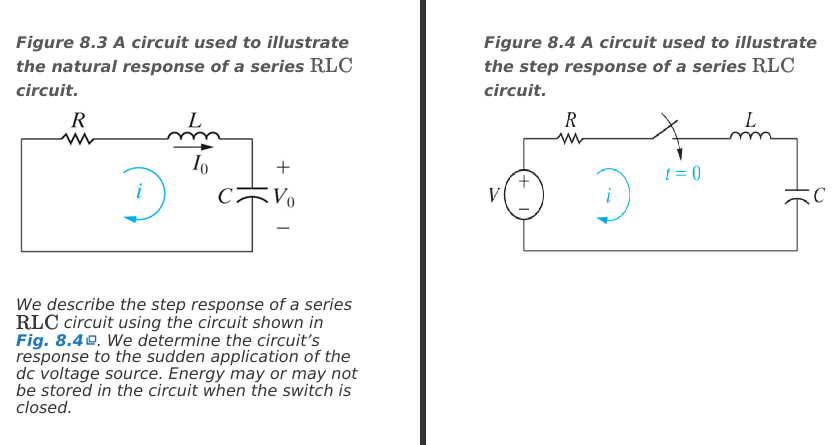
Derive the second order DE when solving the natural response of a prallel RLC circuit
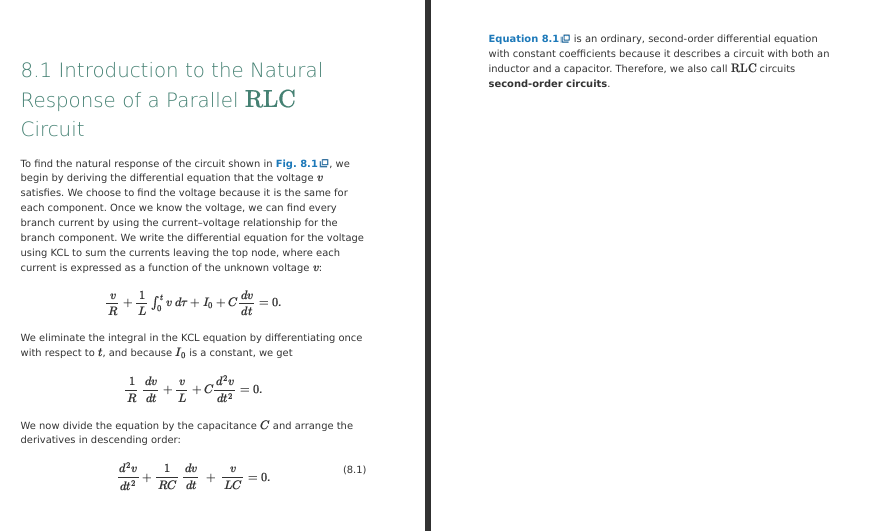
Find the solutions to the final voltage of a parallel RLC circuit undergoing a natural response
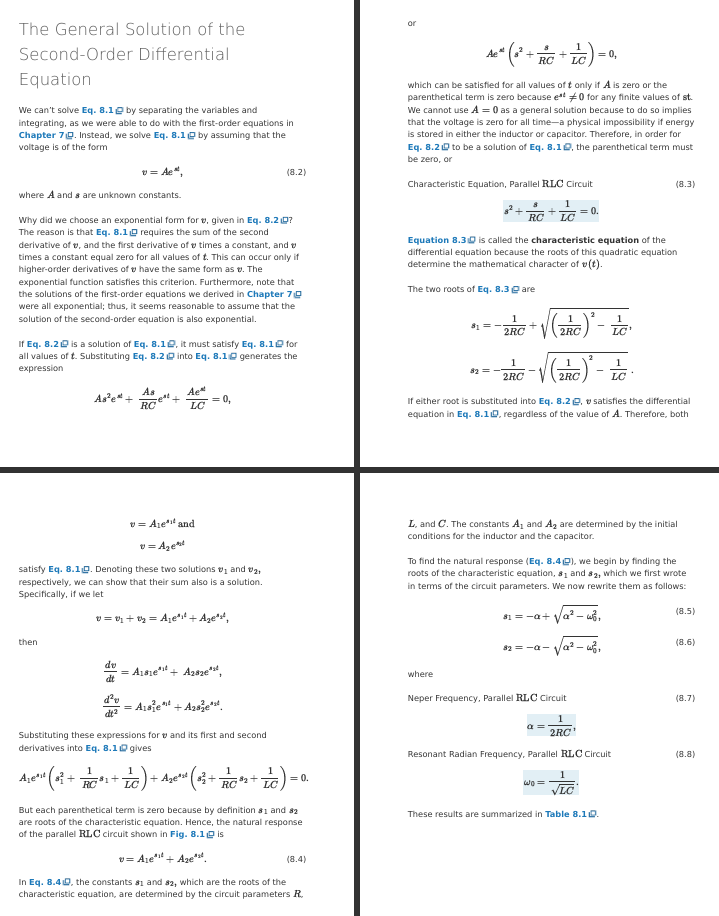
Explain the components of the solutions to the second order DE and describe when the discriminant is:
= 0
< 0
> 0
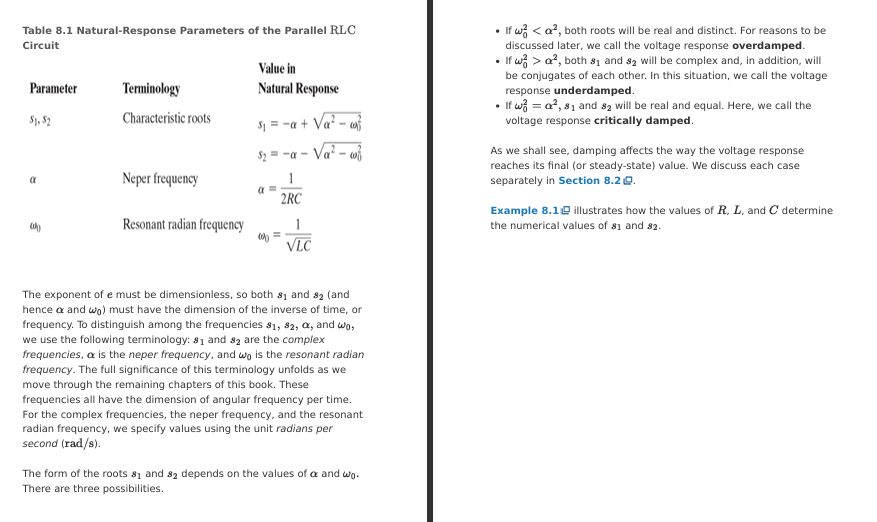
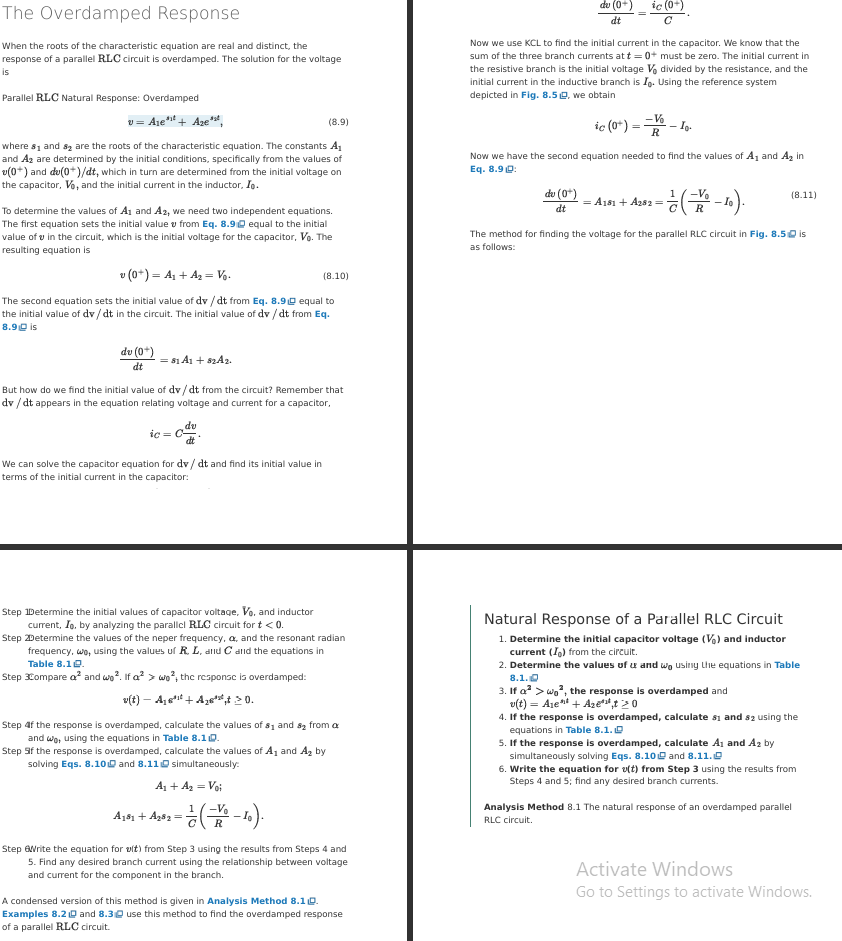
For an overdamped parallel RLC response, describe how to find v(t)
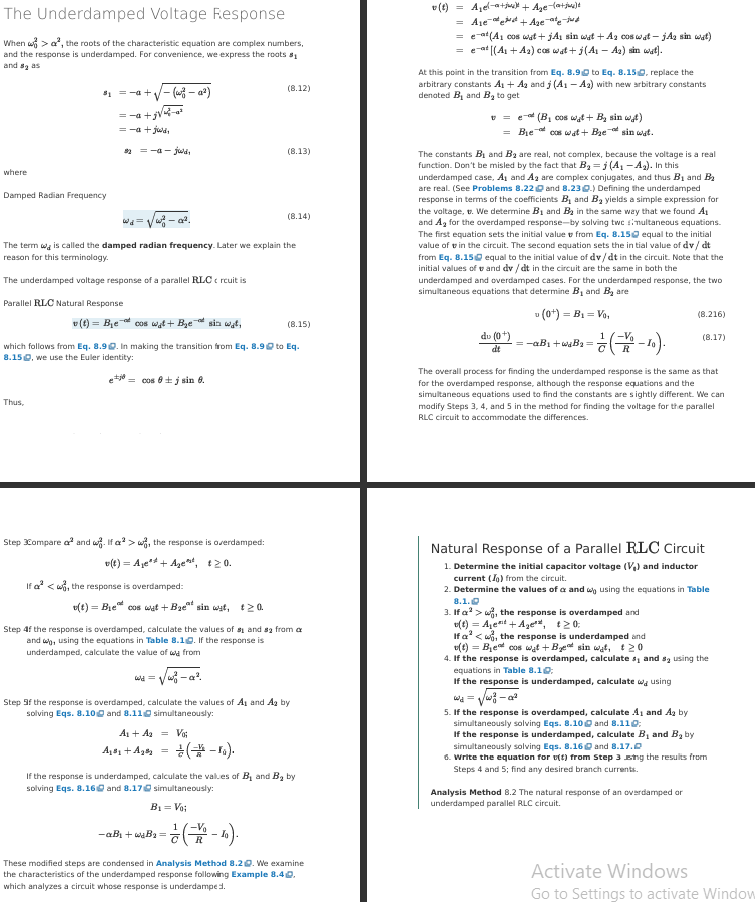
For an underdamped parallel natural RLC response, describe how to find v(t)
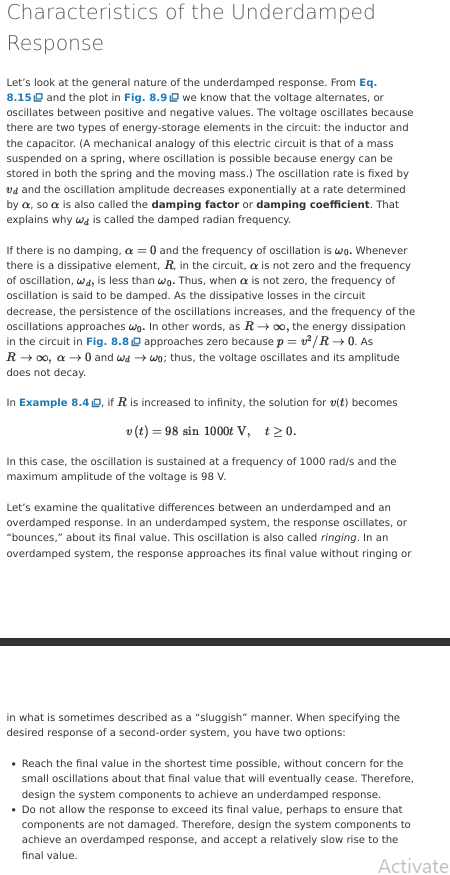
Describe the characteristics of an underdamped response
For a critically daped parallel natural RLC response, describe how to find v(t)
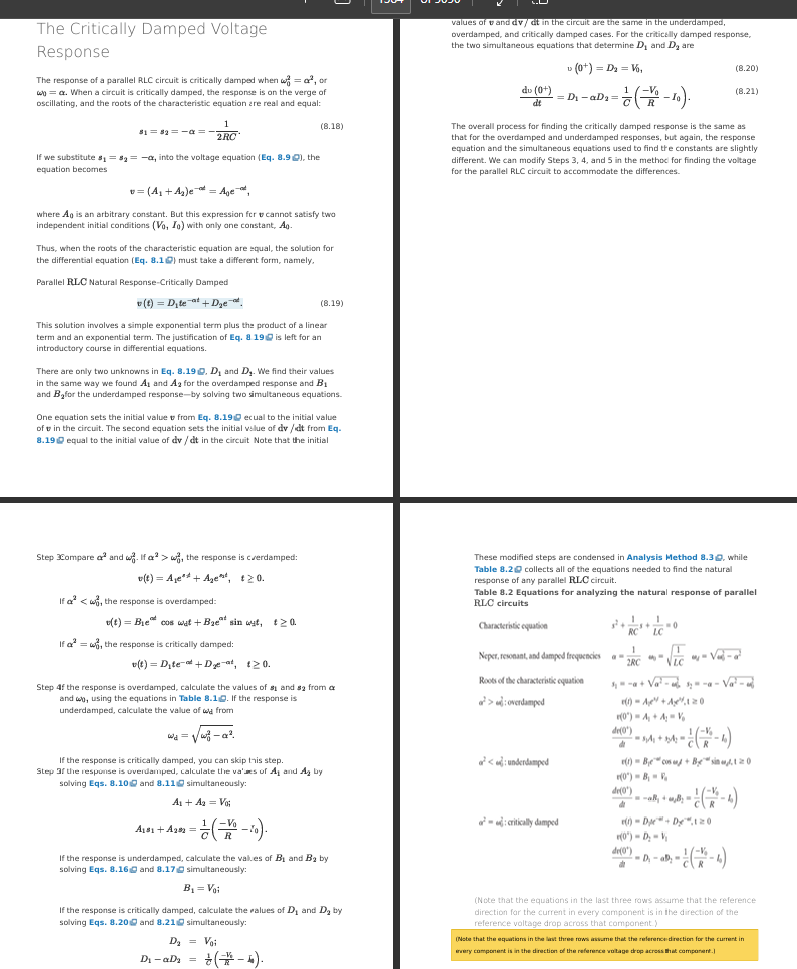
Summarize the working process for the natural response of a parallel RLC circuit
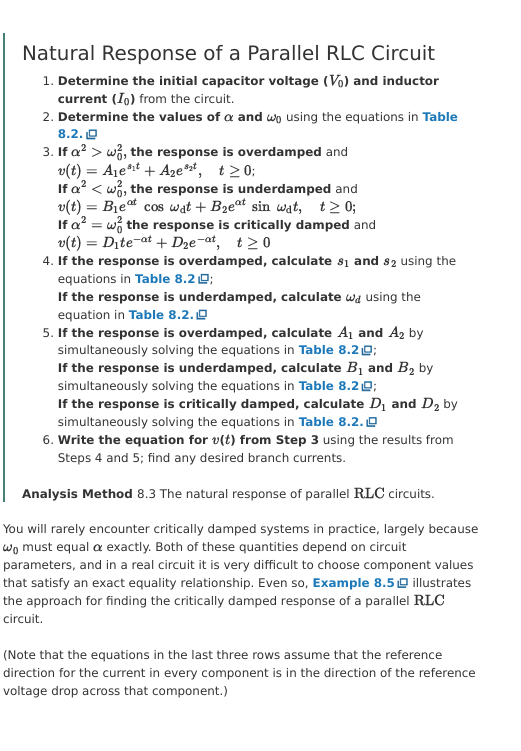
Lay the groundwork for describing the step response of a paralllel RLC circuit
initial conditions present
DC current source
as t tends to infinity
ic → open circuit as t → infinity
iL → short circuit as t → infinity
iR → 0 as t → infinity
v → 0 as t → infinity
so we measure current iL of the inductor
Derive the second order DE for the step response of a parallel RLC circuit
iL + iR + ic = I
1/ L * dv + v/R + C (dv/dt) = I
1/L * v + (1/R) v’ + Cv’’ = I
v’’ + (1/RC) v’ + (1/LC) v = 0
v = Li’, v’ = Li’’
or v = Li’, v’ = Li’’
iL + v / R + Cv’ = I
iL + L/R i’ + (LC)i’’ = I
(1/LC) * iL + (1/RC) i’ + i’’ = I/LC
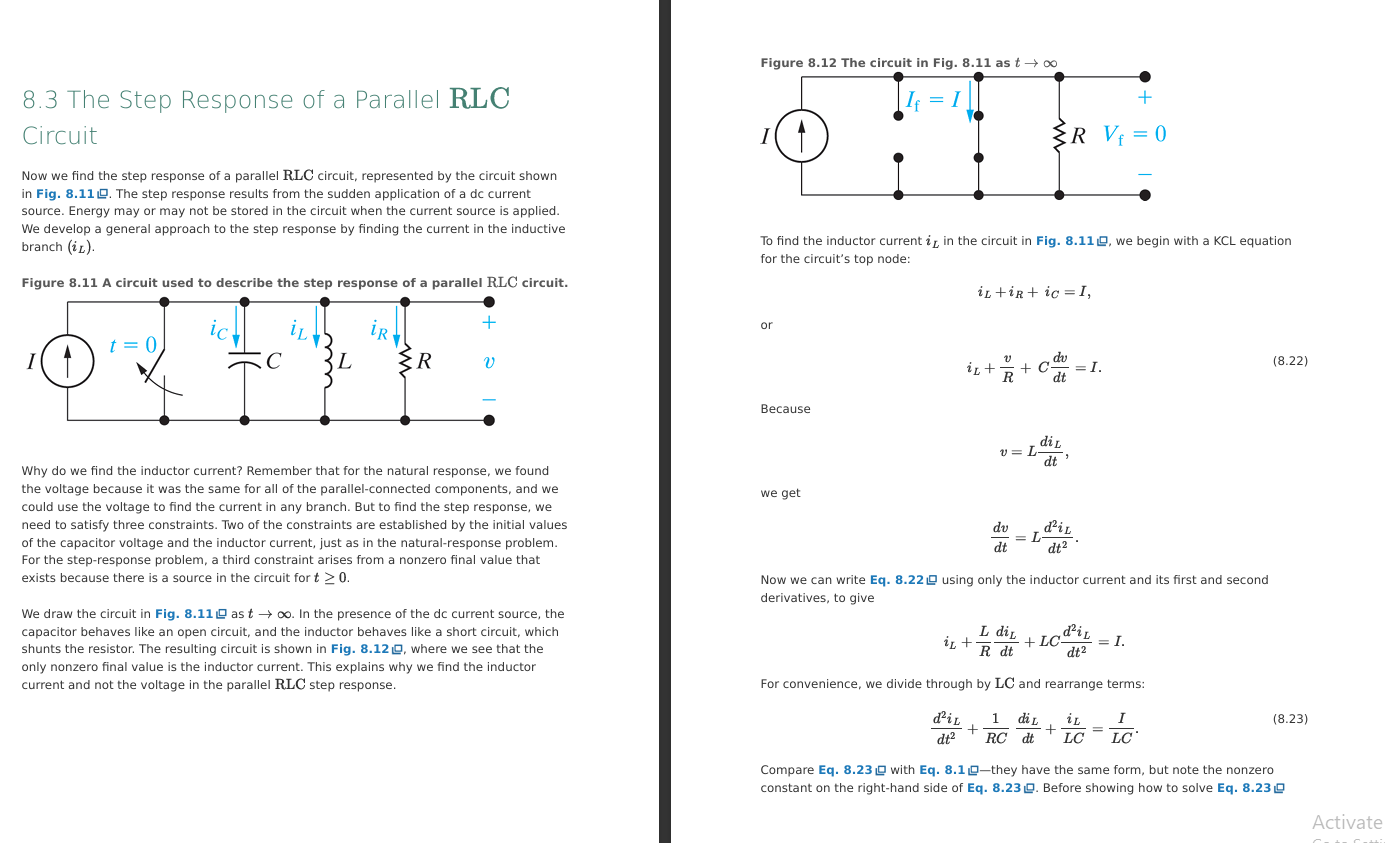
Describe the indirect approach to solving the second order DE of a the step response for a parallel RLC circuit
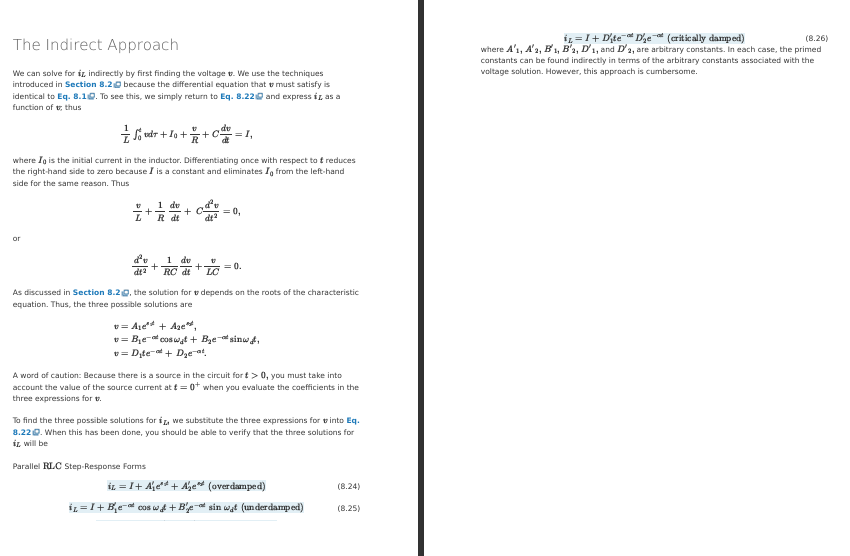
Describe the direct approach to finding v(t) for the step response of a parallel RLC circuit
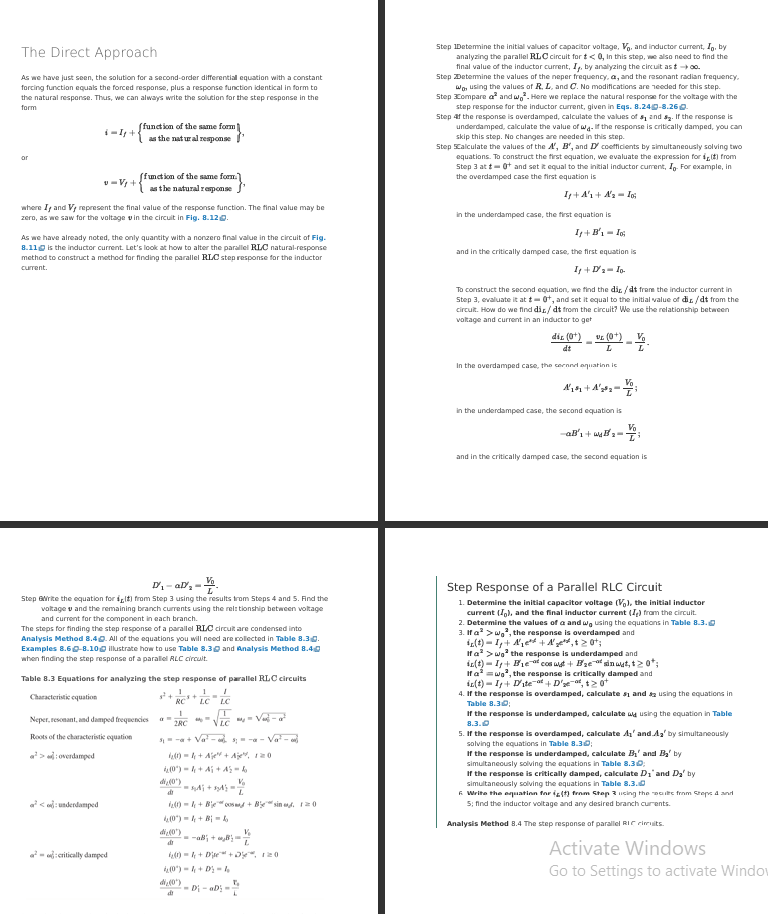
Derive the formulas for i(t) for the natural response of a series RLC circuit
mesh current method
vr + vc + vL = 0
Ri + (1/C) di + Li’ = 0
Ri’ + (1/C) i + L i’’ = 0
i’’ + (1/LR) i’ + (1/LC) i = 0
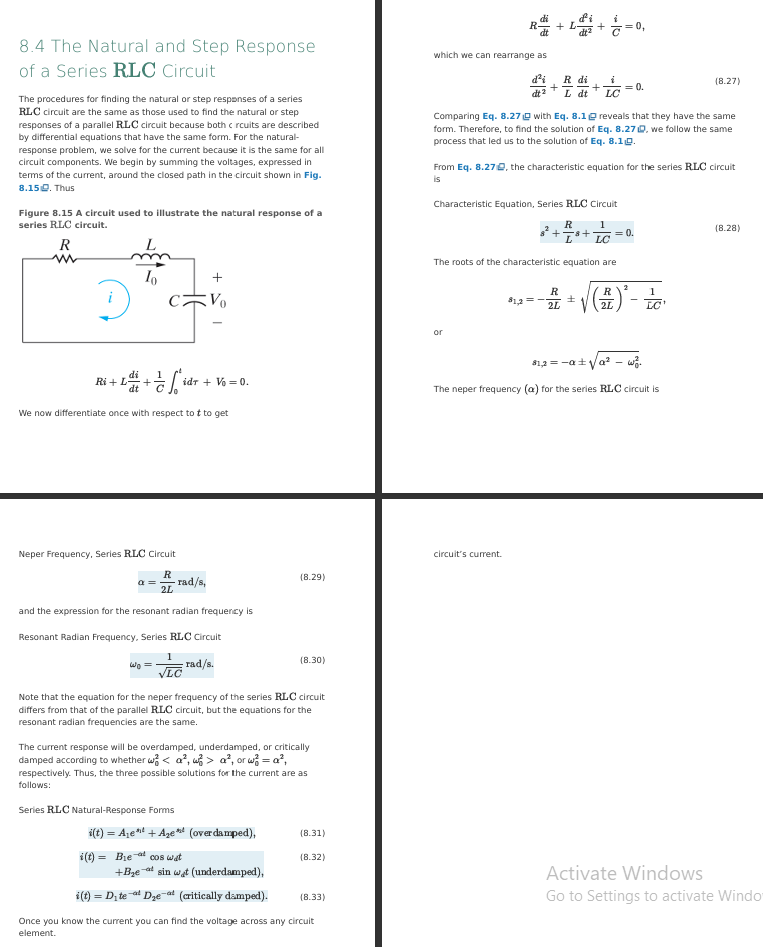
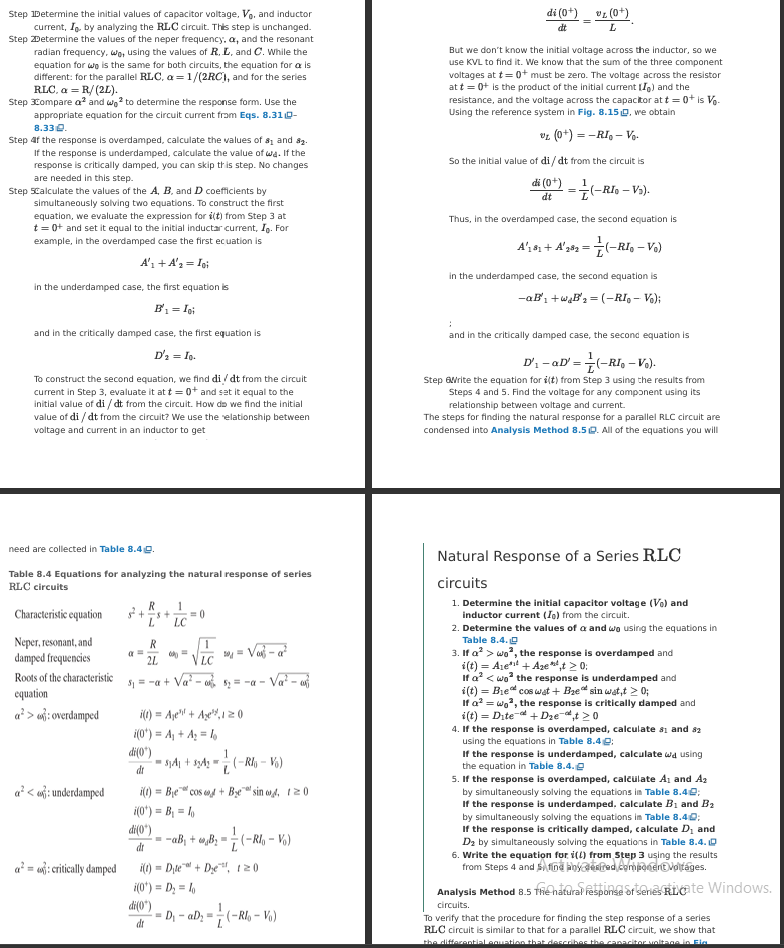
Summarize the process for finding i(t) for the natural response of a series RLC circuit
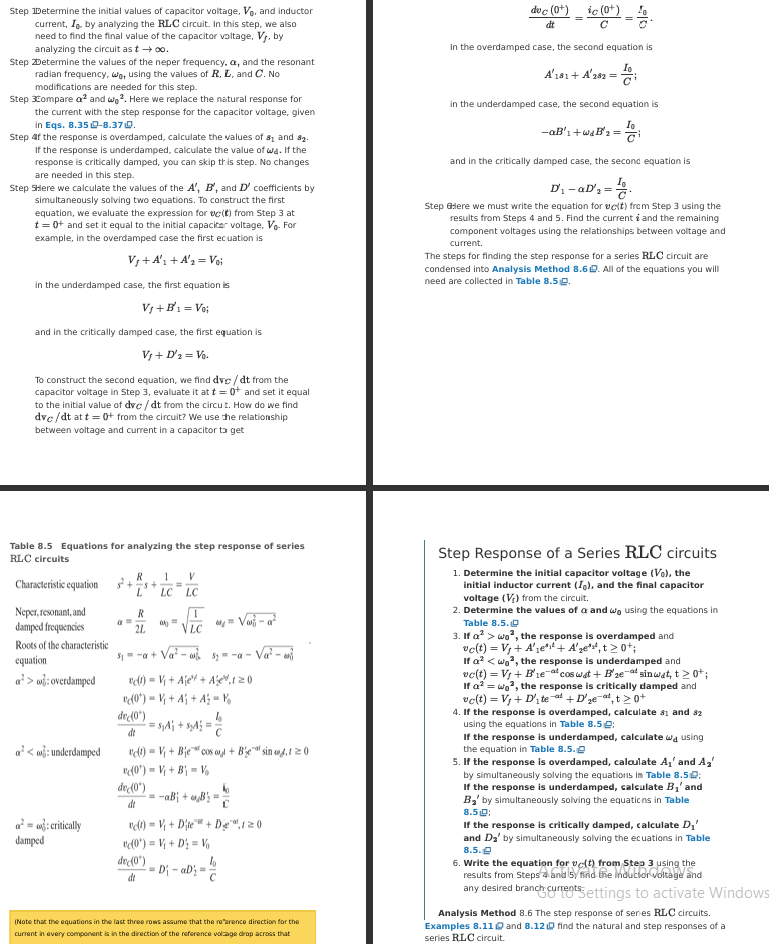
For the step response of an RLC series circuit:
derive the second order DE
Derive the solutiions for that DE
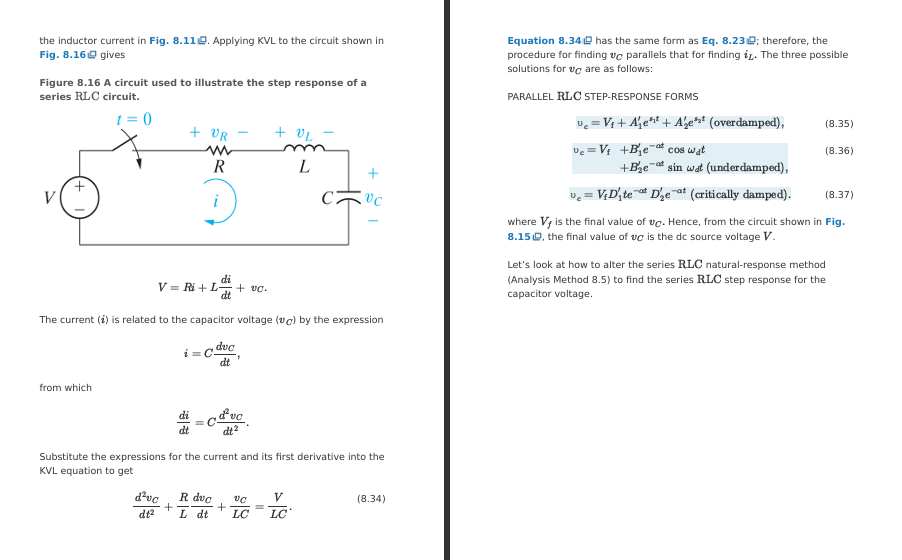
Summarize the working process for solving vc(t) for the step response of a series RLC circuit