MCAT: Reflection, Refraction, Dispersion, and Diffraction
 Call Kai
 Learn
Learn Practice Test
 Spaced Repetition
 Match
Match Flashcards
 Knowt Play
1/17

There's no tags or description
Looks like no tags are added yet.
Name | Mastery | Learn | Test | Matching | Spaced | Call with Kai | Chat |
|---|
No analytics yet
Send a link to your students to track their progress
18 Terms
What are the properties of light reflection?
When light reflects off a surface it does so at a similar but opposite angle to the angle of incidence

Angle of incidence is the angle at which:
light hits the reflective surface
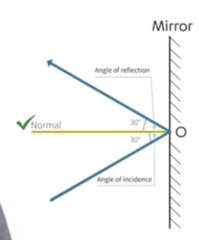
Angle of reflection is the angle at which:
light bounces of a reflective surface, at an angle equal and opposite to the angle of incidence

What is refraction?
the bending of waves due to a change in speed, as a result of the light entering a new medium
What is the speed of light in a vacuum?
c = 3x10^8 m/s
(T/F) Light traveling through a medium cannot travel faster that 3x10^8 m/s.
True, the fastest light can travel is in a vacuum
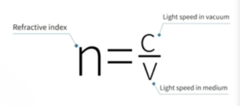
What is the refractive index (n) a measure of?
The difference in speed at which light travels through a certain medium
What is the equation for the refractive index?
n = c/v
What is the equation for measuring the velocity of light?
v = wavelength x frequency

What light travels from a medium with a low refractive index to a medium of high refractive index the _____________ and _________________ of the light decreases.
speed and wavelength (and vice versa)

What does Snell's Law describe and what is its equation?
Snell's law describes the bending of light passing form one medium to another
n1sin01 = n2sin02

A beam of sunlight hitting the surface of a pool of water will potentially (select all that apply):
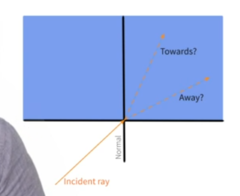
When light passes from a less dense medium to a more dense medium, its refracted angle is what?
less than the angle of incidence compared to the normal

What happens when light hits a medium at a zero degree angle towards the normal?
The angle of incidence doesn't change
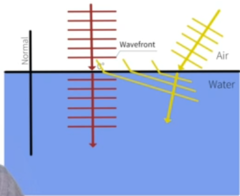
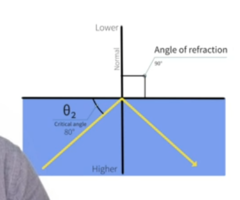
What is the critical angle, and what occurs when it is hit when light travels from a medium of high refractivity to low refractivity?
Critical angle is a high angle at which the light traveling in a high refractive medium will be refracted back at a 90-degree angle, due to the fact that when light travels from a high to a low refractive medium, it bends away from the normal
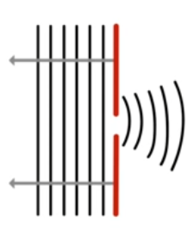
When a wave encounters a barrier with a small opening some waves will hit the barrier and be reflected back, while other waves will pass through the opening and expand outward. This phenomenon is known as:
diffraction
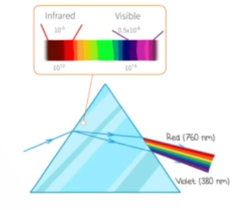
What is dispersion?
light rays passing through a glass prism are broken up into their component wavelengths
What is the difference between double-slit and single slit diffractions?
Double slit diffractions produce more even distributions of the maxima and minima