9/10 lecture drug absorption, distribution, and clearance
 Call Kai
 Learn
Learn Practice Test
 Spaced Repetition
 Match
Match Flashcards
 Knowt Play
1/54

There's no tags or description
Looks like no tags are added yet.
Name | Mastery | Learn | Test | Matching | Spaced | Call with Kai | Chat |
|---|
No analytics yet
Send a link to your students to track their progress
55 Terms
Oral drug pathway (from mouth to bloodstream)
Disintegration → Dissolution → Absorption
pharmacodynamics
what the drug does to the body, how drug produces its effect (esp. interactions w/ receptors)
pharmacokinetics
what the body does to the drug over time
ADME (absorption, distribution, metabolism, excretion)
Disintegration
break the dosage form apart in GI tract
capsule vs tablet, solid vs liquid, coating
Dissolution
drug dissolves in GI fluid
lipophilicity vs hydrophilicity, weak acid vs weak base
Absorption
drug has to cross the intestinal epithelial cell membrane and ultimately enter the bloodstream
active vs passive
Cmax
highest concentration of drug in the blood after the dose
Tmax
how long it takes to reach the peak (Cmax)
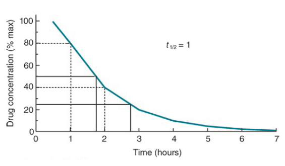
Half-life
time required for the drug concentration to decrease by 50%
Cplasma×Vd
amount of drug in body
AUC (Area Under the Curve)
the total amount of drug exposure in the body over time
more=more overall drug exposure
less=less overall drug exposure
To dissolve in GI fluid
drug needs to be water-soluble in ionized form
To cross the GI membrane
drug needs to be lipid-soluble, non-ionized form
Transcellular transport
enters one side of the intestinal cell, travels through it, and exits the other side into the blood
non-ionized and lipophilic
Paracellular transport
goes b/t cells thru tight junctions
Influx pumps
transport proteins that help move certain drugs (like ionized drugs)
GI tract → enterocyte → toward bloodstream
Efflux pumps
pumps drugs back into GI lumen
P-glycoprotein
if P-glycoprotein is inhibited
less efflux of drugs back in lumen so more drug concentration in blood
first-pass metabolism
metabolism of an oral drug in the intestinal wall and/or liver before it reaches systemic circulation, which reduces the amount of active/unchanged drug reaching the bloodstream
decreases bioavailability
Bioavailability (F)
fraction or percentage of an administered drug dose that reaches systemic circulation unchanged
why we want high bioavailability
more drug reaches blood where the bloodstream can carry drug to tissue or organ where receptor is located
importance of blood
body’s transportation system for drug, why we want more drugs to reach bloodstream
relationship b/t first pass metabolism and bioavailability
inverse relationship
IV administration
drug is placed directly into systemic circulation so %100 bioavailability
value is used to determine bioavailability (F) value
bioavailability (F) formula
AUC oral/AUC iv x 10
Volume of Distribution (Vd)
how much a drug appears to leave the blood/plasma and distribute into the body's tissues
High Vd
more drug in tissues
Low Vd
more drug remains in blood/plasma
Plasma
liquid portion of your blood
Vd (L) formula
concentration of drug in body(mg) /concentration of drug in plasma(mg/L)

loading dose
larger initial dose given to quickly reach the desired drug concentration in the blood
affected mostly by Vd
loading dose formula
= desired concentration x Vd
Maintenance dose
keeps you in the therapeutic range by replacing the drug being eliminated
protein binding
drug in the blood attaches to proteins in the plasma, especially albumin, only free drug can do this
bound drug won’t be excreted by kidney
Vd and protein binding
when a drug is highly bound to plasma proteins, it tends to stay in the bloodstream instead of entering tissues which lowers Vd
Clearance (CL)
the volume of plasma that is completely cleared of drug per unit time
how efficiently the body removes a drug from the blood/plasma
Clearance (CL) formula
Rate of drug removal (mg/min) / Plasma concentration (mg/mL)
total Clearance (CL) formula
CLkidney + CLliver + CLother
two major ways the body clears drugs
kidneys clearance and liver clearance
kidney clearance
remove drug from the blood and put it into the urine
Liver clearance
chemically changes the parent drug into metabolites
phase I and phase II (conjugation)
Phase I
oxidation/reduction/hydrolysis, commonly involving CYP450
rate of drug administration
clearance (CL) x Csteady-state
Vd and half life relationship
proportional, high Vd = long half life , low Vd = short half life
ke
first-order elimination rate constant
t1/2 = 0.693 / ke
Ke formula
ln (C2/C1) / t2-t1
Steady state
when the rate of drug entering the body equals the rate of drug being eliminated
rate in = rate out
4-5 half lives
to achieve steady state
Rate of drug removal formula
= ke x Cplasma x Vd
amount of drug in body formula
Cplasma×Vd
first-order elimination
body eliminates a constant percentage/fraction of the drug per unit time
half-life is constant
zero-order elimination
constant amount eliminated
half-life depends on concentration and CL is constant
saturable route of elimination
zero order where too much drug so elimination enzymes become saturated so they can’t any faster → fixed amount eliminated per hour
zero order graph

first order graph