Classification of limestone
 Call Kai
 Learn
Learn Practice Test
 Spaced Repetition
 Match
Match Flashcards
 Knowt Play
1/28

There's no tags or description
Looks like no tags are added yet.
Name | Mastery | Learn | Test | Matching | Spaced | Call with Kai | Chat |
|---|
No analytics yet
Send a link to your students to track their progress
29 Terms
In the classification of carbonate rocks , does mineralogy play a key role? If not, then why?
No, mineralogy doesnt play a significant role. Why? I will have to find out.
What is the difference between grain-supported and mud-supported?
In grain supported carbonate rocks fabric is packed with grains that are in contact with each other, giving rise to an intact grain framework.
In mud-supported carbonate rocks, the grains dont touch each other. Instead they appear to float in the mud supported matrix.
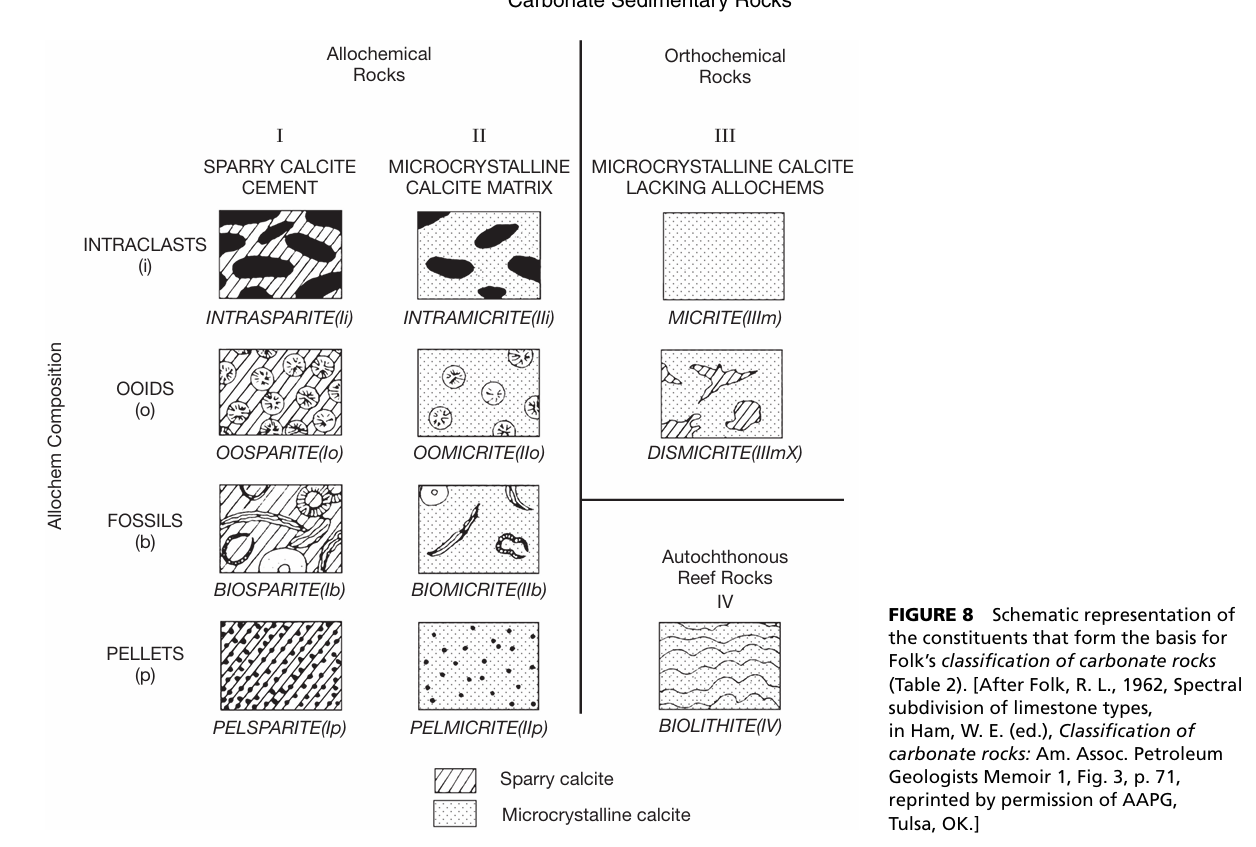
What is the classification based on? On which three constituents?
Carbonate grains/Allochems(Ooids/Peloids)
Micrite(Micro-crystalline mud)
Sparry crystalline cement
Define oomicrite.
Oolitic limestone with dominance of micrite.
Define oosparite.
Oolitic limestone with dominance of sparry calcite.
What is the meaning of packed oomicrite?
Packed oomicrite means oomicrite that has greater concentration of grains.
What is the meaning of sparse oomicrite?
Sparse oomicrite refers to an oomicrite that has higher concentration of mud.
What are the environmentally significant names ?
Bio-micrite- indicates deposition under quiet water conditions.More micrite indicates calm conditions.
Bio-sparite-Indicates deposition in agitated conditions. Here , sparry calcite is more and the micrite(mud ) is removed. This indicates high energy conditions.
Dunhams classification
Classification on the basis of allochems, micrite and sparry calcite
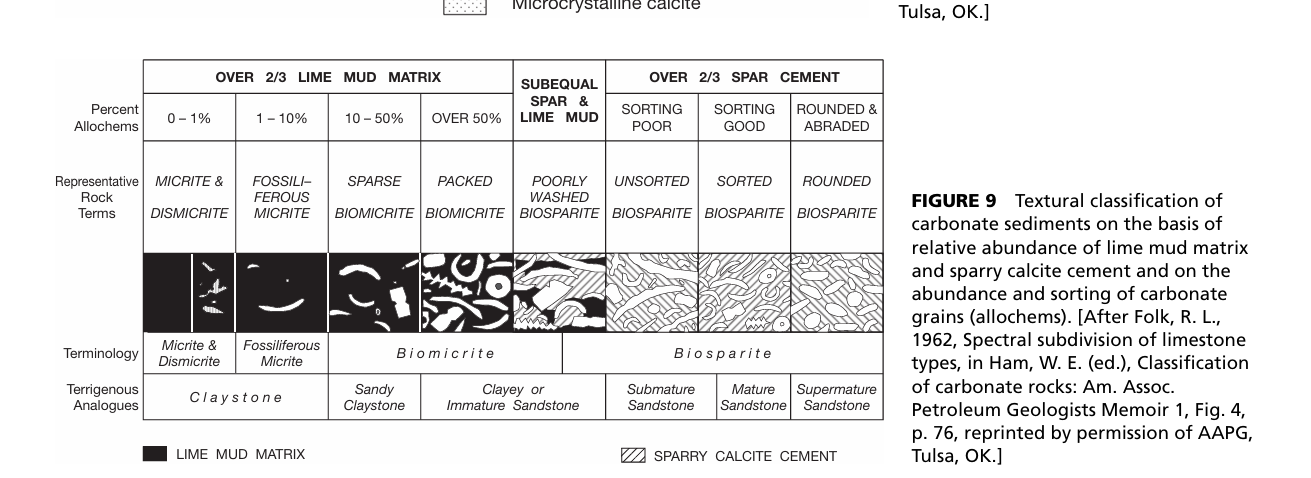
Micrite, sparite and allochems
What is the second type of classification of limestone?
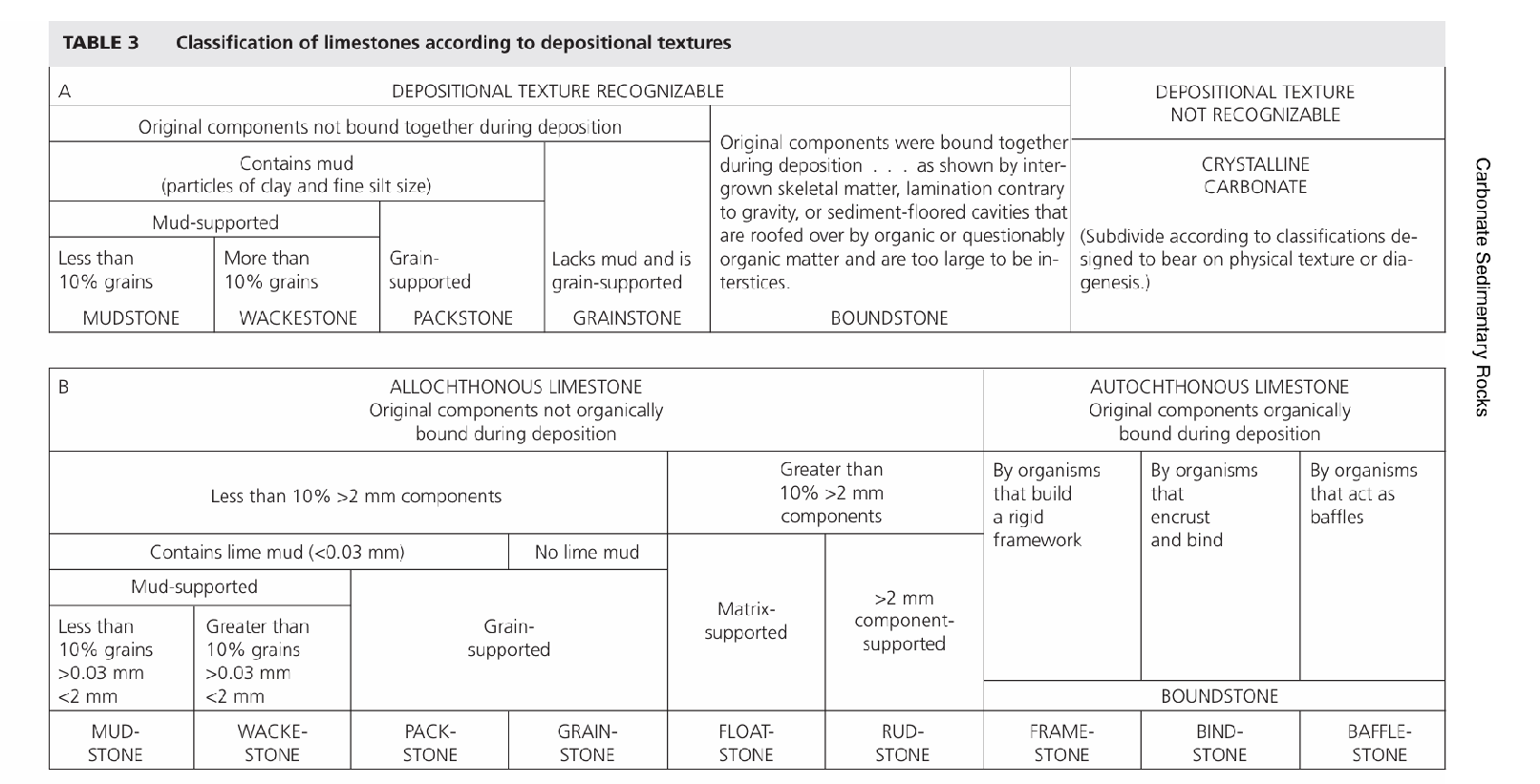
The second type is based on whether original components are organically bound or not, during depsosition.
If they are not bound, they are called allochthonous limestone.
If they are bound then they are called autochthonous limestone. The term boundstone is also used for the same.
Allochthonous limestone can be further classified into:
Rocks that contain less than 10 percent components having size greater than 2mm.
Mudstone, Wackestone, Packstone, Grainstone
Rocks that contain more than 10 percent components having size greater than 2mm.
Floatstone, Rudstone.
Autouchthonous limestones/boundstones can be further classified into:
Framestone-By organisms that build rigid framework.
Bindstone-By organisms that encrust and bind.
Bafflestone-By Organisms act as baffles
Define mudstone.
It is mud-supported.
It has less than 10 percent grains.
Grain size is greater than 0.03 mm but less than 2 mm.
Define wackestone.
It has greater than 10 percent grains.
Grain size is between 2mm and 0.03 mm.
Define packstone.
It is grain supported with minor amount of mud.
Define grainstone.
It is grain supported with no mud whatsoever.
The rocks having more than 10 percent components with size greater than 2mm can be classified into
Floatstone.
It is matrix supported.
Rudstone
It is 2mm component supported.
Define ooids. In which conditions does it form? Limestone made up of ooids are called______
These are spherical bodies of Caco3 less than 2mm in diametre.
It has concentric layers.
It forms in agitated warm water conditions, where CaCo3 is saturated. Limestones made up of ooids are called oolitic limestones.
Define pisoids.
These have greater size than 2mm.
Define pellets or peloids.
These are finer than pisoids and ooids and lack internal structure(They dont have concentric layers)
Size is less than 1mm.(Fecal pellets)
Define intraclasts.
These are fragments of CaCo3.
When a partly lithified limestone is broken , fragmented and then incoroporated into a sediment, the resulting incorporated clast is called intraclast.
These are microcrystalline fine grained sediments.
Name the allochems or the allochemical components.
Ooids
Peloids
Intraclasts
Skeletals(Fossils)
Define micrite.
It refers to microcrystalline mud. It can be easily distinguished from peloids and ooids by its extremely fine grain size.
As the grains are very small, almost of mud size , their deposition indicates very low energy , calm and tranquil conditions.
Deposition of sediments in high energy, agitated conditions yields a sediment that is devoid of micrite.
Define sparite or sparry calcite.
These are larger than micrite.Unlike micrites , they lack internal structure. As the size is larger , these are deposited in relaitvely high energy conditions.
Allochems, micrite and sparry calcite in simpler terms.
Allochems refer to the carbonate grains. They maybe ooids , peloids , skeletals or intraclasts.
Micrite refers to mud.
Sparite refers to cement.
How is highstand and lowstand related to formation of ooids?
During highstand, elevated CO2 concentration and lower Mg/Ca ratio promotes the formation of calcites(ooids). During lowstand, lowered levels of CO2 and higher Mg/Ca concentration favour the formation of aragonite.
It is important to know that higher concentrations of Mg inhibits the formation of calcite.