Chapter 8- Failure
 Call Kai
 Learn
Learn Practice Test
 Spaced Repetition
 Match
Match Flashcards
 Knowt Play
1/29

There's no tags or description
Looks like no tags are added yet.
Name | Mastery | Learn | Test | Matching | Spaced | Call with Kai | Chat |
|---|
No analytics yet
Send a link to your students to track their progress
30 Terms
What are the three usual causes of material component failure?
Improper materials selection and processing. 2. Inadequate component design. 3. Component misuse.
What are the two modes of fracture that can occur in response to tensile loading at relatively low temperatures?
Ductile and brittle modes.
Why is ductile fracture normally preferred over brittle fracture in engineering applications?
- Warning indicator: It exhibits plastic deformation as evidence that fracture is imminent. 2. Energy absorption: It requires significantly more energy to induce ductile fracture.
What is the difference between a stable crack and an unstable crack?
Stable crack (Ductile): Resists extension unless there is an increase in applied stress. Unstable crack (Brittle): Propagates spontaneously once started without needing an increase in stress.
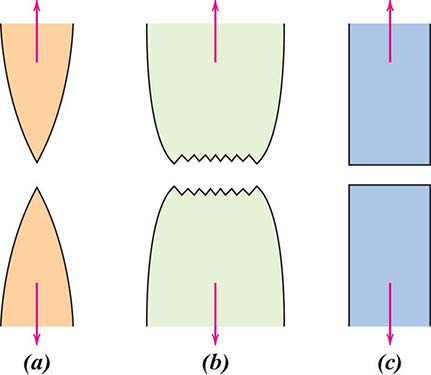
What are the two possible tensile fracture profiles for ductile metals depending on their degree of ductility?
Necking down to a point (very high ductility). 2. Cup-and-cone fracture profile (moderate ductility).
What are the characteristics of a brittle fracture surface and its propagation paths in polycrystalline materials?
Surface: Relatively flat and perpendicular to the direction of the applied tensile load. Paths: Can be transgranular (through-grain) or intergranular (between-grain).
What explains the significant discrepancy between the actual and theoretical fracture strengths of brittle materials?
The existence of small flaws that amplify the applied tensile stress in their vicinity. Fracture ensues when theoretical cohesive strength is exceeded at the tip of a flaw.
Why must sharp corners be avoided when designing structures subjected to stresses?
They act as points of stress concentration, which drastically increases local stress levels and risks crack initiation.
What does the fracture toughness of a material indicate, and what is its design parameter symbol?
It indicates a material's resistance to brittle fracture when a crack is present. The design parameter symbol is K_Ic.
What variables dictate the value of K_Ic, and how does it differ between material types?
It is a function of microstructure, strain rate, and temperature. It is relatively large for ductile materials and small for brittle ones.
What three factors must be considered when designing a structure to protect against the possibility of sudden fracture?
- Material fracture toughness. 2. The stress level. 3. The flaw size detection limit.
What three environmental/loading factors can cause a metal to undergo a ductile-to-brittle transition?
- Exposure to stresses at relatively low temperatures. 2. High strain rates (rapid loading). 3. The presence of a sharp notch.
Which two standardized impact testing techniques are used to qualitatively determine the fracture behavior of materials?
The Charpy and Izod impact tests.
How do engineers ascertain if a material experiences a ductile-to-brittle transition and determine its temperature range?
By measuring the temperature dependence of impact energy or observing the physical appearance of the fractured surface.
What type of material typifies ductile-to-brittle behavior, and how should it be used structurally?
Low-strength steel alloys. For structural applications, they must always be used at temperatures in excess of the transition range.
What two modifications can lower the ductile-to-brittle transition temperature in low-strength steel alloys?
- Decreasing the grain size. 2. Lowering the carbon content.
Define fatigue and describe its primary hazard condition.
A common type of catastrophic, sudden failure occurring under fluctuating/cyclic stress over time. It can happen at maximum stress levels considerably lower than the material's static tensile or yield strength.
What are the three general stress-versus-time cycle modes for fluctuating stresses, and how are cyclical modes characterized?
Modes: Reversed, repeated, and random. Characterized in terms of: mean stress, range of stress, and stress amplitude.
How is fatigue test data plotted on an S-N Curve?
It plots stress (normally stress amplitude) on the vertical axis versus the logarithm of the number of cycles to failure (N) on the horizontal axis.
Describe the two distinct types of S-N behavior displayed by metal alloys.
- No Fatigue Limit: Stress decreases continuously with an increasing number of cycles. 2. With Fatigue Limit: The curve flattens out and stress ceases to decrease, becoming independent of the number of cycles.
Where do fatigue cracks normally nucleate?
On the surface of a component at some point of stress concentration.
What are the two characteristic macroscopic/microscopic features found on a fatigue fracture surface?
Beachmarks and striations.
List five metallurgical or design measures that extend a component's fatigue life.
- Reducing mean stress. 2. Eliminating sharp surface discontinuities. 3. Improving surface finish by polishing. 4. Imposing surface residual compressive stresses via shot peening. 5. Case hardening via carburizing/nitriding.
Define thermal fatigue and corrosion fatigue.
Thermal Fatigue: Induced by fluctuating elevated temperatures when thermal expansion/contraction is restrained. Corrosion Fatigue: Reduction in fatigue life caused by cyclic stress in a chemically active environment.
Define creep and its general temperature threshold.
The time-dependent, permanent plastic deformation of metals subjected to a constant load or stress at high temperatures—typically greater than about 0.4 T_m (where T_m is the absolute melting temperature).
What are the three distinct regions of a standard creep curve (strain vs. time)?
- Transient (or Primary) creep. 2. Steady-state (or Secondary) creep. 3. Tertiary creep.
What are the two critical design parameters extracted from a standard creep curve?
- The steady-state creep rate (linear slope of the secondary region). 2. The rupture lifetime.
Increasing either temperature or applied stress produces what three effects on creep behavior?
- An increase in the instantaneous initial deformation. 2. An increase in the steady-state creep rate. 3. A decrease in the total rupture lifetime.
How can engineers extrapolate creep test data to lower-temperature or longer-time operational regimes?
By utilizing a plot of the logarithm of stress versus the Larson-Miller parameter calibrated for that specific alloy.
What two physical/mechanical properties make metal alloys exceptionally resistant to high-temperature creep?
- High elastic moduli. 2. High melting temperatures.