Nucleophilic Addition
 Call Kai
 Learn
Learn Practice Test
 Spaced Repetition
 Match
Match Flashcards
 Knowt Play
1/15

There's no tags or description
Looks like no tags are added yet.
Name | Mastery | Learn | Test | Matching | Spaced | Call with Kai | Chat |
|---|
No analytics yet
Send a link to your students to track their progress
16 Terms
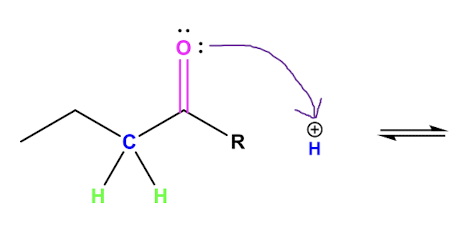
carbonyl + H+ ————>
enol formation

which group is more reactive, enol or enolate?
the enolate is more reactive because they have negative charges
which hydrogen will get deprotonated on an asymmetric molecule?
the alpha hydrogen on the more-substituted carbon
how can you deprotonate the alpha hydrogen of the less substituted carbon?
use a bulks base (LDA) at low temperature
How many hydrogens can LDA remove?
1

carbonyl (with alpha hydrogens) + base + X2 ————>
halogenated carbonyl compound (all alpha-Hs replaced with X)


carbonyl (with alpha hydrogens) + acid + X2 ————>
halogenated carbonyl compound (only 1 alpha-H is replaced)
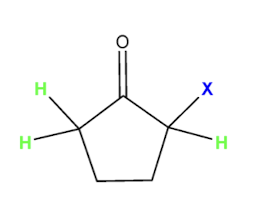
ketone + OH-, xs X2, H3O+ ————>
Carboxylate
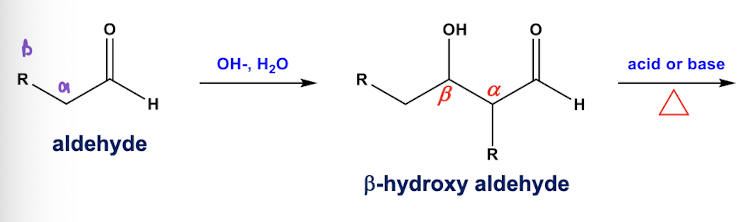
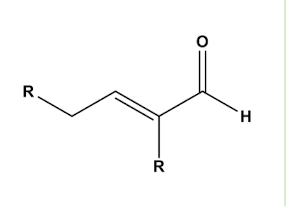
aldehyde + OH- + acid/base ————>
aldol condensation

ester + RO- + H+ ————>
Beta-keto ester (claisen condensation)
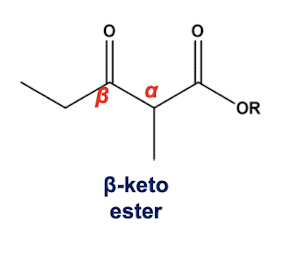
what is the rule for claisen condensation?
The OR- group must watch the ester

Beta-keto ester + OH- + heat ———>
ketone (beta decarboxylation)


acetoacetic ester + ————>
RO-
R1Br
RO_
R2Br
H3O, heat
di-alpha-alkylated ketone


acetoacetic ester + ————>
RO-
R1Br
H3O, heat
di-alpha-alkylated ketone


malonic ester + ————>
RO-
R1Br
RO_
R2Br
H3O, heat
di-alpha alkylated carboxylic acid
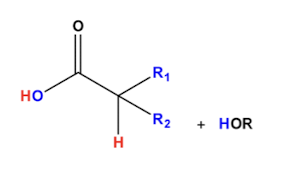

malonic ester + ————>
RO-
R1Br
H3O, heat
di-alpha alkylated carboxylic acid
