Chapter 7: Attention
 Studied by 0 people
 Call Kai
 Learn
Learn Practice Test
 Spaced Repetition
 Match
Match Flashcards
 Knowt Play
1/38

There's no tags or description
Looks like no tags are added yet.
Name | Mastery | Learn | Test | Matching | Spaced |
|---|
No study sessions yet.
39 Terms
Attention
The ability to selectively focus on the most relevant aspects of our environment
with selective processing
Selective Processing
Act of focusing or honing on a subset of available information deemed most important
We selectively choose what we want to further process
Flashbulb Memories
Vivid memories caused by especially salient or emotional events
Captured our attention the most
Falliable: as it relies on both the interplay of memory and attention
Processing Types
Incoming data interacts with information we already have resulting int two flows
Bottom-Up Processing:
Top-Down Processing
Bottom-Up Processing:
stimulus-driven mechanism whereby we perceive events or stimuli by piecing together smaller pieces of sensory information
Raw data gathered by our sense
Attention is captured by salient changes in the environment
Salient
: most important/noticable
Top-Down Processing:
Memory-driven mechanism whereby we perceive events or stimuli more holistically based on prior experiences or context
Uses a combination of memories, biases and heuristics to interpret info
“Filling in the blank” after making initial judgement
Helps direct attention to match current goals → understanding context
Study where people were told to tell information about people → eyes go to the place that helps provide context
Reading
Mendela effect:
a phenomenon where a large group of people collectively misremember a specific detail or even
False memory/ misattribution
topdown processing
Conspiracy theory:
When top-down processing meets confirmation bias
Automatic Processing
he cognitive ability to perform tasks without conscious thought or effort, developing from frequent, consistent practice
Eg reading
Controlled Processing
the deliberate, conscious, and effortful type of thinking that requires focused attention
Orienting
The act by which attention moves across a scene
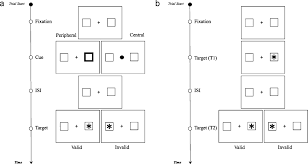
Spatial Cueing Paradigm
Measures shifts of attentions across a scene which lead to faster and more accurate target detection
When given a cue that attract the person attention they will do better on congruent trials than incongruent trials
Inhibition of Return:
Tends to prevent your gaze/attention from revisiting a previously attended location → promoting orienting to other locations
Normally improves search
Occurs when the time between a cue and the actual target is more than 300 milliseconds
Overt Attending
instances where the direction of attention is made clear through eye movements - Looking towards what we are paying attention to
Covert Orienting
instances where the direction of attention is not necessarily guided by eye movements, and can be measured using spatial cueing
Visual Search
Measures how long it takes to detect a target amid distracters as a function of set size
Set Size
total number of items in the visual display/search
Pop-Out Effect:
visually salient stimuli automatically capture attention regardless of set size
Like a different colour
Bottom up capture of attention
Search time is not affected by set size
Conjunctive Search:
Searching for a combination of features during a visual search taking away from the pop-out effect
takes a longer time as set size increases
Contextual Cueing
Guides our attention in a more efficient manner via prior knowledge
using our schemas
Schema
Representation of depicting the range plausible objects and likely configurations of those objects within a particular scenario during visual searches
Inattention Task:
Selective Attention
Cocktail Part Effect:
Breakthrough Effect
Inattentional Blindness
Change Blindness
Selective Attention
How we focus in on a subset of stimuli in our environment to process them more efficiently
Attended items are better remembered than unattended items
Cocktail Part Effect
How we can focus on a single source of auditory information despite background noise
Single Filter Model:
Breakthrough Effect:
Highly relevant information from the unattended channel can draw our attention
Dual Filter Model
Dichotic Listening Paradigm
a study where people can ignore information coming into one ear when told to focus on the other ear, however some information can get through from the ignored ear based on important
Most of the time only physical characteristics (tone, pitch and volume) of sounds in the unattended channel can be remembered
Dichotic Listening paradigm extension mackay study
attended ear had an ambiguous message with two interpretations, unattended channel had words being said that were related to one of the interpretations but not the other
When asked to recall the ambiguous message they would say it was like the interpretation that the unattended ear was hearing
Bank → financial institution or river
Inattentional Blindness:
Limited attentional resources can result in not noticing very important or noticeable things
Selective Looking Paradigm
measures how people focus their attention by asking them to selectively watch one of two or more superimposed visual stimuli
Eg, not noticing the gorilla
Change Blindness Paradigm:
Perceptual phenomenon where a change has occurred in a visual scene but the observer does not notice nor can identify it
In the experiment an intervening black screen is added causing a flicker that prevent automatic capture of attention
When flicker does not occur: much easier to spot the difference
Stroop Task:
A taks where participants are required to identify the colour of ink a coloured word is written in while ignoring the word itself
Stroop Paradigm: Difficult task due to the automatic processing of word reading
Congruent trails: word matches the colour
When there are mostly congruent trials: 75% congruent
strategy : read the word however this makes reading incongruent trials even harder → Larger stroop effect
Incongruent trials: Word does not match the colour
Takes longer to determine the colour
Automatic Reading Interferes with the ability to name colour
When there are mostly incongruent trials: 75% incongruent
strategy : ignore the word only look at the colour
Decreases stroop effect as you are not reading and getting confused
Stroop effect:
How long it takes to read incongruent trials
Spotlight Model (Posner)
Attention highlights and enhancing the processing of things that fall within the focus of a spotlight
Easier to see things in the spotlight draws spatial attention
Has limits
Filter Model
Only certain information is allowed to pass through into our conscious awareness
Single Filter Model: Early selection theory (Broadbent)
Bottleneck
Double Filter Model
Attenuation Theory
Later Selection Model (Deutch):
Single Filter Model: Early selection theory (Broadbent):
Information is categorized by physical characteristics where they are briefly stored to analyze
Information is filtered very quickly through the bottleneck before semantics is understood
bottleneck
Only a limited amount of information based on physical characteristic pass on to further processing
Does not explain how semantics of unattended channels can still be understood in certain scenarios
Attenuation Theory (Triesman
Another early filter model dual filter
Unattended information is not completely filtered out, but rather ‘turned down’ or attenuated
A new filter is in place of the bottleneck → everything goes by but its categorized based on physical features
A second filter is added to filter semantic meaning
Later Selection Model (Deutch):
First filter: physical and semantic analysis
All information is stored in short-term memory
Second Filter/ Late filter: organized information is then selected by personal relevance to go further for deeper level processing due to limited capacity
Unselected information just fades - but is still registered