Topic 3 — Particle Model of Matter
 Call Kai
 Learn
Learn Practice Test
 Spaced Repetition
 Match
Match Flashcards
 Knowt Play
1/66

There's no tags or description
Looks like no tags are added yet.
Name | Mastery | Learn | Test | Matching | Spaced | Call with Kai | Chat |
|---|
No analytics yet
Send a link to your students to track their progress
67 Terms
What is the definition of density?
Mass per unit volume of an object.
What is the equation for density? State the units.
density = mass / volume
ρ=Vm
density — kilograms per metre cubed (kg/m3)
mass — kilograms (kg)
volume — metres cubed (m³)
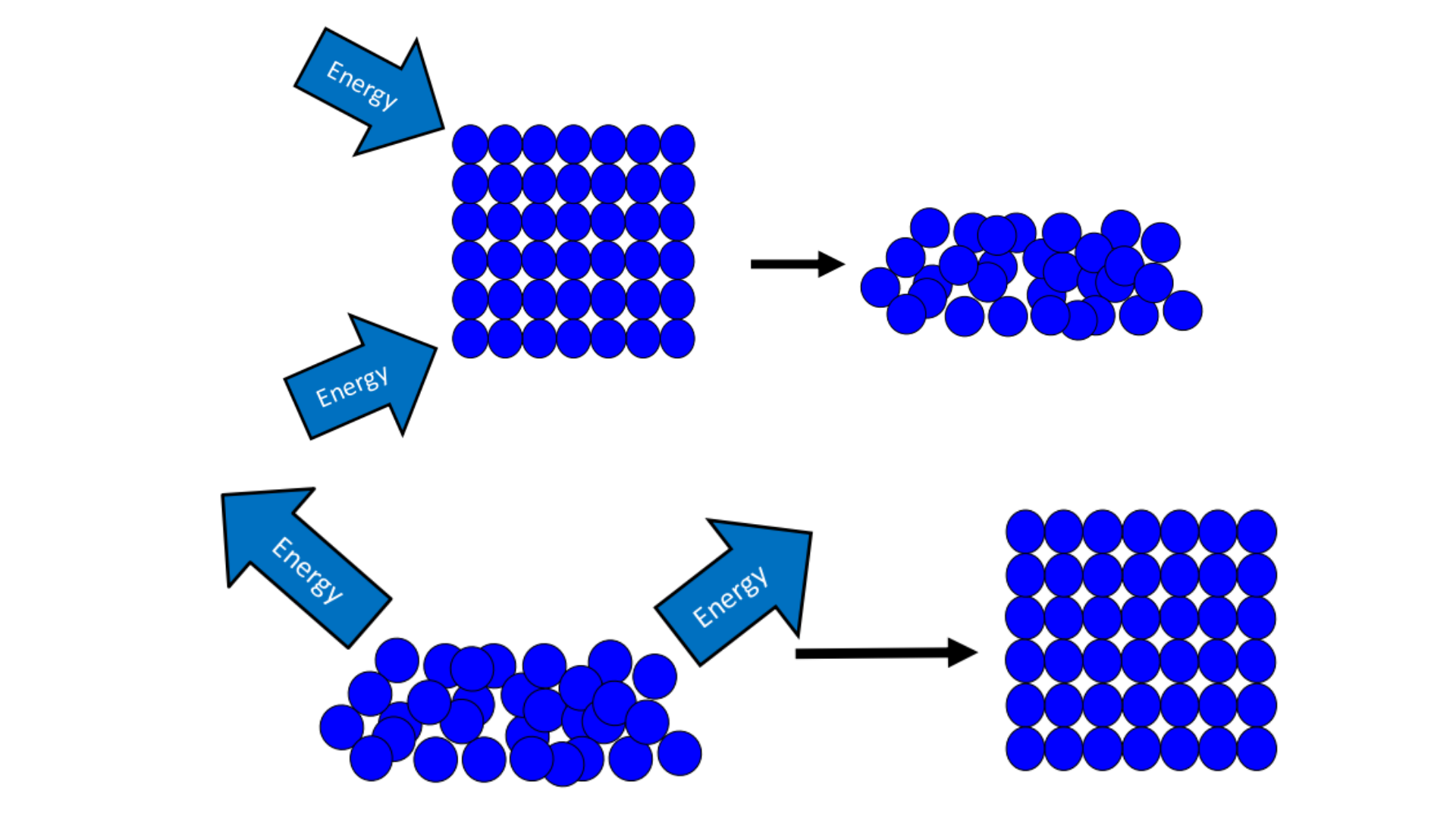
What can the particle model be used to explain?
Different states of matter
Differences in density
Draw a particle model of a solid, liquid, and gas.

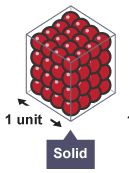
Explain the density of a solid in terms of the arrangement of atoms or molecules.
Tightly packed together — fixed regular pattern
Highest density
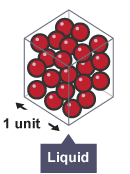
Explain the density of a liquid in terms of the arrangement of atoms or molecules.
Close together — irregular arrangement → can flow over one another
Lower density than solids — particles are less closely packed
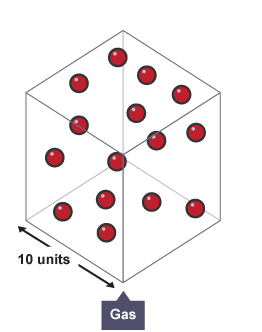
Explain the density of a gas in terms of the arrangement of atoms or molecules.
Very far apart — move freely
Lots of empty space — small mass for a given volume
Least density
Required Practical 5 — Density — Activity 1 (Regularly Shaped Object)
Describe a method to determine the density of a regularly shaped object.
Use this equation to help you: ρ=Vm
For each object, measure and record the:
length
width
height
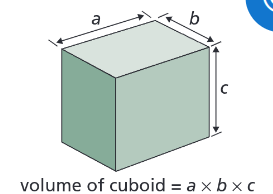
Calculate the volume of each object — l × w × h
Measure the mass of each object using a balance — zero the balance first
Calculate the density using: ρ=Vm

Required Practical 5 — Density — Activity 2 (Irregularly Shaped Object)
Describe a method to determine the density of a irregularly shaped object.
Use this equation and apparatus diagram to help you: ρ=Vm
Measure the mass of the object with a balance — zero the balance first
Fill the displacement can with water until water starts to drip from the spout
Place a measuring cylinder under the spout of the displacement can
Lower the object into the displacement can — fully submerged
Measure the volume of the water in the measuring cylinder = to the volume of the object
Calculate the density using: ρ=Vm
Required Practical 5 — Density — Activity 3 (Liquid)
Describe a method to determine the density of a liquid.
Use this equation to help you: ρ=Vm
Measure the mass of the empty measuring cylinder using a balance — zero the balance first
Pour the liquid into the measuring cylinder — e.g. 100 cm³
Measure the mass of the measuring cylinder with the liquid using a balance — zero the balance first
Calculate the mass using: final mass - starting mass
Calculate the density using: ρ=Vm
State the independent, dependent, and control variables for:
Required Practical 5 — Density — Activity 1 (Regularly Shaped Object)
Independent — object being tested
Dependent — density of the object (mass and volume)
Control:
setting balance to zero — avoids zero errors
State the independent, dependent, and control variables for:
Required Practical 5 — Density — Activity 2 (Irregularly Shaped Object)
Independent — object being tested
Dependent — density of the object (mass and volume)
Control:
starting level of water in displacement can
State the independent, dependent, and control variables for:
Required Practical 5 — Density — Activity 3 (Liquid)
Independent — liquid being tested
Dependent — density of the liquid (mass and volume)
Control:
mass of empty measuring cylinder
What are safety precautions that need to be taken for Required Practical 5 — Density?
Glass equipment breaking — hold it carefully
Water spillage — clean it up or use a sign to avoid slipping
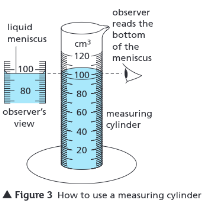
![<ul><li><p>The figure shows a measuring cylinder containing some water, which a student used to measure the volume of a metal ring.</p></li><li><p>When measuring the volume, the student’s eye was in line with the level of the water. </p></li></ul><p>Which type of error would have been caused if the student s eye was not in line with the level of the water? [1 mark]</p>](https://assets.knowt.com/user-attachments/94bc88c8-b876-4b44-bcd2-291041314ab5.png)
The figure shows a measuring cylinder containing some water, which a student used to measure the volume of a metal ring.
When measuring the volume, the student’s eye was in line with the level of the water.
Which type of error would have been caused if the student s eye was not in line with the level of the water? [1 mark]
Random error
![<ul><li><p>The figure shows a measuring cylinder containing some water, which a student used to measure the volume of a metal ring.</p></li><li><p>The student tied a piece of thick string to the metal ring and lowered the ring into the water. </p></li></ul><p>Suggest one reason why the student should have used thin string instead of thick string. [1 mark]</p>](https://assets.knowt.com/user-attachments/b543abda-7176-43a1-a844-ddd2c0dc67f0.png)
The figure shows a measuring cylinder containing some water, which a student used to measure the volume of a metal ring.
The student tied a piece of thick string to the metal ring and lowered the ring into the water.
Suggest one reason why the student should have used thin string instead of thick string. [1 mark]
It would displace less water than thick string.

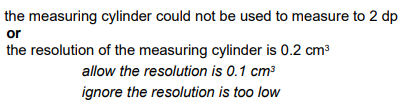
![<ul><li><p>The figure shows a measuring cylinder containing some water, which a student used to measure the volume of a metal ring.</p></li><li><p>The table below shows the results.</p></li></ul><table style="min-width: 75px;"><colgroup><col style="min-width: 25px;"><col style="min-width: 25px;"><col style="min-width: 25px;"></colgroup><tbody><tr><td colspan="1" rowspan="1" style="animation: auto ease 0s 1 normal none running none; appearance: none; background: none 0% 0% / auto repeat scroll padding-box border-box rgb(239, 239, 239); inset: auto; clear: none; clip: auto; columns: auto; contain: none; container: none; content: normal; cursor: auto; cx: 0px; cy: 0px; d: none; direction: ltr; display: table-cell; fill: rgb(0, 0, 0); filter: none; flex: 0 1 auto; float: none; gap: normal; hyphens: manual; interactivity: auto; isolation: auto; margin-right: 0px; margin-bottom: 0px; margin-left: 0px; marker: none; mask: none; offset: normal; opacity: 1; order: 0; orphans: 2; outline: rgb(31, 31, 31) none 0px; overlay: none; padding: 16px 12px 16px 0px; page: auto; perspective: none; position: static; quotes: auto; r: 0px; resize: none; rotate: none; rx: auto; ry: auto; scale: none; speak: normal; stroke: none; transform: none; transition: all; translate: none; visibility: visible; widows: 2; x: 0px; y: 0px; zoom: 1; border: 1px solid; margin-top: 0px !important;"><p><span style="color: red;"><strong>Volume of water in cm³</strong></span></p></td><td colspan="1" rowspan="1" style="animation: auto ease 0s 1 normal none running none; appearance: none; background: none 0% 0% / auto repeat scroll padding-box border-box rgb(239, 239, 239); inset: auto; clear: none; clip: auto; columns: auto; contain: none; container: none; content: normal; cursor: auto; cx: 0px; cy: 0px; d: none; direction: ltr; display: table-cell; fill: rgb(0, 0, 0); filter: none; flex: 0 1 auto; float: none; gap: normal; hyphens: manual; interactivity: auto; isolation: auto; margin-right: 0px; margin-bottom: 0px; margin-left: 0px; marker: none; mask: none; offset: normal; opacity: 1; order: 0; orphans: 2; outline: rgb(31, 31, 31) none 0px; overlay: none; padding: 16px 12px 16px 0px; page: auto; perspective: none; position: static; quotes: auto; r: 0px; resize: none; rotate: none; rx: auto; ry: auto; scale: none; speak: normal; stroke: none; transform: none; transition: all; translate: none; visibility: visible; widows: 2; x: 0px; y: 0px; zoom: 1; border: 1px solid; margin-top: 0px !important;"><p><span style="color: red;"><strong>Volume of water and ring in cm³</strong></span></p></td><td colspan="1" rowspan="1" style="animation: auto ease 0s 1 normal none running none; appearance: none; background: none 0% 0% / auto repeat scroll padding-box border-box rgb(239, 239, 239); inset: auto; clear: none; clip: auto; columns: auto; contain: none; container: none; content: normal; cursor: auto; cx: 0px; cy: 0px; d: none; direction: ltr; display: table-cell; fill: rgb(0, 0, 0); filter: none; flex: 0 1 auto; float: none; gap: normal; hyphens: manual; interactivity: auto; isolation: auto; margin-right: 0px; margin-bottom: 0px; margin-left: 0px; marker: none; mask: none; offset: normal; opacity: 1; order: 0; orphans: 2; outline: rgb(31, 31, 31) none 0px; overlay: none; padding: 16px 0px; page: auto; perspective: none; position: static; quotes: auto; r: 0px; resize: none; rotate: none; rx: auto; ry: auto; scale: none; speak: normal; stroke: none; transform: none; transition: all; translate: none; visibility: visible; widows: 2; x: 0px; y: 0px; zoom: 1; border: 1px solid; margin-top: 0px !important;"><p><span style="color: red;"><strong>Volume of ring in cm³</strong></span></p></td></tr><tr><td colspan="1" rowspan="1" style="animation: auto ease 0s 1 normal none running none; appearance: none; background: none 0% 0% / auto repeat scroll padding-box border-box rgba(0, 0, 0, 0); inset: auto; clear: none; clip: auto; columns: auto; contain: none; container: none; content: normal; cursor: auto; cx: 0px; cy: 0px; d: none; direction: ltr; display: table-cell; fill: rgb(0, 0, 0); filter: none; flex: 0 1 auto; float: none; gap: normal; hyphens: manual; interactivity: auto; isolation: auto; margin-right: 0px; margin-bottom: 0px; margin-left: 0px; marker: none; mask: none; offset: normal; opacity: 1; order: 0; orphans: 2; outline: rgb(31, 31, 31) none 0px; overlay: none; padding: 16px 12px 16px 0px; page: auto; perspective: none; position: static; quotes: auto; r: 0px; resize: none; rotate: none; rx: auto; ry: auto; scale: none; speak: normal; stroke: none; transform: none; transition: all; translate: none; visibility: visible; widows: 2; x: 0px; y: 0px; zoom: 1; border: 1px solid; margin-top: 0px !important;"><p><span style="background-color: rgba(0, 0, 0, 0);">5.0</span></p></td><td colspan="1" rowspan="1" style="animation: auto ease 0s 1 normal none running none; appearance: none; background: none 0% 0% / auto repeat scroll padding-box border-box rgba(0, 0, 0, 0); inset: auto; clear: none; clip: auto; columns: auto; contain: none; container: none; content: normal; cursor: auto; cx: 0px; cy: 0px; d: none; direction: ltr; display: table-cell; fill: rgb(0, 0, 0); filter: none; flex: 0 1 auto; float: none; gap: normal; hyphens: manual; interactivity: auto; isolation: auto; margin-right: 0px; margin-bottom: 0px; margin-left: 0px; marker: none; mask: none; offset: normal; opacity: 1; order: 0; orphans: 2; outline: rgb(31, 31, 31) none 0px; overlay: none; padding: 16px 12px 16px 0px; page: auto; perspective: none; position: static; quotes: auto; r: 0px; resize: none; rotate: none; rx: auto; ry: auto; scale: none; speak: normal; stroke: none; transform: none; transition: all; translate: none; visibility: visible; widows: 2; x: 0px; y: 0px; zoom: 1; border: 1px solid; margin-top: 0px !important;"><p><span style="background-color: rgba(0, 0, 0, 0);">5.4</span></p></td><td colspan="1" rowspan="1" style="animation: auto ease 0s 1 normal none running none; appearance: none; background: none 0% 0% / auto repeat scroll padding-box border-box rgba(0, 0, 0, 0); inset: auto; clear: none; clip: auto; columns: auto; contain: none; container: none; content: normal; cursor: auto; cx: 0px; cy: 0px; d: none; direction: ltr; display: table-cell; fill: rgb(0, 0, 0); filter: none; flex: 0 1 auto; float: none; gap: normal; hyphens: manual; interactivity: auto; isolation: auto; margin-right: 0px; margin-bottom: 0px; margin-left: 0px; marker: none; mask: none; offset: normal; opacity: 1; order: 0; orphans: 2; outline: rgb(31, 31, 31) none 0px; overlay: none; padding: 16px 0px; page: auto; perspective: none; position: static; quotes: auto; r: 0px; resize: none; rotate: none; rx: auto; ry: auto; scale: none; speak: normal; stroke: none; transform: none; transition: all; translate: none; visibility: visible; widows: 2; x: 0px; y: 0px; zoom: 1; border: 1px solid; margin-top: 0px !important;"><p><span style="background-color: rgba(0, 0, 0, 0);">0.4</span></p></td></tr></tbody></table><ul><li><p>The true volume of the ring was 0.44 cm<sup>3</sup>. </p></li><li><p>Even without using the string, the measuring cylinder could not give an accurate value for the volume of the ring. </p></li></ul><p>Give one reason why. [1 mark]</p>](https://assets.knowt.com/user-attachments/9428b4ea-1ee8-4842-a8ab-5665c21ba851.png)
The figure shows a measuring cylinder containing some water, which a student used to measure the volume of a metal ring.
The table below shows the results.
Volume of water in cm³ | Volume of water and ring in cm³ | Volume of ring in cm³ |
5.0 | 5.4 | 0.4 |
The true volume of the ring was 0.44 cm3.
Even without using the string, the measuring cylinder could not give an accurate value for the volume of the ring.
Give one reason why. [1 mark]
The resolution of the measuring cylinder is 0.2 cm³.
![<ul><li><p>The figure shows a measuring cylinder containing some water, which a student used to measure the volume of a metal ring.</p></li><li><p>The student used a balance to measure the mass of the ring. </p></li><li><p>After the ring was removed from the balance, the reading on the balance was 0.02 g. </p></li></ul><p>How could the student use the readings from the balance to determine the correct mass of the ring? [1 mark]</p>](https://assets.knowt.com/user-attachments/70050301-dd17-452b-9960-61793001b03b.png)
The figure shows a measuring cylinder containing some water, which a student used to measure the volume of a metal ring.
The student used a balance to measure the mass of the ring.
After the ring was removed from the balance, the reading on the balance was 0.02 g.
How could the student use the readings from the balance to determine the correct mass of the ring? [1 mark]
Subtract 0.02 from the measured value.

A student investigated the density of different fruits.
The table below shows the results.
Fruit | Density in g/cm³ |
Apple | 0.68 |
Kiwi | 1.03 |
Lemon | 0.95 |
Lime | 1.05 |
The student determined the volume of each fruit using a displacement can and a measuring cylinder.
What other piece of equipment would the student need to determine the density of each fruit? [1 mark]
Balance
A student investigated the density of different fruits.
The table below shows the results.
Fruit | Density in g/cm³ |
Apple | 0.68 |
Kiwi | 1.03 |
Lemon | 0.95 |
Lime | 1.05 |
The student determined the volume of each fruit using a displacement can and a measuring cylinder.
The student only measured the volume of each fruit once.
The volume measurements cannot be used to show that the method to measure volume gives precise readings.
Give the reason why. [1 mark]
Repeat readings of volume need to be taken of each fruit to show that the readings are close together.

![<ul><li><p>The diagrams, X, Y and Z, show how the particles are arranged in the three states of matter.</p></li></ul><p>Which one of the diagrams, X, Y or Z, shows the arrangement of particles in a liquid? [1 mark]</p>](https://assets.knowt.com/user-attachments/29736a96-f15d-4a79-97df-9551ed9cef7a.png)
The diagrams, X, Y and Z, show how the particles are arranged in the three states of matter.
Which one of the diagrams, X, Y or Z, shows the arrangement of particles in a liquid? [1 mark]
Z
![<ul><li><p>The diagrams, X, Y and Z, show how the particles are arranged in the three states of matter.</p></li></ul><p>Which one of the diagrams, X, Y or Z, shows the arrangement of particles in a gas? [1 mark]</p>](https://assets.knowt.com/user-attachments/00e31b15-fe38-423d-b5b6-b186a1b872ea.png)
The diagrams, X, Y and Z, show how the particles are arranged in the three states of matter.
Which one of the diagrams, X, Y or Z, shows the arrangement of particles in a gas? [1 mark]
X
![<p>Choose the correct answer in each box to complete the sentence. [1 mark]</p><p>In a gas, the particles are _____________________________________.</p>](https://assets.knowt.com/user-attachments/2d2d7eb0-161f-491a-9883-1a4b69c6c7b3.png)
Choose the correct answer in each box to complete the sentence. [1 mark]
In a gas, the particles are _____________________________________.
moving randomly
![<p>Choose the correct answer in each box to complete the sentence. [1 mark]</p><p>In a solid, the forces between the particles are _____________________________ the forces between weaker than the particles in a liquid.</p>](https://assets.knowt.com/user-attachments/e4b9b17d-9723-44ff-b806-68b0136e90cd.png)
Choose the correct answer in each box to complete the sentence. [1 mark]
In a solid, the forces between the particles are _____________________________ the forces between weaker than the particles in a liquid.
stronger than
![<ul><li><p>The diagrams show the arrangement of the particles in a solid and in a gas. </p></li><li><p>Each circle represents one particle.</p></li></ul><p>Explain, in terms of the particles, why gases are easy to compress. [2 marks]</p>](https://assets.knowt.com/user-attachments/72bd6b84-7f9b-44e6-92d8-f29d77c37567.png)
The diagrams show the arrangement of the particles in a solid and in a gas.
Each circle represents one particle.
Explain, in terms of the particles, why gases are easy to compress. [2 marks]
Large gaps between particles
So it is easy to push particles closer together

When substances change state (______, ________, _____, ________, ________, or __________) — mass is ____________.
melt
freeze
boil
evaporate
condense
sublimate
conserved
Changes of state are physical changes which differ from chemical changes.
Explain why.
The material recovers its original properties if the change is reversed.
What is the definition of internal energy?
The energy stored inside a system by the atoms and molecules (particles) that make up the system.
What is internal energy?
The total kinetic energy and potential energy of the particles that make up a system.
Heating changes the energy stored within the system by increasing the energy of the particles that make up the system.
What does this do? (2)
Raises the temperature of a system
Produces a change of state
Heating changes the energy __________ within the __________ by increasing the _________ of the particles that make up the __________.
stored
system
energy
system
If the temperature of the system increases, what does the increase in temperature depend on?
Mass of substance heated
Type of material
Energy input into the system
What is the specific heat capacity of a substance?
The amount of energy required to raise the temperature of 1 kg of the substance by 1°C.
What is the equation for the amount of energy stored in or released from a system as its temperature changes (change in thermal energy)? State the units.
change in thermal energy = mass × specific heat capacity × temperature change
ΔE=mcΔθ
change in thermal energy — joules (J)
mass — kilograms (kg)
specific heat capacity — joules per kilogram per degree Celcius (J/kg°C)
temperature change — degrees Celcius (°C)
What is the definition of latent heat?
The energy needed for a substance to change state.
When a change of state occurs, what does the energy supplied change?
Internal energy (energy stored)
Not the temperature
What is meant by the specific latent heat of a substance?
The amount of energy required to:
change the state of 1 kg of the substance
no change in temperature
What is the equation for specific latent heat? State the units.
energy for a change of state = mass × specific latent heat
E=mL
energy — joules (J)
mass — kilograms (kg)
specific latent heat — joules per kilogram (J/kg)
What is the specific latent heat of fusion?
The amount of energy required to:
change the state of 1 kg of the substance (solid → liquid)
no change in temperature
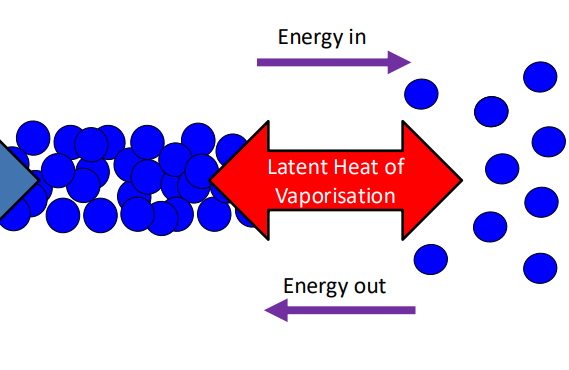
What is the specific latent heat of vaporisation?
The amount of energy required to:
change the state of 1 kg of the substance (liquid → vapour)
no change in temperature

Label the graph.
A — Melting
B — Boiling
C — Gas
D — Liquid
E — Solid

![<ul><li><p>A student determined the specific latent heat of vaporisation of water.</p></li><li><p>The figure shows some of the equipment used.</p></li></ul><p>This is the method used:</p><p>1. Put 50 cm<sup>3</sup> of water in a beaker.</p><p>2. Measure the mass of the beaker and water.</p><p>3. Use a heater to boil the water and keep it boiling for 600 seconds.</p><p>4. Measure the mass of the beaker and water after 600 seconds.</p><p>What measuring instrument should be used to measure the volume of water? [1 mark]</p>](https://assets.knowt.com/user-attachments/c7518929-d7b6-434b-866b-e84463f42f0b.png)
A student determined the specific latent heat of vaporisation of water.
The figure shows some of the equipment used.
This is the method used:
1. Put 50 cm3 of water in a beaker.
2. Measure the mass of the beaker and water.
3. Use a heater to boil the water and keep it boiling for 600 seconds.
4. Measure the mass of the beaker and water after 600 seconds.
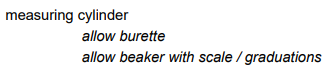
What measuring instrument should be used to measure the volume of water? [1 mark]
Measuring cylinder
![<p>A student determined the specific latent heat of vaporisation of water.</p><ul><li><p>The figure shows some of the equipment used.</p></li></ul><p>This is the method used:</p><p>1. Put 50 cm<sup>3</sup> of water in a beaker.</p><p>2. Measure the mass of the beaker and water.</p><p>3. Use a heater to boil the water and keep it boiling for 600 seconds.</p><p>4. Measure the mass of the beaker and water after 600 seconds.</p><p>What is a hazard in the student's investigation? [1 mark]</p>](https://assets.knowt.com/user-attachments/11a1abfc-4366-434e-ae59-c1c8b5d98885.png)
A student determined the specific latent heat of vaporisation of water.
The figure shows some of the equipment used.
This is the method used:
1. Put 50 cm3 of water in a beaker.
2. Measure the mass of the beaker and water.
3. Use a heater to boil the water and keep it boiling for 600 seconds.
4. Measure the mass of the beaker and water after 600 seconds.
What is a hazard in the student's investigation? [1 mark]
boiling water
![<ul><li><p>A student determined the specific latent heat of vaporisation of water.</p></li><li><p>The figure shows some of the equipment used.</p></li></ul><p>This is the method used:</p><p>1. Put 50 cm<sup>3</sup> of water in a beaker.</p><p>2. Measure the mass of the beaker and water.</p><p>3. Use a heater to boil the water and keep it boiling for 600 seconds.</p><p>4. Measure the mass of the beaker and water after 600 seconds.</p><ul><li><p>The student calculated the latent heat of vaporisation as 2.8 × 10<sup>6</sup> J/kg.</p></li></ul><ul><li><p>Some thermal energy was transferred to the surroundings while the water was being heated.</p></li></ul><p>Explain how this affected the student's value for the specific latent heat of vaporisation of water. [2 marks]</p>](https://assets.knowt.com/user-attachments/b5b5c0c0-37fa-49c4-b728-91c8a00e29c0.png)
A student determined the specific latent heat of vaporisation of water.
The figure shows some of the equipment used.
This is the method used:
1. Put 50 cm3 of water in a beaker.
2. Measure the mass of the beaker and water.
3. Use a heater to boil the water and keep it boiling for 600 seconds.
4. Measure the mass of the beaker and water after 600 seconds.
The student calculated the latent heat of vaporisation as 2.8 × 10⁶ J/kg.
Some thermal energy was transferred to the surroundings while the water was being heated.
Explain how this affected the student's value for the specific latent heat of vaporisation of water. [2 marks]
Less energy than 25 200 J was transferred to the water
So the student’s value of L is too high

![<ul><li><p>A student determined the specific latent heat of vaporisation of water.</p></li><li><p>The figure shows some of the equipment used.</p></li></ul><p>This is the method used:</p><p>1. Put 50 cm<sup>3</sup> of water in a beaker.</p><p>2. Measure the mass of the beaker and water.</p><p>3. Use a heater to boil the water and keep it boiling for 600 seconds.</p><p>4. Measure the mass of the beaker and water after 600 seconds.</p><ul><li><p>The student calculated the latent heat of vaporisation as 2.8 × 10<sup>6</sup> J/kg.</p></li></ul><ul><li><p>Some of the water evaporated before its temperature reached 100 °C.</p></li></ul><p>Explain how this affected the student's value for the specific latent heat of vaporisation of water. [2 marks]</p>](https://assets.knowt.com/user-attachments/0fbd1744-10fd-4fae-b359-db8e8c1effe8.png)
A student determined the specific latent heat of vaporisation of water.
The figure shows some of the equipment used.
This is the method used:
1. Put 50 cm3 of water in a beaker.
2. Measure the mass of the beaker and water.
3. Use a heater to boil the water and keep it boiling for 600 seconds.
4. Measure the mass of the beaker and water after 600 seconds.
The student calculated the latent heat of vaporisation as 2.8 × 10⁶ J/kg.
Some of the water evaporated before its temperature reached 100 °C.
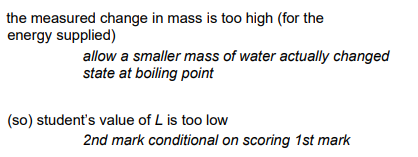
Explain how this affected the student's value for the specific latent heat of vaporisation of water. [2 marks]
The measured change in mass is too high for the energy supplied
So the student’s value of L is too low
![<ul><li><p>A student investigated how the temperature of a lump of ice varied as the ice was heated. </p></li><li><p>The student recorded the temperature until the ice melted and then the water produced boiled. </p></li><li><p>The figure shows the student’s results. </p></li><li><p>The power output of the heater was constant.</p></li><li><p>The specific heat capacity of ice is less than the specific heat capacity of water. </p></li></ul><p>Explain how the figure shows this. [2 marks]</p>](https://assets.knowt.com/user-attachments/bcc85dc0-65ce-4bd0-b4dd-4832486dfbfb.png)
A student investigated how the temperature of a lump of ice varied as the ice was heated.
The student recorded the temperature until the ice melted and then the water produced boiled.
The figure shows the student’s results.
The power output of the heater was constant.
The specific heat capacity of ice is less than the specific heat capacity of water.
Explain how the figure shows this. [2 marks]
The gradient for ice is steeper than the gradient for water
Which means that less energy is needed to increase the temperature by a fixed amount

![<ul><li><p>A student investigated how the temperature of a lump of ice varied as the ice was heated. </p></li><li><p>The student recorded the temperature until the ice melted and then the water produced boiled. </p></li><li><p>The figure shows the student’s results. </p></li><li><p>The power output of the heater was constant.</p></li><li><p>The specific latent heat of fusion of ice is less than the specific latent heat of vaporisation of water.</p></li></ul><p>Explain how the figure above shows this. [2 marks]</p>](https://assets.knowt.com/user-attachments/05548929-4ca4-4785-b279-bd090a73b6b5.png)
A student investigated how the temperature of a lump of ice varied as the ice was heated.
The student recorded the temperature until the ice melted and then the water produced boiled.
The figure shows the student’s results.
The power output of the heater was constant.
The specific latent heat of fusion of ice is less than the specific latent heat of vaporisation of water.
Explain how the figure above shows this. [2 marks]
Water took more time to vaporise than the ice took to melt
Which means that less energy is needed to change the state from solid to liquid than from liquid to vapour

![<ul><li><p>A student investigated how the temperature of a lump of ice varied as the ice was heated. </p></li><li><p>The student recorded the temperature until the ice melted and then the water produced boiled. </p></li><li><p>The figure shows the student’s results. </p></li><li><p>The power output of the heater was constant.</p></li><li><p>A second student did the same investigation and recorded the temperature until the water produced boiled. </p></li><li><p>In the second student’s investigation more thermal energy was transferred to the surroundings. </p></li></ul><p>Describe two ways the results of the experiment in the figure above would have been different. [2 marks]</p>](https://assets.knowt.com/user-attachments/a41edf4a-9a4b-45ee-b0ed-c871f3ddeaa6.png)
A student investigated how the temperature of a lump of ice varied as the ice was heated.
The student recorded the temperature until the ice melted and then the water produced boiled.
The figure shows the student’s results.
The power output of the heater was constant.
A second student did the same investigation and recorded the temperature until the water produced boiled.
In the second student’s investigation more thermal energy was transferred to the surroundings.
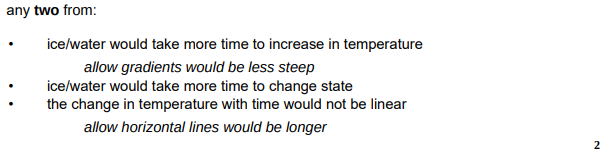
Describe two ways the results of the experiment in the figure above would have been different. [2 marks]
Ice/water would take more time to increase in temperature
Ice/water would take more time to change state
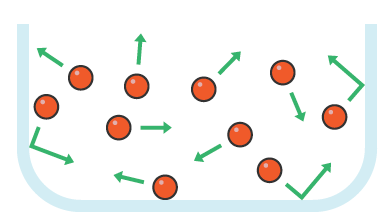
The molecules of a gas are in __________ _________ motion.
The ______________ of the gas is related to the average __________ energy of the molecules.
constant
random
temperature
kinetic
What does changing the temperature of a gas, held at constant volume do?
Changes the pressure exerted by the gas
As a gas gets hotter, what happens to the speed of the particles?
They move faster.
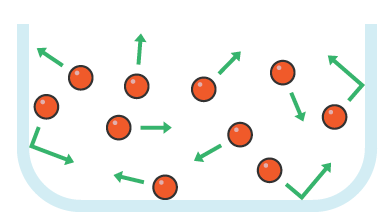
What is gas pressure caused by?
Moving particles continuously colliding with the walls of their container — they exert a force
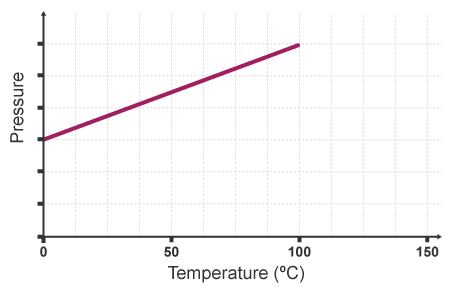
When you heat a gas (constant __________):
the particles gain _________ energy — move __________
They _________ with the container walls more frequently and with a greater _________ — results in a higher overall ______ __________
volume
kinetic
faster
collide
force
gas pressure
What can a gas be compressed or expanded by?
Pressure changes
A gas can be ____________ or ___________ by pressure changes.
The pressure produces a net force at _______ ________ (___________) to the wall of the gas container (or any surface).
compressed
expanded
right angles
perpendicular

When you increase the volume in which a gas is container (at constant temperature), what can it lead to?
Decrease in pressure
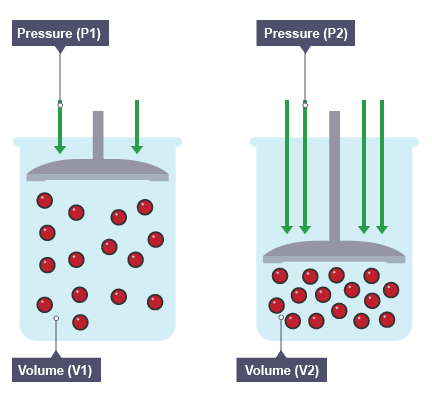
Explain how increasing the volume in which a gas is contained, at constant temperature, can lead to a decrease in pressure.
The gas particles spread out → more room to move
They have to travel further → hit walls of container less often
Fewer collisions = less overall force exerted on the walls → pressure decreases
![<ul><li><p>A student investigated how the pressure in a fixed mass of air varies with the volume of the air.</p></li><li><p><strong>Figure 1</strong> shows the equipment used.</p></li><li><p>When the plunger was pushed slowly into the syringe, the pressure in the syringe increased. </p></li><li><p>The temperature of the air remained constant. </p></li></ul><p>Explain why the pressure increased. [3 marks]</p>](https://assets.knowt.com/user-attachments/53639348-e9ac-4ae2-b9b1-1b483456bd20.png)
A student investigated how the pressure in a fixed mass of air varies with the volume of the air.
Figure 1 shows the equipment used.
When the plunger was pushed slowly into the syringe, the pressure in the syringe increased.
The temperature of the air remained constant.
Explain why the pressure increased. [3 marks]
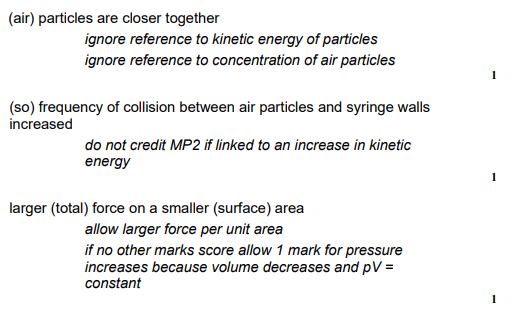
Air particles are closer together
So frequency of collisions between air particles and syringe walls increased
Larger total force on a smaller surface area
![<ul><li><p>A fire piston is a special type of syringe that can be used to start fires. </p></li><li><p><strong>Figure 2</strong> shows a fire piston.</p></li></ul><ul><li><p>The plunger is pushed quickly downwards and compresses the air. </p></li><li><p>When the air is compressed quickly, the temperature of the air increases.</p></li></ul><p>How does an increase in temperature affect the air particles inside the piston? [1 mark]</p>](https://assets.knowt.com/user-attachments/006a2366-0b46-4f6a-ada1-e62b812229e8.png)
A fire piston is a special type of syringe that can be used to start fires.
Figure 2 shows a fire piston.
The plunger is pushed quickly downwards and compresses the air.
When the air is compressed quickly, the temperature of the air increases.
How does an increase in temperature affect the air particles inside the piston? [1 mark]
The mean kinetic energy of the particles increases.
![<ul><li><p>The image shows air being pumped into a car tyre.</p></li></ul><p>Complete the sentence. [1 mark]</p><p>Air particles in the tyre move quickly in ___________________ directions.</p>](https://assets.knowt.com/user-attachments/106f8961-cff1-435f-9c43-68d8e873dca2.png)
The image shows air being pumped into a car tyre.
Complete the sentence. [1 mark]
Air particles in the tyre move quickly in ___________________ directions.
random
![<ul><li><p>The image shows air being pumped into a car tyre.</p></li><li><p>When the tyre is at the correct pressure, pumping more air into the tyre causes the pressure to increase further. </p></li><li><p>The volume and temperature of the air in the tyre do not change. </p></li></ul><p>Explain why the pressure increases as more air is pumped into the tyre. [2 marks]</p>](https://assets.knowt.com/user-attachments/0b6c5f1b-a490-463a-879d-e01ea4f3cf16.png)
The image shows air being pumped into a car tyre.
When the tyre is at the correct pressure, pumping more air into the tyre causes the pressure to increase further.
The volume and temperature of the air in the tyre do not change.
Explain why the pressure increases as more air is pumped into the tyre. [2 marks]
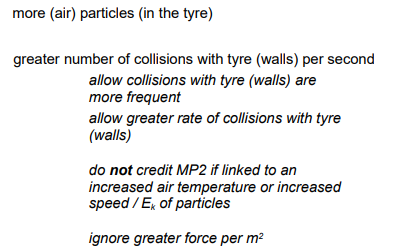
More air particles in the tyre
Collisions with tyre walls are more frequent
![<ul><li><p>The image shows air being pumped into a car tyre.</p></li><li><p>The air pressure in a car tyre changes if the temperature of the air in the tyre increases.</p></li></ul><p>Explain why. [4 marks]</p>](https://assets.knowt.com/user-attachments/9df282fe-ffc2-46b7-9487-8df3cf517da6.png)
The image shows air being pumped into a car tyre.
The air pressure in a car tyre changes if the temperature of the air in the tyre increases.
Explain why. [4 marks]
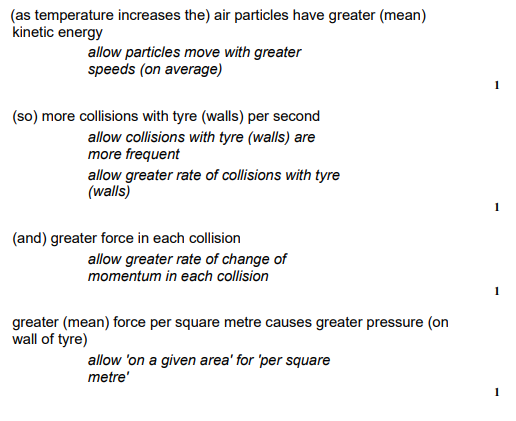
As the temperature increases — particles have a greater mean kinetic energy
Collisions with tyre walls are more frequent
Each collision has a greater force
Greater mean force per square metre causes greater pressure
What is the equation for a fixed mass of gas held at a constant temperature? State the units.
pressure × volume = constant
pV=constant
pressure — pascals (Pa)
volume — metres cubed (m³)
What is ‘work’?
The transfer of energy by a force.
What is the effect on a gas of doing work on a gas? (2)
Increases internal energy
Can cause an Increase in temperature
![<ul><li><p><strong>Figure 3</strong> shows a person using a bicycle pump to inflate a tyre.</p></li><li><p>The internal energy of the air increases as the tyre is inflated.</p></li></ul><p>Explain why. [2 marks]</p>](https://assets.knowt.com/user-attachments/312e76d3-21ab-456f-855e-e0283f9a9561.png)
Figure 3 shows a person using a bicycle pump to inflate a tyre.
The internal energy of the air increases as the tyre is inflated.
Explain why. [2 marks]
A temperature increase would increase the pressure in the tube.
Because higher temperature means higher kinetic energy of particles.
What is the equation for pressure? State the units.
pressure = force ÷ area
P=AF
pressure — pascals (Pa) or newtons per metre squared (N/m²)
force — newtons (N)
area — metres squared (m²)