Simple Interest and Compound Interest Flashcards
 Call Kai
 Learn
Learn Practice Test
 Spaced Repetition
 Match
Match Flashcards
 Knowt Play
1/20

Earn XP
Description and Tags
Vocabulary flashcards covering simple interest, compound interest, financial terminology, algebraic formulas, and calculator functions from Chapters 8 and 9.
Name | Mastery | Learn | Test | Matching | Spaced | Call with Kai | Chat |
|---|
No analytics yet
Send a link to your students to track their progress
21 Terms
Interest
The cost of borrowing money or the earnings gained from investing money.
Simple Interest
Interest used mainly for short-term loans or investments (typically a maximum term of 1 year), where interest is constant over the term and calculated only on the principal amount.
Compound Interest
Interest used for longer-term loans and investments, where both the principal and accumulated interest earn interest over time, causing the money to grow exponentially.
Simple Interest Formula
The algebraic formula I=prt, where I is simple interest earned in dollars, p is principal, r is interest rate per period, and t is time term.
Principal (p)
The original amount of money borrowed for a loan or invested.
Interest Rate (r)
The interest rate expressed in percent per unit of time (yearly, monthly, or daily) that corresponds with the time unit of the term.
Time Term (t)
The length of time of a loan or investment expressed in years, months, or days.
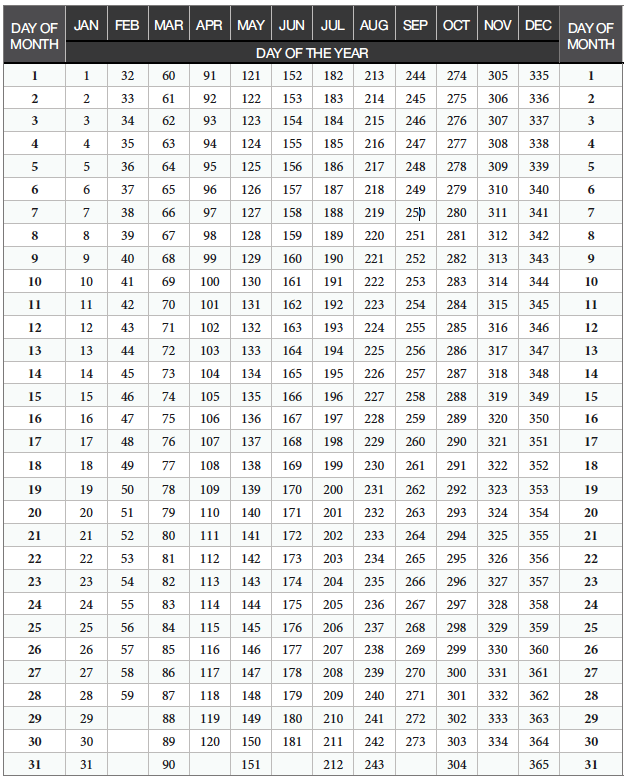
Day of the Year Table
A reference table providing the serial number (1 to 365) for each day of each month, used to determine the exact number of days between two dates within the same calendar year.
Compounding Period
The period of time between successive calculations of interest on a compound interest loan or investment.
Compounding Frequency (m)
The number of times interest is compounded in one year (e.g., annually m=1, semi-annually m=2, quarterly m=4, monthly m=12, daily m=365).
Nominal Interest Rate (j)
The quoted or stated annual interest rate on which compound interest calculations are based for a given compounding period.
Periodic Interest Rate (i)
The interest rate for a single compounding period, given by the formula i=mj.
Total Number of Compounding Periods (n)
The total count of compounding periods over the entire term t, calculated as n=m×t.
Future Value Formula (Compound Interest)
The formula FV=PV(1+i)n, used to calculate the future accumulated value of investments and loans.
Present Value Formula (Compound Interest)
The formula PV=(1+i)nFV or PV=FV(1+i)−n, used to find the initial discounted value of a future payment stream.
Amount of Compound Interest (I)
The total interest accumulated under compounding, calculated as the difference between Future Value and Present Value: I=FV−PV.
Cash Inflow
Money received in a transaction, entered into a financial calculator as a positive (+) value.
Cash Outflow
Money paid out in a transaction, entered into a financial calculator as a negative (−) value.
Cash-Flow Sign Convention
The standard calculator entry rule where an investment has PV as Outflow (−) and FV as Inflow (+), while a loan has PV as Inflow (+) and FV as Outflow (−).

TVM Row Keys (BA II Plus Calculator)
The 3rd row keys on the financial calculator used for time value of money calculations: N (compounding periods), I/Y (nominal rate per year), PV (present value), PMT (periodic annuity payment), and FV (future value).

Simple Interest vs. Compound Interest
A comparison showing that simple interest applies to short periods (<1 year), remains constant, earns interest on principal only, and grows linearly, whereas compound interest applies to longer terms, grows over time, earns interest on principal and interest, and grows exponentially.
