Economics chapter 3
 Call Kai
 Learn
Learn Practice Test
 Spaced Repetition
 Match
Match Flashcards
 Knowt Play
1/38

Earn XP
Description and Tags
Circular flow diagram, demand + quantity demanded, supply + supply demanded, market outcomes +market mechanism, market change, price controls, efficency+surplus
Name | Mastery | Learn | Test | Matching | Spaced | Call with Kai | Chat |
|---|
No analytics yet
Send a link to your students to track their progress
39 Terms
Who are the direct participants of a market?
Individuals/household: maximize utility they can get from available income
Businesses/firms: maximize profits by selling goods that satisfy while keeping costs low
Who are the indirect participants of a market?
Government: maximize general welfare through policies
Market outcome
Examining levels of quantity and prices
Market demand
concept that explains consumption behavior in a market
Law of Demand
Quantity demanded of a good is negatively related to the market price of a good, ceteris paribus (means a direct relationship)
Quantity demanded (Qd)
Specific quantity that consumers are able and willing to buy at a specific market price, P (SPECIFIC PRICE)
Demand (D)
Set of all quantities of a good consumers are able and willing to buy at alternative prices in a given time period, ceteris paribus (RANGE OF PRICES)
Change in quantity demanded results in:
Buyer behavior does not change due to price change. movement along the demand curve, just goin up/down curve
Change in demand results in:
Shift of the demand curve: buyer behavior changes. Curve going left if price decreasing or right if increasing in price
Determinants of demand
Change in household income
Changing tastes/preferences
Change in population
Prices of related goods and services
Complements and substitutes
Changes in expectations about the future (big decision making)
Market supply:
concept used to describe production behavior in a market
Law of Supply
Direct (or opposite) relationship between price (P) and quantity supplied (Qs), ceteris paribus
Supply
Set of all quantities of a good producers are able and willing to sell at alternative prices in a given time period, ceteris paribus
What is quantity supplied (Qs)
Specific quantity that producers are able and willing to sell at a specific market price (P)
What happens in change in quantity supplied?
Due to price change, it’s movement along curve
Shift in supply
Moves left/right, a change in supply
What are the determinants of supply?
Change in the cost of inputs (increasing costs=less supply)
Availability and quality of inputs
weather and natural conditions
government policies
available technology (advanced tech=more productivity=more supply)
What are inputs
factors of production like labor, materials, etc
Equilibrium
A single market price where demand and supply meet
Surplus
Excess supply, quantity demanded exceeding supplied, above equilibrium
Shortage
Excess demand, below equilibrium
Why do markets reach equilibrium?
Buyers act on their demand behavior (according to law of demand)
Sellers act on their supply behavior (according to law of supply)
Market mechanism leads market to equilibrium
We strive for equilibrium because…
it stable
What are the steps to model changes?
Model initial market BEFORE any changes occur (assume equilibrium)
Identify what side of market is changing and why
Is the change a decrease or increase (left or right)
How will market mechanism restore equilibrium
What are price controls?
Government mandated market price
What is a price floor?
Mandated minimum price limit
What is a price ceiling?
Mandated maximum price limit
What does it mean if a price control is binding?
Market mechanism is blocked and market can’t reach equilibrium
What does it mean if a price control is non-binding?
No effect on market mechanism and equilibrium
Economic effeciency
The economic system achieving maximum benefits and gains from trade as possible (equilibrium is a signal of this)
Surplus (or welfare)
Additional benefit for firms and consumers participating in market transactions
Consumer surplus
Difference between what a consumer is willing to pay and market price

Producer surplus
Difference between market price and what firm is willing to sell for (a signal of profit potential)
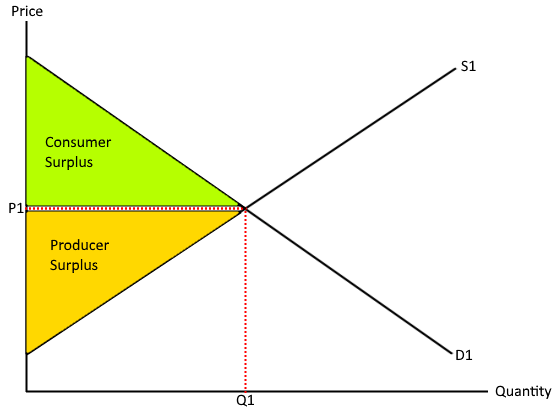
What is total welfare
“Sum of consumer and producer surplus”; how the efficiency of an economic system is determined; total welfare and efficiency are maximized
How does policy affect surplus/welfare?
As prices and quantity change, surplus may be transferred or lost (this depends on the policy innacted)
What is dead weight loss?
Total welfare that once existed but was lost due to changes
How can we tell who benefits from a policy?
Who gains/loses surplus(welfare)
Who does the price ceiling benefit and how can we measure?
Consumer surplus, is consumer surplus more than producer
Who does the price floor benefit and how can we measure?
Producer surplus, is producer surplus more than consumer