fish reproduction - 19.11.24
 Studied by 0 people
 Call Kai
 Learn
Learn Practice Test
 Spaced Repetition
 Match
Match Flashcards
 Knowt Play
1/92

There's no tags or description
Looks like no tags are added yet.
Name | Mastery | Learn | Test | Matching | Spaced |
|---|
No study sessions yet.
93 Terms
Life history
Organism's reproductive activities throughout its lifetime.
Adaptive plasticity
Ability to change traits for reproductive success.
Anthropogenic pressures
Human impacts affecting fish life histories.
Life history traits
Characteristics influencing reproductive success and behavior.
r-strategists
Species with high reproduction rates, low parental care.
K-strategists
Species with lower reproduction rates, high parental care.
Free spawning
Releasing eggs and sperm into the environment.
Egg defense
Protecting eggs from predators and environmental hazards.
Planktonic larvae
Larvae that drift in water currents.
Vivipary
Live birth instead of laying eggs.
Parental care
Investment in offspring survival post-birth.
Migration
Seasonal movement for breeding or feeding.
Sequential hermaphroditism
Changing sex during an organism's life cycle.
Endocrine disruption
Chemical interference affecting hormonal functions.
Feminization of fish
Male fish developing female characteristics.
Anadromous
Fish migrating from freshwater to marine for feeding.
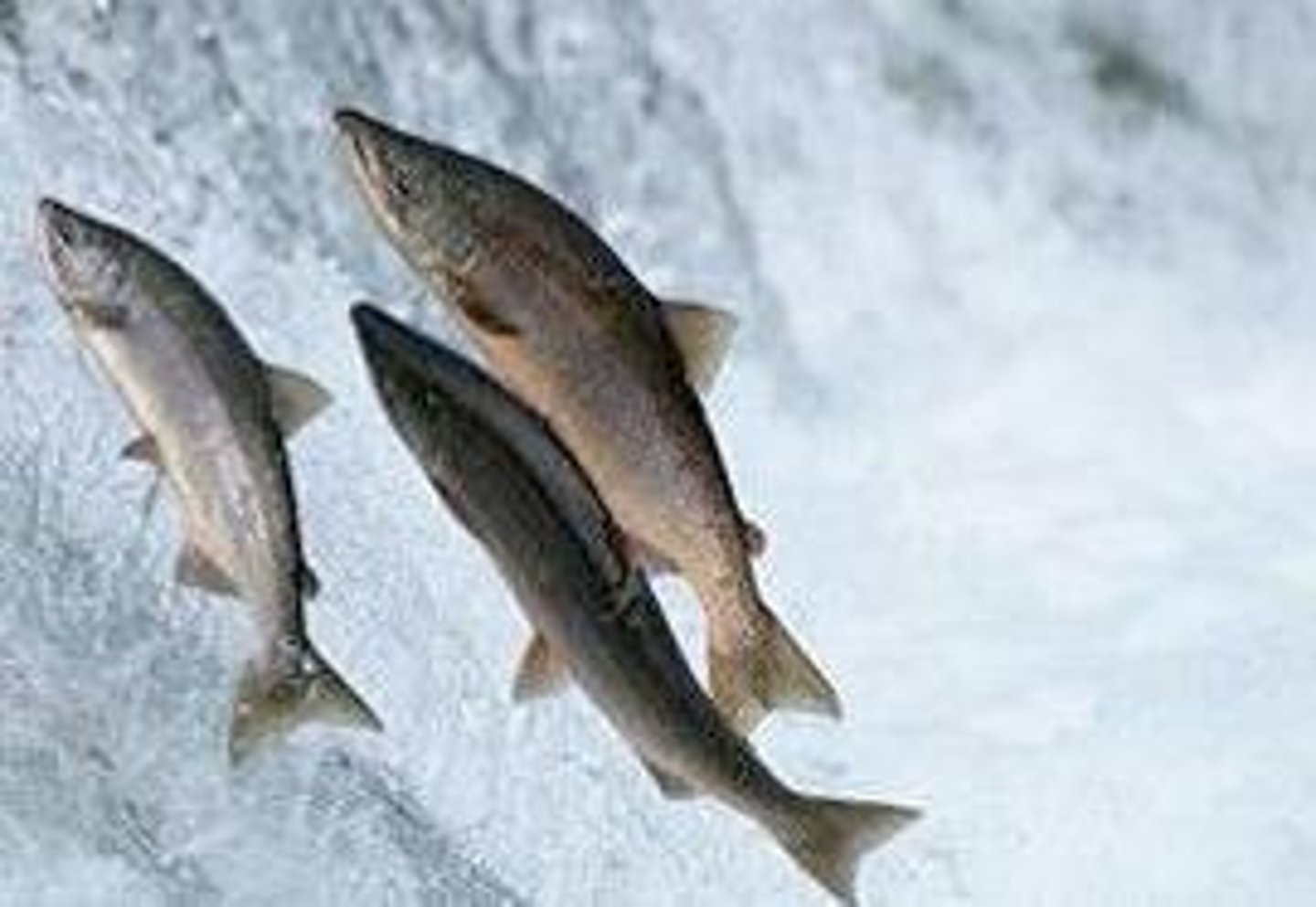
Salmonid
Family of fish including salmon and trout.
Spawning adults
Mature fish reproducing in their native habitat.
Alevins
Newly hatched fish still dependent on yolk.
Smolt
Young salmon transitioning from freshwater to saltwater.
Fry
Young fish that have absorbed their yolk sac.
Parr
Juvenile salmonids in freshwater before smolt stage.
Semelparous
Species that reproduce only once before dying.
Reproductive investment
Energy and resources allocated to offspring production.
Variable migratory behavior
Different migration patterns among salmon populations.
MSW fish
Mature salmon that migrate to sea for feeding.
Atlantic salmon migrations
Movement patterns during life cycle stages.
Eurasian one sea winter fish
Salmon that spend one winter at sea.
Land-locked populations
Salmon populations that do not migrate.
Smoltification
Process of juvenile salmon adapting to saltwater.
Redds
Nesting sites where salmon spawn in rivers.
External fertilization
Eggs fertilized outside female's body.
Precocious males
Males maturing early to compete for fertilization.
Gametes contribution
Precocious males contribute 40-50% of female eggs.
Natal homing
Salmon's ability to return to birthplace.
Survival rate
Only 700 adults return from 100,000 smolts.
Genetic drift
Random changes in allele frequencies in populations.
Microsatellites
Short tandem repeat units for genetic analysis.
Pedigree reconstruction
Determining lineage through genetic markers.
Effective population size (Ne)
Number of breeding individuals in a population.
Asyncronicity of breeding
Breeding occurring at different times among individuals.
Reproductive investment
Energy allocated to reproduction by fish.
Macro-gametic sex
Sex with larger gametes, typically females.
Frequency dependent selection
Selection based on the frequency of traits.
Fishery pressure
Impact of fishing on fish populations.
Fishing mortality
Rate of fish deaths due to fishing activities.
Plasticity vs evolution
Debate on whether changes are adaptive or genetic.
Plasticity
Phenotypic response to environmental changes.
Earlier maturation
Response to reduced stock size from exploitation.
Compensatory growth
Increased growth rates due to resource relaxation.
Evolutionary advantage
Older spawners produce larger, more viable eggs.
Fishing impact
Targets larger fish, disrupting fitness advantages.
Natural selection
Favors early-maturing phenotypes despite lower fertility.
Genetic make-up
Influences maturation age and size in fish.
Fishery pressure
Long-term reduction needed for late-maturing recovery.
Reaction norm
Phenotypic expression pattern across environments.
Sexual maturity variance
Variation in size at maturity within populations.
LP50
Length for 50% probability of maturation.
Teleost populations
Exhibit phenotypic variation in life history.
Fishing mortality
Selection pressure affecting fish maturation traits.
Complex genetic trait
Maturation timing influenced by multiple genetic factors.
GWAS studies
Genetic analysis to understand maturation changes.
Sequential hermaphroditism
Change sex from male to female or vice versa.
Protandry
Starts as male, later becomes female.
Protogyny
Starts as female, later becomes male.
Simultaneous hermaphroditism
Possesses both male and female reproductive organs.
Size advantage model
Larger individuals have reproductive benefits.
Low density model
Simultaneous hermaphroditism in low population densities.
Anthropogenic gender modification
Human activities altering fish reproductive strategies.
Gonochorism
Fixed male or female reproductive roles.
Endocrine disrupting chemicals (EDC)
Chemicals affecting hormonal systems in organisms.
Estradiol (E2)
A potent estrogen hormone from human waste.
Estrone (E1)
A weaker estrogen hormone from human excreta.
17 alpha-ethinylestradiol (EE2)
Synthetic estrogen in contraceptive pills.
Feminization of male gonads
Development of female characteristics in male fish.
Intersex index
Measure of sexual differentiation in fish.
Nonintersex male fish
Males with normal testis and mature sperm.
Mildly intersex fish
Males with some oocytes among sperm.
Severely intersex fish
Males with predominance of oocytes.
Effective population size (Ne)
Estimated number of breeding individuals in a population.
Microsatellite loci
Short, repetitive DNA sequences used for genetic analysis.
Population structure
Distribution of genetic variation within a population.
Anthropogenic pressure
Human-induced stressors affecting ecosystems.
Long-term exposure effects
Prolonged contact leading to significant ecological changes.
Testicular feminization
Progressive change of male gonads towards female characteristics.
Self-sustaining populations
Populations that can maintain themselves despite challenges.
Extinction risk
Likelihood of a species disappearing from its habitat.
Flathead minnow (Pimephales promelas)
Fish species affected by synthetic estrogen exposure.
Life history strategies
Reproductive strategies influencing survival and reproduction.
Age at maturity
Age when fish can reproduce.
Gender plasticity
Ability of fish to change sex in response to environment.
Feminization impact on genetic diversity
Reduced male breeding leads to lower genetic variation.
Conservation genomics
Study of genetic diversity for species preservation.