Econ 200 Exam 1 UNL With 100% accuracte solutions + rationales
 Call Kai
 Learn
Learn Practice Test
 Spaced Repetition
 Match
Match Flashcards
1/72

There's no tags or description
Looks like no tags are added yet.
Name | Mastery | Learn | Test | Matching | Spaced | Call with Kai | Chat |
|---|
No analytics yet
Send a link to your students to track their progress
73 Terms
Microecnomics
the study of the economy at the small-scale level, examning individuals and specific markets
Macroeconomics
the study of the economy at the large-scale level, examining total output, price level, and aggregates measures
resource
any item that is used to produce goods and services
land
all natural resources used in production
labor
all physical and mental activity devoted to producing goods and services
capital
the tools, machinery, infrastructure, and knowledge used to produce goods and services
entrepreneurial ability
the talent or ability to combine land, labor, and capital to produce goods or services
scarcity
inability of limited resources to satisfy unlimited wants
importance of scarcity in economics
scarcity of goods plays a significant role in affecting competition in any price-based market. Because scarce goods are typically subject to greater demand, they often command higher prices as well
opportunity cost
the value of the opportunity that you gave up when you chose an alternative
marginal benefit
maximum amount a consumer is willing to pay for an additional good or service or the additional satisfaction that consumer receives when the additional good or service is purchased
marginal cost
the change in cost that comes from making more of something
marginal decision making
The process of making choices in increments by evaluating the additional, or marginal, benefit against the additional, or marginal, cost of an action.
optimization
maximize overall benefit; marginal benefit > or equal to marginal cost
prodution possibilities frontier (PPF)
a graph that shows the possible combinations of two different goods/services that can be produced with fixed resources
comparitive advantage
the ability to produce a good at a lower opportunity cost than another producer
If in the time it takes you to iron one shirt, you could wash 10 dishes, but in the time it takes your roommate to iron one shirt, she could wash 20 dishes, who has the comparative advantage?
you because you only give up 10 dishes while she gives up 20
circular flow model
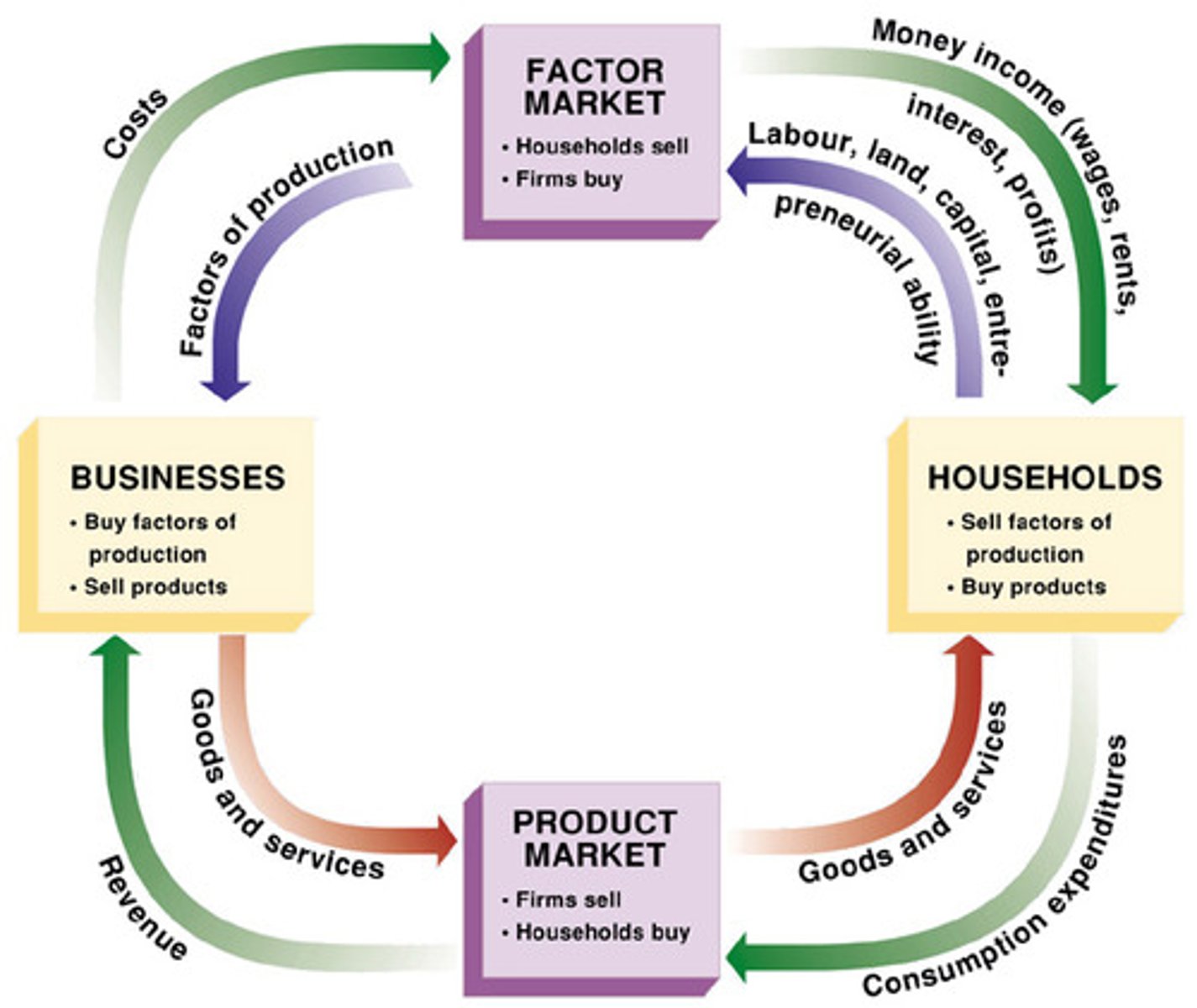
market vs command system
Market economies utilize private ownership of the means of production and voluntary exchanges/contracts. In a command economy, governments own the factors of production such as land, capital, and resources.
prices and quantities traded are determined by
the interaction of buyers and seller in a market
as the price of a good increases, quantity demanded...
decreases (law of demand)
demand curve
a graph of the relationship between the price of a good and the quantity demanded
demand curves are downward sloping due to
income effect, substitution effect, and diminishing marginal utility
income effect
the effect that a change in price of a good has on the purchasing power of income
substitution effect
the effect that a change in the price of one good has on the demand for another (price of coke goes up, demand for pepsi goes up)
diminishing marginal utility
commodities become less valuable as more of them are acquired
a change in demand vs. a change in the quantity demanded.
A change in demand means that the entire demand curve shifts either left or right. A change in quantity demanded refers to a movement along the demand curve, which is caused only by a chance in price
as the price of a good increases, quantity supplied...
increases (law of supply)
supply curve
a graph of the relationship between the price of a good and the quantity supplied
Factors that shift supply
taxes and subsidies placed on businesses, resource costs, and technological changes
a change in supply vs. a change in quantity supplied
a change in supply is a shift of the entire supply curve in response to something besides price;
a change in quantity supplied is a movement along the supply curve in response to a change in price.
equilibrium price
the price at which the quantity supplied equals the quantity demanded
equilibrium quantity
the quantity at which the quantity supplied equals the quantity demanded
shortage
quantity demanded is greater than quantity supplied
surplus
quantity supplied is greater than quantity demanded
increase in supply (rightward shift of supply curve) causes equilibrium price to...
fall
increase in demand causes the equilibrium price to...
rise
A decrease in demand and an increase in supply causes equilibrium price to...
fall
An increase in demand and a decrease in supply will cause equilibrium price to...
rise
price ceiling
a maximum price a which a good can be sold
does a price ceiling above or below equilibrium price affect the market (binding)
below
price floor
a minimum legal price at which a good can be sold (ex: minimum wage)
does a price floor above or below equilibrium price affect the market (binding)
above
elasticity
a measure of how responsive one variable is to a change in another variable
price elasticity of demand
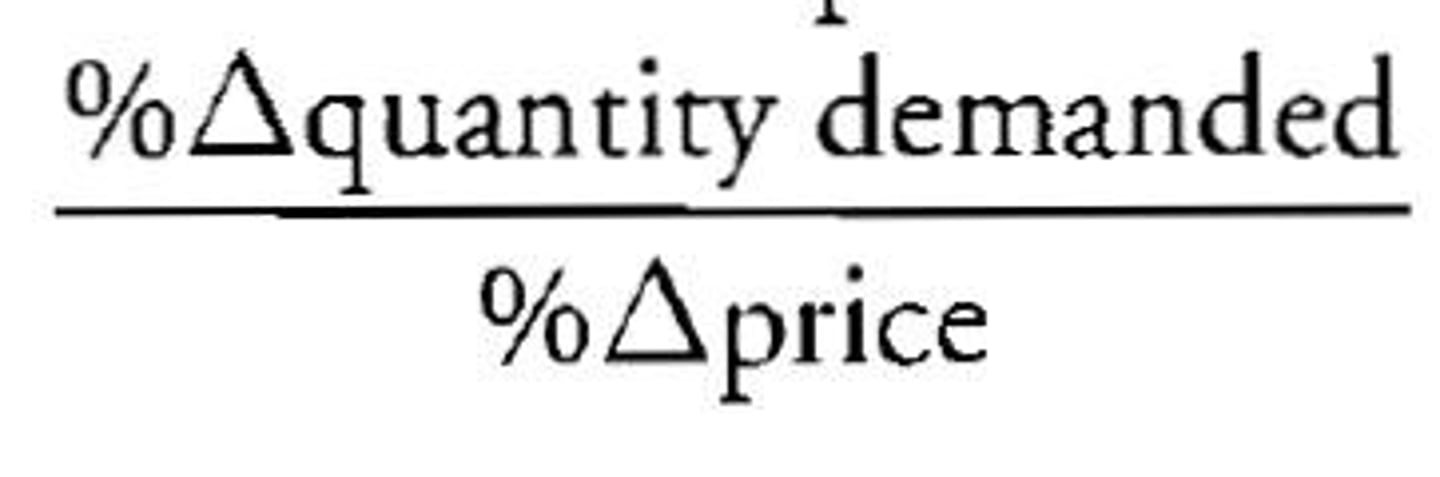
A measure of how responsive demand for a product is to changes in price
price elasticity of demand equation
E > 1
elastic
E < 1
inelastic
E = 1
unit elastic
why does the elasticity of demand change along a linear demand curve?
the linear demand curve uses changes in price and quantity while elasticity uses percentage changes in price and quantity
total revenue
Price x Quantity
if demand is elastic, an increase in price will ___________ total revenue
decrease
if demand is inelastic, an increase in price will ___________ total revenue
increase
Goods with substitutes have _______ demand
Elastic - Goods with close substitutes tend to have more elastic demand because it is easier for consumers to switch from that good to others
goods that are viewed as luxuries have _______ demand
elastic
Describe the relationship between private and social benefits and costs.
Social costs take into account private costs and externalities that come as a result of a given economic decision
private marginal cost
the cost to the producer of an additional unit of a good or service
private marginal benefit
the benefit to the consumer of an additional unit of a good or service
external marginal cost
the cost of an additional unit of a good or service that is imposed on people other than the producer
external marginal benefit
the benefit of an additional unit of a good or service that is enjoyed by people other than the direct consumer of the good or service
positive externality
a benefit that is enjoyed by a third-party as a result of an economic transaction
negative externality
the harm, cost, or inconvenience suffered by a third party as a result of an economic transaction
rival
consumption of a good by on person reduces the quantity available for consumption by others
excludable
people can be prevented from consuming a good
private good
rival and excludable
public good
nonrival and nonexcludable
free rider problem
when a good is nonexcludable, people will choose to consume the good without paying for it (ex: firework show)
marginal benefit of preventing pollution
reduction in health expenditures and increased quality of life
marginal cost of preventing pollution
opportunity cost of money used because it could be used to fund education, homelessness, national defense, etc.
optimal level of pollution
marginal benefit and marginal cost are equal
property rights
the exclusive right to determine how a resource is used
market failure
a situation in which the market fails to produce the efficient level of output
poorly defined property rights causes
market failure because there is no solution that meets the needs of all parties involved