M3 - Membrane Bioenergetics and Electron Transport
 Call Kai
 Learn
Learn Practice Test
 Spaced Repetition
 Match
Match Flashcards
 Knowt Play
1/87

There's no tags or description
Looks like no tags are added yet.
Name | Mastery | Learn | Test | Matching | Spaced | Call with Kai | Chat |
|---|
No analytics yet
Send a link to your students to track their progress
88 Terms
Membrane Bioenergetics
How E is stored and used for biological purposes
Ways to Make ATP
1 Substrate Lvl phosphorylation
2 Oxidative Phosphorylation
Substrate Level phosphorylation
METABOLISM of high energy molecules in cytosol are COUPLED to transfer Pi to ADP to make ATP

Oxidative Phosphorylation
LIGHT or CHEMICAL energy are converted to electrochemical gradients in membrane that are COUPPLED to transfer Pi to ADP with ATP synthase.

Chemiosmotic Theory
Theory that electrochemical gradient can be FORMED BY ENZYMES on a membrane to do biological work

Electrochemical Gradient
Sodium or proton motive force --> Δp (or ΔμH+)

Membrane Associated enzymes
Enzymes that form chemical gradient at exposure to chemical or light energy
Δp = Δψ - 60ΔpH
Equation that represents the potential of a membrane to do work.
Δp
proton motive force (what's used to do work)
-> the more negative, the greater the potential to do work
Δψ
Membrane potential
Δψ= - 60 log [X+ in]/[X+ out]
Membrane potential equation
ΔpH
pH Gradient
ΔpH = pH in - pH out
pH Gradient equation
Steps in electrochemical gradient
1 membrane potential develops ( Δψ)
2 pH Gradient (ΔpH) develops
3 As pH Gradient (ΔpH) develops, positive ions pass through membrane
4 Membrane potential (Δψ) develops as e- pass across membrane

Ways to use electrochemical gradient to do work (4)
1 Antiport
2 ATP synthase
3 Flagellum Rotation
4 Solute uptake (simport)

antiport
Uses electrochemical gradient to transport one type of substance into cell while transporting out another type of substance (substances of same charge)

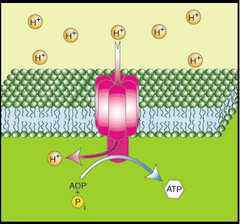
ATP synthase
Uses electrochemical gradient to turn/use this membrane bound protein to add Pi to ADP+

Solute uptake
Uses electrochemical gradient to uptake solutes into the cell.
EX: symport

Symport
Uses electrochemical gradient to transport two substances in the same direction across the membrane.

Reverse Electron Transport
Uses electrochemical gradient to do generate NADP. Causes e- to move backwards through gradient
-High concentrations of H+ or Na+ required to offset make E0 negative enough to move e-
-endergonic
-heavily reduced Q
-common in chemolithotrophs

ATP Synthase domains
F0 and F1 domains

F0 domain
Domain that harbors proton channel that spans the cell membrane
F1 domain
Domain that is on the inner membrane and harbors active site. Drives ATP synthesis with Δp or uses ATP hydrolysis to generate Δp
Types of ATP synthase
F1F0
A1A0
A1A0
F1F0 ATP synthase
Most common type of ATP synthase. Common in B, mitochondria, chloroplasts, some A. Is reversable and uses H+ (Na+ in anaerobic B)
V1V0 ATP synthase
ATP synthase found in vacuoles. NOT reversable (only ATP hydrolysis = ATPase). Uses H+ as e- acceptor (N+ in anaerobic B)
A1A0 ATP synthase
ATP synthase used in many A and some B. is reversable and uses Na+ and H+ as e- acceptors (H+ in methanogens).
-differs in structure; central stalk has 2 peripheral stalks
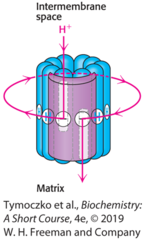
ATP synthase C-Subunit (F0 domain*)
Subunits in ATP synthase that are the part that rotates and binds H+. # ATP produced/stoichiometry varies with organism
-For every 360 rotation, produces 3 ATP in Yeast
-Large C likely selected for in phototrophs
Chemical Mechanisms to generating Electrochemical Gradients
1 ATP synthase
2 respiration
3 Methyl Transfer
4 Decarboxylation
5 End-Product Efflux
Light Mechanisms to generating Electrochemical Gradients
1 Photosynthesis
2 Photocycle
Photosynthesis
Oxidation of chlorophyl in reaction center generates Electrochemical Gradient

Photocycle
Conformational change of rhodopsin with membrane bound enzymes generates Electrochemical Gradient

ATP Hydrolysis
Common in organisms under fermentation conditions. ATP is converted to ADP & phosphate energized myosin heads (removal of phosphate) need energy.
-> substrate lvl phosphorylation dominates metabolism
-> how aerobes usually generate ATP***
Rhodopsin-Based Phototrophy and Photocycle
Predominant in ocean/aquatic/high saline envo
-> light-driven H+ pump generates Electrochemical Gradient
Chromophore (retinal)
light-sensitive group that captures light photons for photocycle.
-Forms schiff's base with lysine of rhodopsin
-Retinal covalently bonds
-Undergoes Cis -> Trans change w/ light
-transports H+ across cell to generate gradient

Methyltransferase
Enzyme common in methanogens and homoacetogens. Used in Wood-Ljngdahl pathway to generate Electrochemical Gradient
Decarboxylation
Uses CO2 to generate electrochemical gradient. 2 types
1 Membrane Bound
2 Soluble (Membrane Bound Antiporter)

Membrane bound decarboxylation
Decarboxylation common in Lactic Acid Bacteria and Enterobacter and w/ inside-out vesicles
1 decarboxylate generates ΔμNa+
2 ΔμNa+ converted to PMF with antiporter
3 ΔμNa+ syth ATP (w/ ATP synthase ofc)
4 ΔμNa+/H+ solute uptake w/ symport
Soluble Decarboxylation (Membrane-Bound Antiporter)
Decarboxylation of acid and H+ to monocarboxylic acid and CO2. Consumes [H+] in cell and antiporter reduces (-) charge out of cell
Oxalobacter formigenes
Organism that converts oxalate to formate with HP+ gradient (3 molc oxalate consumed per ATP synthesized)
End Product Flux
Concentration of organic metabolic end products can DRIVE SYMPORT w/ H+/Na+ & formation of electrochemical gradient
Respiratory Chains
Respiration uses membrane bound enzymes to cat RedOx RXNs and coupling with Na+/H+ to generate electrochemical gradient
terminal e- acceptors
anaerobes -> non-O2
aerobes -> O2
redox potential (E0)
Tendency of systems to couple to accept and donate e-. Determined by mixing equimolar ratios of two couples (Aox/Ared & Box/Bred).
-More positive = more potential
Steps in Respiration
1 Membrane bound enzymes cat RedOx RXN
2 Redox RXNs alternate between H+ and e- carriers
3 redox potential (E0) of the primary e- donor is < terminal e- acceptor
PMF of Neutrophiles
(live in pH 7-8.5). Anaerobic respiration doesn't involve reparatory chain, 3* ATP is used to maintain gradient
PMF of Acidophiles
(pH 1-4). Δψ is inverted so ATP must be hydrolyzed to counter negative charge on inside* of membrane. Work hard to maintain basic internal environment (is super favorable e- gradient)
PMF of Alkalophiles
(pH NOT favorable). So, Δψ is even more important. Na+ dependent for growth --> Na+/H+ antiporter needed to bring H+ inside cell to maintain neutral cytosol
PMF uncoupled at pH< pKa of acid
WEAK acids mess up cells bc their pKA is lowkey between the environmental pH and the pH in the cell, meaning they can diffuse across cell membranes and mess stuff up
H+ Carriers
Flavins and Quinones
e- Carriers
Fe-S clusters, cytochromes
Flavin bound proteins
Proteins that bind FLAVIN groups (FMN, FAD) derived from riboflavin (V B12). are COENZYMES that carry 2H (2H & 2e-)
EX: NADH dehydrogenase, succinate dehydrogenase (SDH, complex II)
NADH dehydrogenase (Complex 1)
FAD
Flavin protein that is predominantly bound non-covalently to flavoproteins
Quinones
Molecules that SHUTTLE 2H between non-mobile enzyme complexes. Bind non-cov and differ in redox potential. V-K derived lipophilic 2H carriers with isoprene [6-10 units] side chains
Ex: ubiquinone (UQ, Q, CoQ), menaquinone (MQ, MK), plastoquinone (PQ)
Cytochromes
ONE e- carriers that bind to heme mostly non-cov
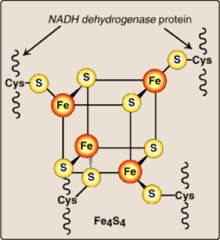
Fe-S Proteins
Made of non-heme Iron, Acid liable S2-, and are ligated protein by Cys side chain.
-E0 ranges from -400 to 350
Ex: Fe2S2, Fe4S4, Fe3S4
Mechanisms of H+ translocation (3,2)
1 H-Pump
2 Q-Loop
3 Q-Cycle
A Vectorial
B Scalar
Scalar
Type of H+ translocation where Q-loop is reduced on cytosolic side. QH2 travels w/in membrane and os oxidized on external face of membrane which releases H+
Vectorial
Type of H+ translocation where e- is transferred directly to coupled H+
H-Pump
Vectorial, 2H+/2e-, syt oxidase complex IV
-H+ translocation that has 2 distinct coupling sites
-NADH is oxidized and O2 is reduced to water
-2 pump sites that diffuse H+

Q-Loop
Scalar, 2H+/2e-, E. coli UQ: cyt c oxidoreductase complex III
-Loop that scalarly pumps H+ across membrane
-Q is reduced to QH2 which is then oxidized in a cycle
-Q redox pumps/couples H+ diffusion

Q-Cycle
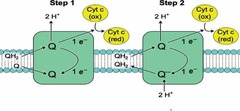
Vectorial, 4H+/2e-, mitochondrial bc I complex 3.
-At bc1 complex
-3 pp subunits with 2 UQ binding sites, cyt b, 2[Fe2-], 1 cyt
![<p>Vectorial, 4H+/2e-, mitochondrial bc I complex 3. </p><p>-At bc1 complex </p><p>-3 pp subunits with 2 UQ binding sites, cyt b, 2[Fe2-], 1 cyt</p>](https://assets.knowt.com/user-attachments/04a5320e-9337-48cb-9596-22bcc3578abd.jpg)
Q-Cycle Steps (7)
1 UQH2 oxidized when binds to bc1
2 UQ- releases e- when oxidized (e- to cyt oxidase, 2H diffuse out)
3 Fully oxidized to UQ (released e- goes to BL&SBS towards - inner membrane)
4 UQ reduced to UQ- with e-
5 Cycle resets (one full loop of the Q pools)
6 UQ generated with 2e- becomes UQ-2 (another H+ diffuses out and e- to cyt oxidase)
7 UQ-2 takes up 2H+ form inner membrane, regenerates UQH2 (resets process)

bc1 complex
Complex where Q-cycle takes place
P side -> 2UQH2 + 2 cyt c(ox) --> 2UQ + 2 cyt c(red) + 4H+(out)
N side -> UQ + 2e- + 2H+(in) --> UQH2
Total -> UQH2 + 2 cyt(ox) + 2H+(in) --> UQ + 2cyt(red) + 4H+(out)
*4H+ per 1 e- since 1 UQH2 regen (1 net UQH2 used)
"Classical" ETC
Process of ETC used in mitochondria and some B like paracoccus denitrificans
includes 4 complexes sites and 3 coupling sites
4 complexes of classical ETC
I - NADH dehydrogenase
II - Succinate dehydrogenase
III - Complex III or bc1 complex
IV - Complex IV or cyt c
Complex I
NADH dehydrogenase
Complex that uses NADH:UQ oxidoreductase to couple H+ diffusion with NADH reduction
-> 4H+/2e-
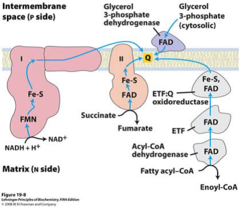
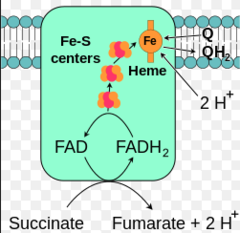
Complex II
succinate dehydrogenase
Complex that DOES NOT COUPLE
-Succinate:UQ oxidoreductase
-FAD cofactor and 3 Fe-S clusters in binding site
-Oxidizes succinate to fumarate
Complex III
bc1 complex (Q-cytochrome c oxidoreductase)
-Couples QU redox with cyt c oxidoreductase
-4H+/2e-
Complex IV
cytochrome c (aa3) oxidase
Oxides O2 to H2O
-2H+/2e-
Coupling Sites
Sites used to form electrochemical gradient vary among bacterial species and environmental condition
-Where H+ and e- transduction are linked
Total ATP per e- carrier
NADPH - 3 ATP
FAD - 2 ATP
ETC in Aerobes
Use O2 as terminal acceptor (use bd, bd-I, and bd-II oxidases depending on [O2])
ETC in Anaerobes
Use Terminal reductases (e.g., nitrate, nitrite, and DMSO, TMAO reductases)
Oxidases in AEROBES
bO3, bd-I, and bd-II
bo3 oxidase
Oxidase used in good [O2] environments. Has fastest and most efficient transfer of O2 (high Km)
bd-I and bd-II oxidase
Oxidase used in low [O2] environments. Has BEST affinity for O2 (low Km)
terminal reductase
Enzyme used in (facultative) anaerobic conditions instead of oxidase to reduce compounds other than oxygen
-> Nitrate, nitrite, DMSO, TMAO
H+/O
# H+ efflux per 2e- transferred to O2
H+/ATP
# H+ influx via ATP synthase to generate 1 ATP
(e.g., for 8 c-subunit complex = 8H+/3 ATP per turn ~ 3 H+/ATP ratio)
P/O
# ATP generated per 2e- transferred to O2
(H+/O divided by H+/ATP)
3 Coupling Sites in Mitochondria (same as classical ETC)
I -> NADH dehydrogenase (4H+/2e-)
III -> cytochrome bc1 complex (4H+/2e-)
IV -> cytochrome aa3 oxidase ( 2H+/2e-)
Respiratory chain and ATP synthase inhibitors
Retonone, HQNO (targets Q site), Antiymcin (targets Q site, cyanide (targets oxidase), oligomycin dicyclohexylcarbo-
diimide
Ionophores
Molecules that uncouple PMF
-cause ions to EQUILIBRATE across membrane
-collapses electrochemical gradient
-Inhibits oxphos (no ATP synth)
-STIMULATES Respiration in short term
EX: valinomycin, nisin, dinitrophenol
ATP Synthase inhibitors
Molecules that inhibit ETC through blocking H+ flow in F0 domain
-INCREASE electrochemical gradient
-Inhibits oxphos
-INHIBITS respiration
Microbial Fuel Cells
Harvest e- produced from e-chemical gradient with electrode. VERY EASY on seafloor w/ many electron rich reductants (e.g., Fe2+, H2S) w/ plenty of O2 as e- acceptor.
(EX Shewanella oneidensis nanowire & Rhodoferax on an
electrode)
ATP synthase Mutations
Mutations in F1 or F0 domains to enhance product formation in metabolic engineering.
(can edit so cells think they're low on ATP and produce an excess of products like NADP which can be harvested)