ASVAB Arithmetic Reasoning and Math Knowledge part 2
 Call Kai
 Learn
Learn Practice Test
 Spaced Repetition
 Match
Match Flashcards
 Knowt Play
1/43

There's no tags or description
Looks like no tags are added yet.
Name | Mastery | Learn | Test | Matching | Spaced | Call with Kai | Chat |
|---|
No analytics yet
Send a link to your students to track their progress
44 Terms
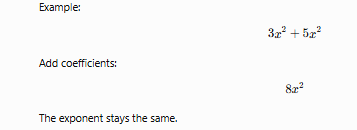
How do you add or subtract polynomials?
Only combine like terms.
Like terms must have:
Same variable
Same exponent
Memory Trick
"Same letters, same powers, combine the hours."
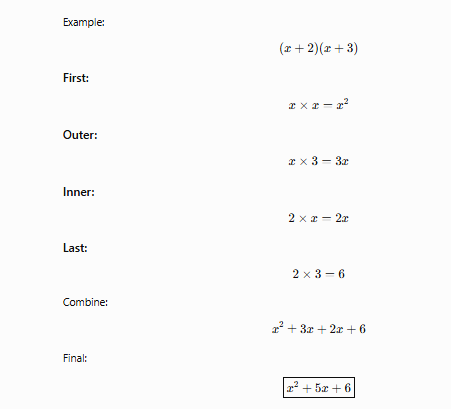
What is the FOIL method used for?
FOIL is a method used to multiply two binomials.
FOIL stands for:
F → First
O → Outer
I → Inner
L → Last
Memory Trick
"First Outer Inner Last."
How do you use FOIL?
How do you divide polynomials?
Arrange terms in descending order.
Divide the first term of the dividend by the first term of the divisor.
Multiply.
Subtract.
Repeat.
This is called polynomial long division.
Memory Trick
"Divide, multiply, subtract, bring down, repeat."
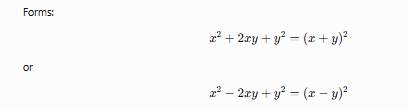
What is a perfect square trinomial?
a polynomial that comes from squaring a binomial.
Memory Trick
"First and last squares, middle is twice their pair."
Example of a perfect square trinomial?
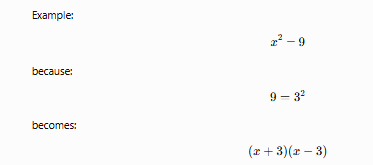
Formula for difference of two squares?

What is the difference of two squares?
Key Point
A subtraction between two perfect squares can always be factored.
Memory Trick
"Difference of squares splits into plus and minus pairs."
What is the formula for factoring the sum of two cubes?
Memory Trick
"Cube plus cube: same sign first, opposite middle."

What is the formula for factoring the difference of two cubes?
Memory Trick
"Cube minus cube: keep the first sign, flip the middle."

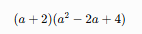
What is the sum of two cubes using the equation:
8 + a ^ 3
What is a perfect cube?
(POSITIVE FORMULA)

What is a perfect cube?
(NEGATIVE FORMULA)

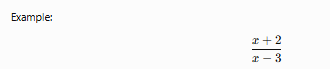
What are rational expressions?
A
Rule
The denominator cannot equal zero.
Memory Trick
"Rational expressions are polynomial fractions." fraction where both the numerator and denominator contain polynomials.
What is an example of a rational expression?
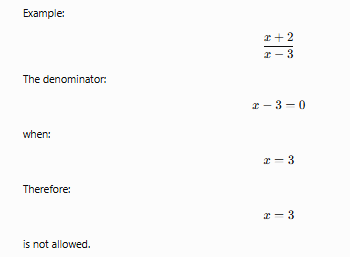
Why can the denominator of a rational expression not equal zero?
Division by zero is undefined.
Memory Trick
"Zero below means no-go."
How do you add and subtract rational expressions?
Find a common denominator.
Rewrite fractions using the common denominator.
Add or subtract numerators.
Keep denominator.
Memory Trick
"Same bottom, add the top."
How do you multiply rational expressions?
Factor each polynomial.
Cancel common factors.
Multiply remaining factors.
🔑 Important
Only cancel entire factors, not individual terms.
Memory Trick
"Factor, cancel, multiply."
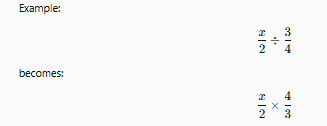
How do you divide rational expressions?
Flip the second fraction (take reciprocal).
Multiply.
Memory Trick
"Division means flip the second."
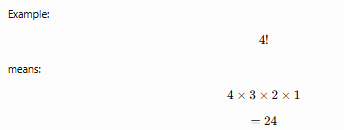
What is a factorial?
The product of all positive integers from a number down to 1.
What is the symbol for a factorial?
!
Example of a factorial equation
What is a line?
A collection of points that extends infinitely in both directions.
Key Points
Has length
Has no endpoint
Extends forever in opposite directions
What is a line segment?
A part of a line that has two definite endpoints.
Key Points
Has a beginning
Has an ending
Has a fixed length
What is a ray?
Part of a line that begins at one point and extends infinitely in one direction.
Key Points
Has one endpoint
Extends forever in one direction
What is the difference between a line, line segment, and ray?
Memory Trick
"Line = limitless, segment = stopped, ray = one way."
What are intersecting lines?
Lines that meet at exactly one point.
The crossing point is where both lines meet.
Memory Trick
"Intersect means they interact."
What are concurrent lines?
Three or more lines that intersect at the same point.
Multiple lines meet at one location.
Memory Trick
"Concurrent = come together."
What are parallel lines?
Lines in the same plane that:
Never intersect
Never meet
Stay the same distance apart
What are perpendicular lines?
Lines that intersect to form a 90° angle.
Key Point
They create a right angle.
Memory Trick
"Perpendicular = perfect corner."
What is a transversal?
A line that crosses two or more other lines.
Key Point
The crossed lines may or may not be parallel.
Memory Trick
"Transversal travels across."
Example:
────────
/
────────
What is a bisector?
A line or segment that divides another segment into two equal parts.
Example:
────────
|
|
🔑 Key Point
A bisector cuts something into equal halves.
Memory Trick
"Bisect means break in half."
What is a perpendicular bisector?
A perpendicular bisector divides a line segment into two equal parts while creating a 90° angle.
🔑 Key Point
Every point on the perpendicular bisector is the same distance from both endpoints.
Memory Trick
"Perpendicular bisector = equal halves at a perfect angle."
What is a plane?
A flat, two-dimensional surface that extends infinitely.
🔑 Key Points
Has length and width
No thickness
Contains infinite points and lines
Example:
A sheet of paper represents part of a plane.
Memory Trick
"Plane = flat forever."
What is an angle?
Formed when two lines, rays, or segments meet at a common point.
Symbol:
∠
What is a vertex?
The point where two rays, segments, or lines meet to form an angle.
Example:
∠ABC
Memory Trick
"Vertex = meeting point."
What are vertical angles?
Opposite angles formed when two lines intersect.
Memory Trick
"Vertical angles match when they face back."
What do vertical angles always have?
Equal measurements.
What is an acute angle?
An angle that measures:
<90∘
What is an obtuse angle?
An angle that measures:
90∘<x<180∘
What is a straight angle?
A straight angle measures:
180∘
What is a reflex angle?
A reflex angle measures:
180∘<x<360∘
What is a full angle?
A full angle measures:
360∘
What are supplementary angles?
Too angles whose measures add up to:
180∘