Lesson 1: Rule-based Expert Systems
 Call Kai
 Learn
Learn Practice Test
 Spaced Repetition
 Match
Match Flashcards
 Knowt Play
1/60

There's no tags or description
Looks like no tags are added yet.
Name | Mastery | Learn | Test | Matching | Spaced | Call with Kai | Chat |
|---|
No analytics yet
Send a link to your students to track their progress
61 Terms
1970s
In the ___, it was finally accepted that to make a machine solve an intellectual problem one had to know the solution.
Knowledge
One has to have ____, ‘know-how,’ in some specific domain.
Knowledge
a theoretical or practical understanding of a subject or a domain. It is also the sum of what is currently known, and apparently knowledge is power.
experts
Those who possess knowledge are called ____. They are the most powerful and important people in their organizations.
domain expert
Anyone can be considered a _____ if he or she has deep knowledge (of both facts and rules) and strong practical experience in a particular domain.
expert
In general, an ____ is a skillful person who can do things other people cannot.
rules
The human mental process is internal, and it is too complex to be represented as an algorithm. However, most experts are capable of expressing their knowledge in the form of ___ for problem solving.
production rules or just rules
These statements represented in the IF-THEN form are called ________.
IF-THEN
The term ‘rule’ in AI, which is the most commonly used type of knowledge representation, can be defined as an ____ structure that relates given information or facts in the IF part to some action in the THEN part.
rule
A ___ provides some description of how to solve a problem. ____ are relatively easy to create and understand.

IF = antecedent
THEN = consequent
Any rule consists of two parts: the IF part, called the ____ (premise or condition) and the THEN part called the ____ (conclusion or action).
In general, a rule can have multiple antecedents joined by the keywords AND (conjunction), OR (disjunction) or a combination of both.

The consequent of a rule can also have multiple clauses:

object, value
The antecedent of a rule incorporates two parts: an ___ (linguistic object) and its ____.

Expert systems can also use mathematical operators to define an object as numerical and assign it to the numerical value.

Rules can represent relations, recommendations, directives, strategies and heuristics (Durkin, 1994).
Relation
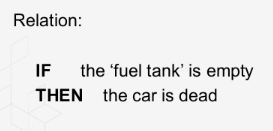
Rules can represent relations, recommendations, directives, strategies and heuristics (Durkin, 1994).
Recommendation

Rules can represent relations, recommendations, directives, strategies and heuristics (Durkin, 1994).
Directive
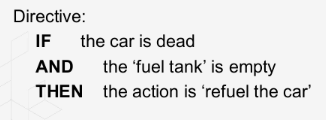
Rules can represent relations, recommendations, directives, strategies and heuristics (Durkin, 1994).
Strategy

Rules can represent relations, recommendations, directives, strategies and heuristics (Durkin, 1994).
Heuristic

rule-based expert system
A _____ has five components: the knowledge base, the database, the inference engine, the explanation facilities, and the user interface.

knowledge base
The ____ contains the domain knowledge useful for problem solving. In a rule-based expert system, the knowledge is represented as a set of rules. Each rule specifies a relation, recommendation, directive, strategy or heuristic and has the IF (condition) THEN (action) structure.
database
The ____ includes a set of facts used to match against the IF (condition) parts of rules stored in the knowledge base.
inference engine
The ____ carries out the reasoning whereby the expert system reaches a solution. It links the rules given in the knowledge base with the facts provided in the database.
explanation facilities
The _____ enable the user to ask the expert system how a particular conclusion is reached and why a specific fact is needed. An expert system must be able to explain its reasoning and justify its advice, analysis or conclusion.
user interface
The ____ is the means of communication between a user seeking a solution to the problem and an expert system. The communication should be as meaningful and friendly as possible.
These five components are essential for any rule-based expert system. They constitute its core, but there may be a few additional components.
External interface
Developer interface
Book-keeping facilities
Debugging aids
Runtime knowledge acquisition
external interface
The ____ allows an expert system to work with external data files and programs written in conventional programming languages such as C, Pascal, FORTRAN and Basic.
developer interface
The ____ usually includes knowledge base editors, debugging aids and input/output facilities.
Book-keeping facilities
monitor the changes made by the knowledge engineer or expert. If a rule is changed, the editor will automatically store the change date and the name of the person who made this change for later reference.
Debugging aids
usually consist of tracing facilities and break packages. Tracing provides a list of all rules fired during the program’s execution, and a break package makes it possible to tell the expert system in advance where to stop so that the knowledge engineer or the expert can examine the current values in the database.
Runtime knowledge acquisition
enables the running expert system to ask for needed information whenever this information is not available in the database. When the requested information is input by the knowledge engineer or the expert, the program resumes.
developer interface, and knowledge acquisition facilities
In general, the _____ and _____ in particular, are designed to enable a domain expert to input his or her knowledge directly in the expert system and thus to minimize the intervention of a knowledge engineer.
Fundamental Characteristics Of An Expert System
Accuracy
Speed
Explanation Capability
Symbolic Reasoning
An expert system is built to perform at a human expert level in a narrow, specialised domain. Thus, the most important characteristic of an expert system is its high-quality performance.
domain knowledge
In a rule-based expert system, the ____ is represented by a set of IF-THEN production rules and data is represented by a set of facts about the current situation.
inference engine
The ____ compares each rule stored in the knowledge base with facts contained in the database. When the IF (condition) part of the rule matches a fact, the rule is fired and its THEN (action) part is executed. The fired rule may change the set of facts by adding a new fact.
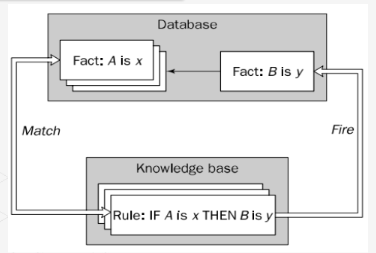
inference chains
The matching of the rule IF parts to the facts produces ____. It indicates how an expert system applies the rules to reach a conclusion.
inference engine
The ____ must decide when the rules have to be fired. There are two principal ways in which rules are executed. One is called forward chaining and the other backward chaining (Waterman and Hayes-Roth, 1978).
Forward chaining
____ is the data-driven reasoning. The reasoning starts from the known data and proceeds forward with that data. Each time only the topmost rule is executed. When fired, the rule adds a new fact in the database. Any rule can be executed only once. The match-fire cycle stops when no further rules can be fired.
Forward chaining
is a technique for gathering information and then inferring from it whatever can be inferred. However, in ____, many rules may be executed that have nothing to do with the established goal.
Forward Chaining
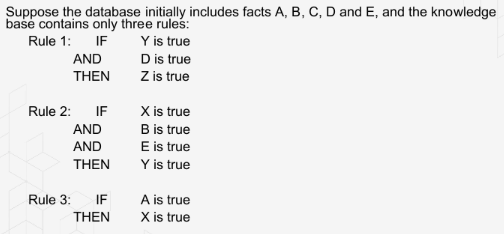
Forward Chaining
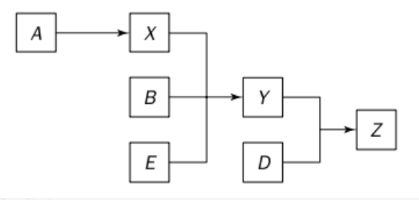
Foward Chaining
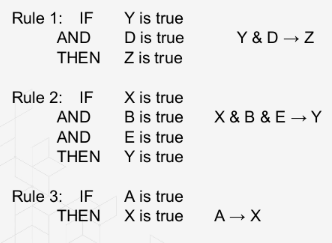
Forward Chaining

Forward Chaining

Forward Chaining
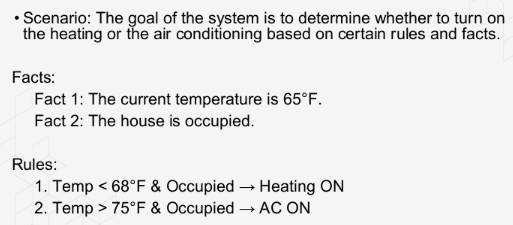
Forward Chaining

forward chaining
A rule-based expert system can have hundreds of rules, many of which might be fired to derive new facts that are valid, but unfortunately unrelated to the goal. Therefore, if our goal is to infer only one particular fact, the _____ inference technique would not be efficient.
backward chaining
is the goal-driven reasoning. In ____, an expert system has the goal (a hypothetical solution) and the inference engine attempts to find the evidence to prove it.
Backward Chaining
First, the knowledge base is searched to find rules that might have the desired solution. Such rules must have the goal in their THEN (action) parts. If such a rule is found and its IF (condition) part matches data in the database, then the rule is fired and the goal is proved.
However, this is rarely the case. Thus. the inference engine puts aside the rule it is working with (the rule is said to stack) and sets up a new goal, a sub-goal, to prove the IF part of this rule. Then the knowledge base is searched again for rules that can prove the sub-goal. The inference engine repeats the process of stacking the rules until no rules are found in the knowledge base to prove the current sub-goal.
Backward Chaining
pt. 1

Backward Chaining
pt. 2

Backward Chaining
Scenario: Determine whether a patient has a common cold.
Facts:
Fact 1: Patient has a runny nose.
Fact 2: Patient is sneezing.
Fact 3: Patient does not have a high fever.
Fact 4: Patient has mild headache.
Rules:
1. Runny nose AND Sneezing AND No high fever → Patient may have common cold.
2. High fever AND Body ache → Patient may have flu.
3. Mild headache AND Runny nose → Symptom supports possibility of common cold.
4. Possibility of common cold & Symptom supports possibility of common cold → Patient has common cold.
Backward Chaining
Backward Chaining Process: (pt. 1)

Backward Chaining
Backward Chaining Process: (pt. 2)
This simple example shows that the backward chaining inference technique is more effective when we need to infer one particular fact.

backward chaining
In _____, the goal is set up and the only data used is the data needed to support the direct line of reasoning, and the user may be asked to input any fact that is not in the database.
How do we choose between forward and backward chaining?
The answer is to study how a domain expert solves a problem. If an expert first needs to gather some information and then tries to infer from it whatever can be inferred, choose the forward chaining inference engine. However, if your expert begins with a hypothetical solution and then attempts to find facts to prove it, choose the backward chaining inference engine.
Forward chaining
a natural way to design expert systems for analysis and interpretation.
DENDRAL
DENDRAL
an expert system for determining the molecular structure of unknown soil based on its mass spectral data (Feigenbaum et al., 1971)
backward chaining
Most ___ expert systems are used for diagnostic purposes.
MYCIN
MYCIN
a medical expert system for diagnosing infectious blood diseases (Shortliffe, 1976)