Cell Cycle
 Call Kai
 Learn
Learn Practice Test
 Spaced Repetition
 Match
Match Flashcards
 Knowt Play
1/52

There's no tags or description
Looks like no tags are added yet.
Name | Mastery | Learn | Test | Matching | Spaced | Call with Kai | Chat |
|---|
No analytics yet
Send a link to your students to track their progress
53 Terms
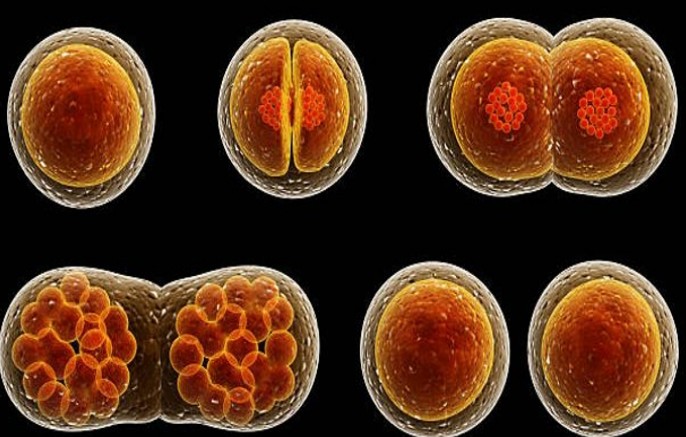
What is cell division?
A series of changes that a mature cell undergoes to produce two daughter cells.
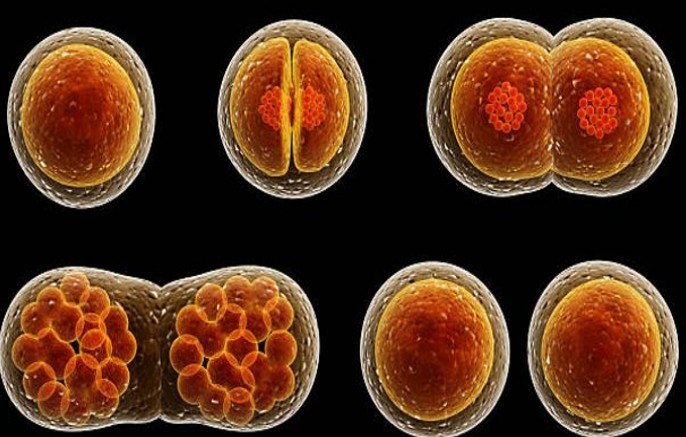
What are the two types of cell division?
Mitosis and meiosis.
What is the cell cycle?
The regular sequence of events through which a cell grows and divides to produce new cells.
Why is understanding the cell cycle important?
It helps explain how cancers develop when cells divide without proper regulation.
What is the minimum duration of the cell cycle?
About 12 hours.
What are the four phases of the cell cycle?
G1 phase, S phase, G2 phase, and M phase.
What is interphase?
The period consisting of G1, S, and G2 phases before mitosis.
What happens during the G1 phase?
Active RNA and protein synthesis, cell growth, and preparation for DNA replication.
Which phase is usually the longest in the cell cycle?
G1 phase.
What happens during the S phase?
DNA replication, histone synthesis, and the beginning of centrosome duplication.
What happens during the G2 phase?
The cell prepares for mitosis, ending with nuclear membrane breakdown and chromosome condensation.
What is the G0 phase?
A quiescent phase where cells temporarily or permanently stop dividing.
What can stimulate cells to leave G0?
Growth factors.
What is mitosis?
Cell division that produces two genetically identical daughter cells.
What are the four stages of mitosis?
Prophase, Metaphase, Anaphase, and Telophase (PMAT).
What happens during prophase?
Nucleolus disappears, chromatin condenses into chromosomes, centrosomes separate, and the mitotic spindle forms.
What happens during metaphase?
Chromosomes attach to spindle fibers and align at the equatorial plate.
What happens during anaphase?
Sister chromatids separate and move to opposite poles.
What happens during telophase?
Chromosomes decondense, spindle disappears, and nuclear envelopes reform.
What is cytokinesis?
Division of the cytoplasm to produce two separate daughter cells.
Which tissues do not normally undergo mitosis?
Nerve tissue and cardiac muscle.
What is meiosis?
A type of cell division that produces four genetically different haploid gametes.
How many cell divisions occur in meiosis?
Two (Meiosis I and Meiosis II).
How many DNA replications occur before meiosis?
One.
What is the chromosome number of human gametes?
23 chromosomes (haploid).
What is crossing over?
The exchange of DNA between homologous chromosomes to increase genetic variation.
During which phase does crossing over occur?
Prophase I.
What is the purpose of crossing over?
To create genetic diversity.
What are the five substages of Prophase I?
Leptotene, Zygotene, Pachytene, Diplotene, and Diakinesis.
What happens during leptotene?
Chromosomes appear as thin threads and DNA has already been replicated.
What happens during zygotene?
Homologous chromosomes pair by synapsis to form bivalents.
What is synapsis?
The pairing of homologous chromosomes.
What is a bivalent?
A pair of homologous chromosomes.
What is the synaptonemal complex?
A protein structure that holds homologous chromosomes together during synapsis.
What happens during pachytene?
Chromosomes thicken, tetrads form, and crossing over occurs.
What is a tetrad?
A group of four chromatids formed by paired homologous chromosomes.
What happens during diplotene?
Homologous chromosomes separate except at chiasmata.
What is a chiasma?
The visible site where crossing over has occurred.
What happens during diakinesis?
Chromosomes become shorter and thicker, nucleolus disappears, spindle forms, and the nuclear membrane breaks down.
What happens during metaphase I?
Bivalents align at the equatorial plate.
What happens during anaphase I?
Homologous chromosomes separate while sister chromatids remain together.
Do centromeres split during anaphase I?
No.
What happens during meiosis II?
Sister chromatids separate, producing four haploid cells.
How is meiosis II similar to mitosis?
Sister chromatids separate during anaphase.
How is meiosis II different from mitosis?
The chromatids are genetically different because of crossing over.
How many daughter cells are produced by mitosis?
Two genetically identical diploid cells.
How many daughter cells are produced by meiosis?
Four genetically different haploid cells.
Which type of cell division produces somatic cells?
Mitosis.
Which type of cell division produces gametes?
Meiosis.
What is the main function of mitosis?
Growth, repair, and replacement of cells.
What is the main function of meiosis?
Production of gametes and genetic variation.
Where does mitosis commonly occur in adults?
Red bone marrow, lymphoid tissue, testes, epidermis, hair follicles, and gastrointestinal epithelium.
What is the mnemonic for the stages of mitosis?
PMAT (Prophase, Metaphase, Anaphase, Telophase).