PRAXIS 4-8 Math and Science (5155)
 Call Kai
 Learn
Learn Practice Test
 Spaced Repetition
 Match
Match Flashcards
 Knowt Play
1/114

There's no tags or description
Looks like no tags are added yet.
Name | Mastery | Learn | Test | Matching | Spaced | Call with Kai | Chat |
|---|
No analytics yet
Send a link to your students to track their progress
115 Terms
Prime Number
A number with exactly two factors: 2, 3, 5, 7, 11, 13, 17, 19, 23, 29, 31
Composite Number
A number with more than two factors. (e.g., 12 has factors 1, 2, 3, 4, 6, 12)
Factor
A number that divides evenly into another number. (e.g., Factors of 18: 1, 2, 3, 6, 9, 18)
Multiple
The result of multiplying a number by whole numbers. (e.g., Multiples of 5: 5, 10, 15, 20...)
Greatest Common Factor (GCF)
Largest factor shared by two numbers. (e.g. factor of 18 and 24 is 6)
Least Common Multiple (LCM)
Smallest multiple shared by two numbers. (e.g., factor of 4 and 6 is 12)
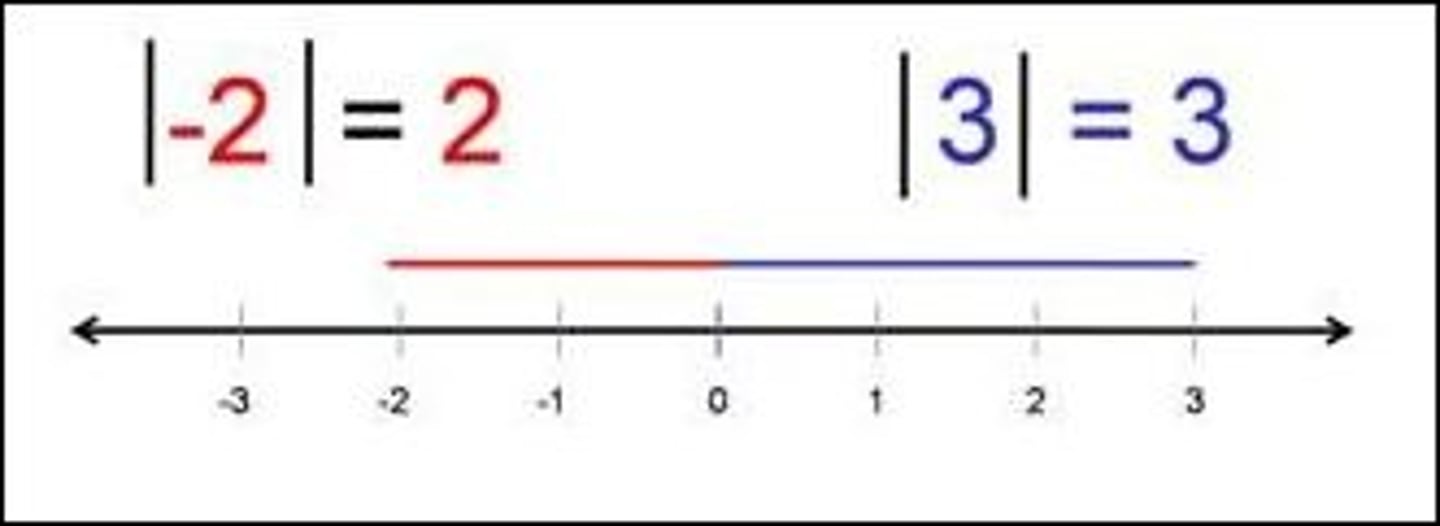
Absolute Value
Distance from zero
Equivalent Fractions
Fractions with the same value. (e.g., 1/2 = 2/4 = 3/6)
Reciprocal
Flip the numerator and denominator. (e.g., 3/5 becomes 5/3)
Improper Fraction
Numerator is larger than the denominator. (e.g., 9/4 converts to 2¼)
Ratio
Compares two quantities. (e.g., 3 boys : 5 girls = 3:5)
Rate
Ratio comparing different units. (e.g., 60 miles per hour)
Unit Rate
Rate with a denominator of 1. (e.g., $12 for 3 notebooks = $4 per notebook)
Proportion
Two equal ratios. (e.g., 3/2 = 12/x, so cross-multiplying gives x = 8)
Percent
Per hundred. (e.g., 35% = 35/100 = 0.35)
Variable
Letter representing an unknown. (e.g., x in x + 5 = 12)
Expression
Numbers and variables without an equals sign. (e.g., 4x + 7)
Equation
Two expressions joined by an equals sign. (e.g., 4x + 7 = 31)
Coefficient
Number multiplying the variable. (e.g., 7 in 7x)
Constant
Number without a variable. (e.g., 12 in 5x + 12)
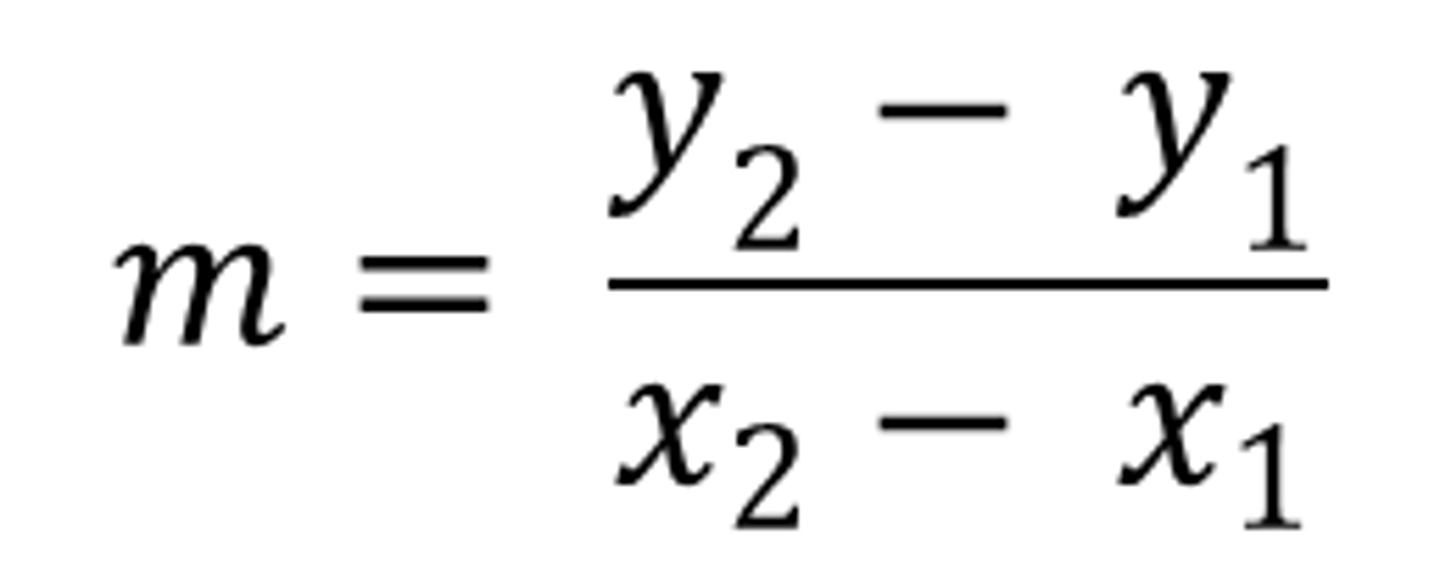
Slope
Rise over run: m = (y₂ - y₁) / (x₂ - x₁). (e.g., points (2,3) and (6,11) have __________ = 2)
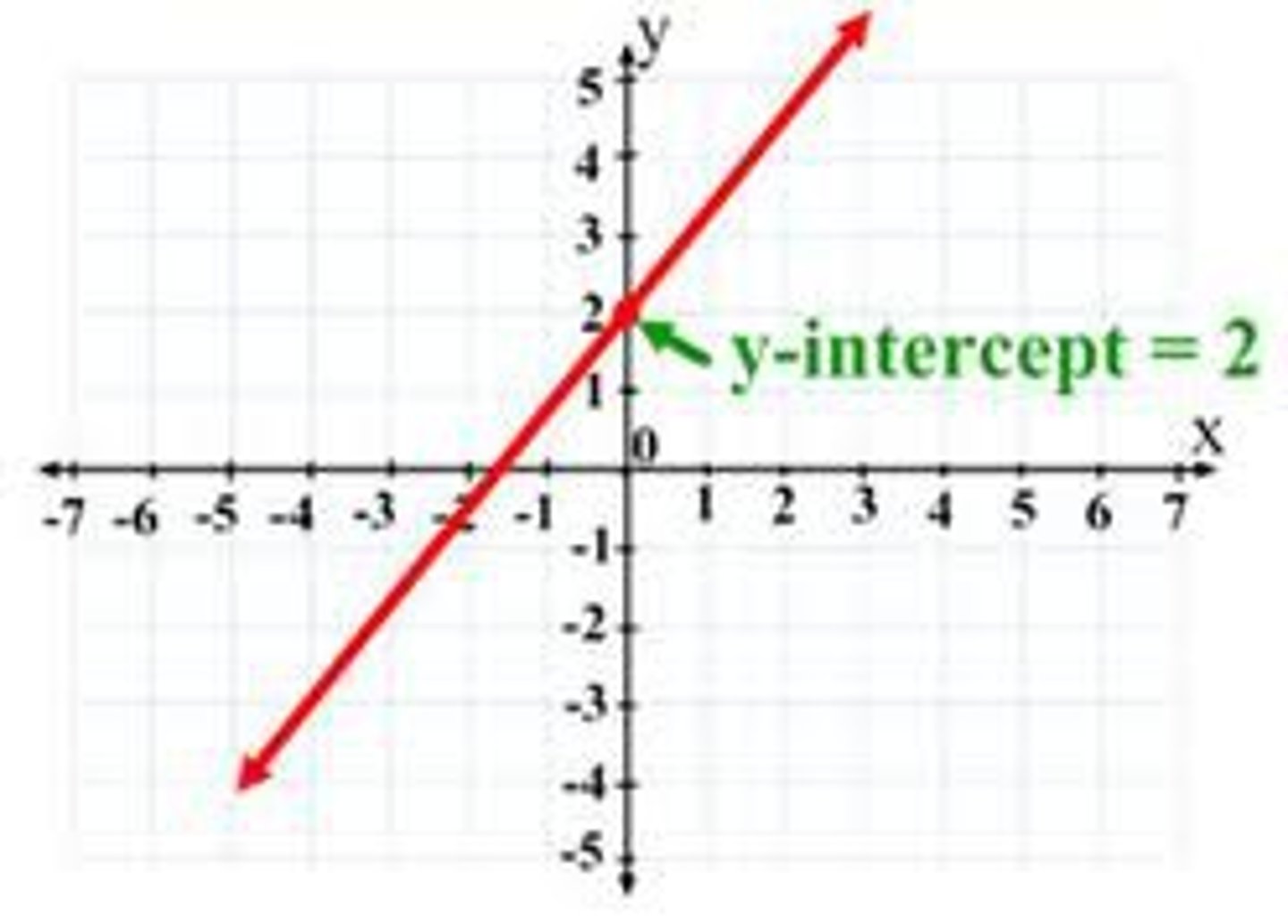
Y-Intercept
Where the graph crosses the y-axis. (e.g., 5 in y = 3x + 5)
Perimeter
Distance around a figure: P = 2L + 2W. (e.g., L=8, W=5 gives P=26)
Area of a Rectangle
A = length × width. (e.g., 8 × 5 = 40)
Area of a Triangle
A = ½bh. (e.g., base=10, height=6 gives A=30)
Volume of a Rectangular Prism
V = lwh. (e.g., 4 × 3 × 2 = 24 cubic units)
Surface Area
Add the area of every face. (e.g., Cube with side 3 has SA = 6(3²) = 54)
Diameter
Distance across a circle: d = 2r. (e.g., radius = 7 means diameter = 14)
Circumference
Distance around a circle: C = 2πr or πd. (e.g., d=10 means C = 10π)
Mean
Average: add all numbers, then divide by the count. (e.g., 6, 8, 10, 12 average is 9)
Median
Middle number in a sorted list. (e.g., 4, 7, 8, 12, 20 has median 8)
Mode
Most common number. (e.g., in 3, 3, 5, 8, the mode is 3)
Range
Largest minus smallest value. (e.g., 18, 21, 25, 30 has range 30 - 18 = 12)
Probability
Favorable outcomes ÷ total outcomes. (e.g., 3 red out of 10 total = 3/10)
Hypothesis
A testable prediction.
Independent Variable
What the scientist changes in an experiment.
Dependent Variable
What is measured or observed in an experiment.
Constant (Scientific)
Factor kept the same throughout an experiment.
Control Group
Group that does not receive the experimental treatment.
Qualitative Data
Descriptive observations using senses.
Quantitative Data
Numerical measurements and counts.
Cell Membrane
Controls what enters and leaves the cell.
Cell Wall
Provides rigid support and protection in plant cells.
Nucleus
Controls cell activities and holds DNA.
Mitochondria
Produces energy (ATP) for the cell.
Chloroplast
Site of photosynthesis in plant cells.
Photosynthesis
Process where plants use sunlight to make glucose.
Cellular Respiration
Process where cells break down glucose for energy.
Producer
Organism that makes its own food.
Consumer
Organism that eats other organisms for energy.
Decomposer
Organism that breaks down dead organic matter.
Food Chain
Single pathway showing energy flow.
Food Web
Multiple interconnected food chains in an ecosystem.
Ecosystem
Living (biotic) and nonliving (abiotic) things interacting.
Habitat
The physical place where an organism lives.
Niche
An organism's specific role in its ecosystem.
Weathering
Breaking rock down into smaller pieces.
Erosion
Movement of weathered material by wind, water, or ice.
Deposition
Dropping or settling of sediments in a new location.
Igneous Rock
Forms from cooled magma or lava.
Sedimentary Rock
Forms from compacted and cemented sediments.
Metamorphic Rock
Forms from existing rock changed by heat and pressure.
Mantle
Thick layer of hot, solid-flowing rock beneath Earth's crust.
Outer Core
Liquid layer of iron and nickel.
Inner Core
Solid sphere of iron and nickel.
Plate Tectonics
Theory explaining the movement of Earth's lithospheric plates.
Force
A push or a pull.
Gravity
Attraction force between masses.
Friction
Force that opposes motion between touching surfaces.
Inertia
Resistance to changes in motion.
Mass
Amount of matter in an object.
Weight
Force of gravity acting on an object.
Velocity
Speed of an object in a specific direction.
Acceleration
Rate of change in velocity.
Potential Energy
Stored energy based on position or state.
Kinetic Energy
Energy of motion.
Conduction
Heat transfer by direct physical contact.
Convection
Heat transfer through fluids (liquids or gases) by density currents.
Radiation
Heat transfer through electromagnetic waves.
Mechanical Wave
Wave that requires a physical medium to travel (e.g., sound).
Electromagnetic Wave
Wave that does not require a medium to travel (e.g., light).
Frequency
Number of waves passing a point per second.
Wavelength
Distance between two consecutive wave crests.
Rotation
Spinning of an object on its axis.
Revolution
Orbiting of one object around another.
Waxing
The illuminated phase of the Moon appears to grow.
Waning
The illuminated phase of the Moon appears to shrink.
New Moon
Phase when the Moon is directly between the Earth and Sun.
Full Moon
Phase when the Earth is directly between the Moon and Sun.
Integers
Whole numbers, their opposites, and zero. Example: -3, -2, -1, 0, 1, 2
Rational Number
A number that can be written as a fraction. Examples: 3, 0.5, -7/8
Irrational Number
Cannot be written as a fraction. Examples: π or √2
Order of Operations (PEMDAS)
Parentheses → Exponents → Multiplication & Division (left to right) → Addition & Subtraction (left to right)
Percent Increase
New Value = Original × (1 + Percent as a Decimal) Example: $50 increased by 20% = $60
Percent Decrease
New Value = Original × (1 − Percent as a Decimal) Example: $80 decreased by 25% = $60
Pythagorean Theorem
a² + b² = c². Used with right triangles.
Distance Formula
= Rate × Time (d = rt)
Speed Formula
= Distance ÷ Time
Force Formula
= Mass × Acceleration (F = ma)
Atom
Smallest unit of an element that retains its properties.