Term List 4
 Studied by 0 people
 Call with Kai
 Learn
Learn Practice Test
 Spaced Repetition
 Match
Match Flashcards
 Knowt Play
1/58

There's no tags or description
Looks like no tags are added yet.
Name | Mastery | Learn | Test | Matching | Spaced | Call with Kai |
|---|
No study sessions yet.
59 Terms
steno
mid-1600's): Clergyman, studied the anatomy of sharks.
Found sharks in stone and argued that sharks were real and must have become encased before stone became solid.
Steno thought that layers (strata) resulted from localized flooding events.
Steno also argued that rocks on the bottom are the oldest and rocks on the top are the youngest. This is the Law of Superposition.
Law of Superposition
The rocks on the bottom are the oldest, and the rocks on the top are the youngest.
William Smith
British Canal Builder
Smith argued that fossils always occur in the same order in strata so he proposed the Law of Faunal Succession.
Law of Faunal Succession
fossil organisms succeed one another in a definite and determinable order. ex. a neanderthal skeleton will never be found in the same strata as a woolly mammoth skeleton.
Idiosyncratic Variation
individual differences - sombr is different from burnet
Sexual variation
variety between organisms due to sexual dimorphism
Geographic variation
differences in the genetic composition of separate populations
Age-related variation
Age-related variation refers to the biological and physical changes that occur as a person grows and ages—such as bone development, tooth eruption, and fusion of growth plates. It helps anthropologists and biologists estimate an individual's age based on skeletal or dental traits.
Ossification Centers
Anatomical areas where bone tissue forms from fibrous tissue and cartilage, ultimately becoming a bone element
Paleodemography
The study of ancient human populations using skeletal and archaeological data to estimate demographic characteristics such as age structure, mortality, fertility, and population size.
Enamel
hard, outermost layer of a tooth
Dentine
dense, ivory-like substance located under the enamel in a tooth
Homodont
All teeth are the same and are generally pointed. These function well ingrasping prey and holding it until it dies. These type of teeth are typical of reptiles.
Heterodont
The teeth have different shapes for different functions. These teeth allow a broader range of functions and food types. All primates have this type of teeth. The tooth shapes are named after their function: incisors (for cutting), canines (for puncturing and holding; also have a big behavioral function in primates), premolars (for puncturing and crushing), and molars (for crushing and grinding)
Molar cusps
Molar teeth have bumps on their occlusal (chewing) surface. These are called toothcusps. Depending on the type of food eaten these cusps can be emphasized or reduced.
generalized feeders
Animals which have all the cusps of relatively equal size and which are generally somewhat flat
Herbivores
Organisms that eat only plants.
Carnivore
A consumer that eats only animals.
Bunodont
Bunodont tooth cusps are generally short, fat, and somewhat rounded. This is the type of cusp pattern you have. Also, your bunodont molar cusps are arranged in a Y -5 pattern .
Bilophodont molar cusp pattern
Bilophodont tooth cusps are tall and pointy.
C/P3 honing complex
Involves large upper and lower canines, a diastema, and lower premolars that are sectorial. Sectorial premolars: "honing" device to sharpen canines. Diastema: space. Enamel surface goes to the root in the premolar -->sharpener!
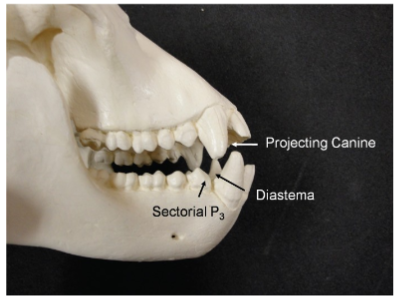
sectorial premolar
premolar adapted for cutting
Diastema
A space between two teeth
Occlusal
how teeth come together
deciduous
baby teeth that fall out
adult teeth
teeth that don't fall out
pelvis
hip bone
shoulder girdle
scapula and clavicle
form and function
the morphology, or form, of a tooth or bone is related to its function (form = function); distinct to the teleological belief that function = form
sutures
Areas where the cranial bones have joined together
articulation
speech
Mastication
chewing
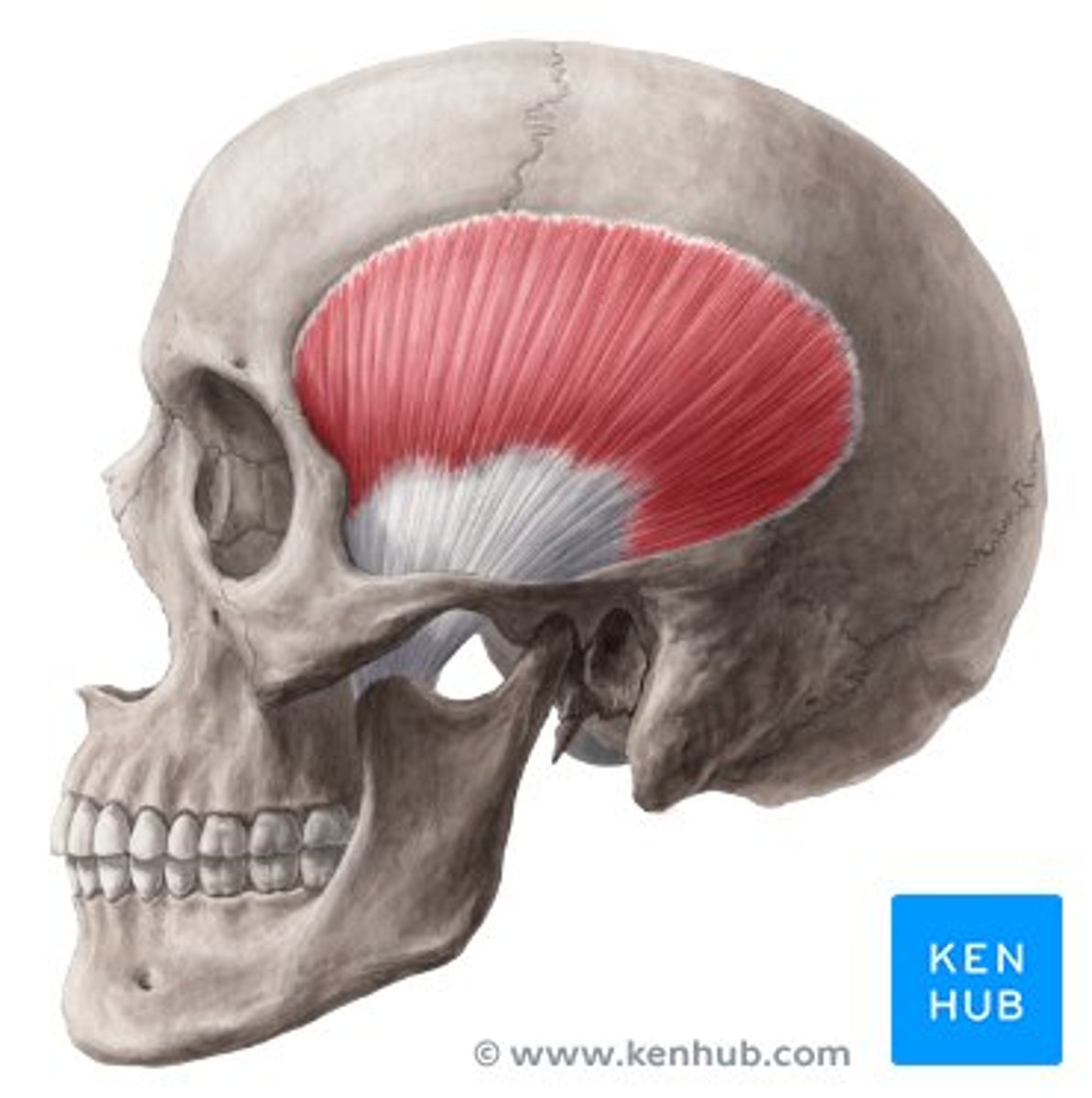
temporalis major
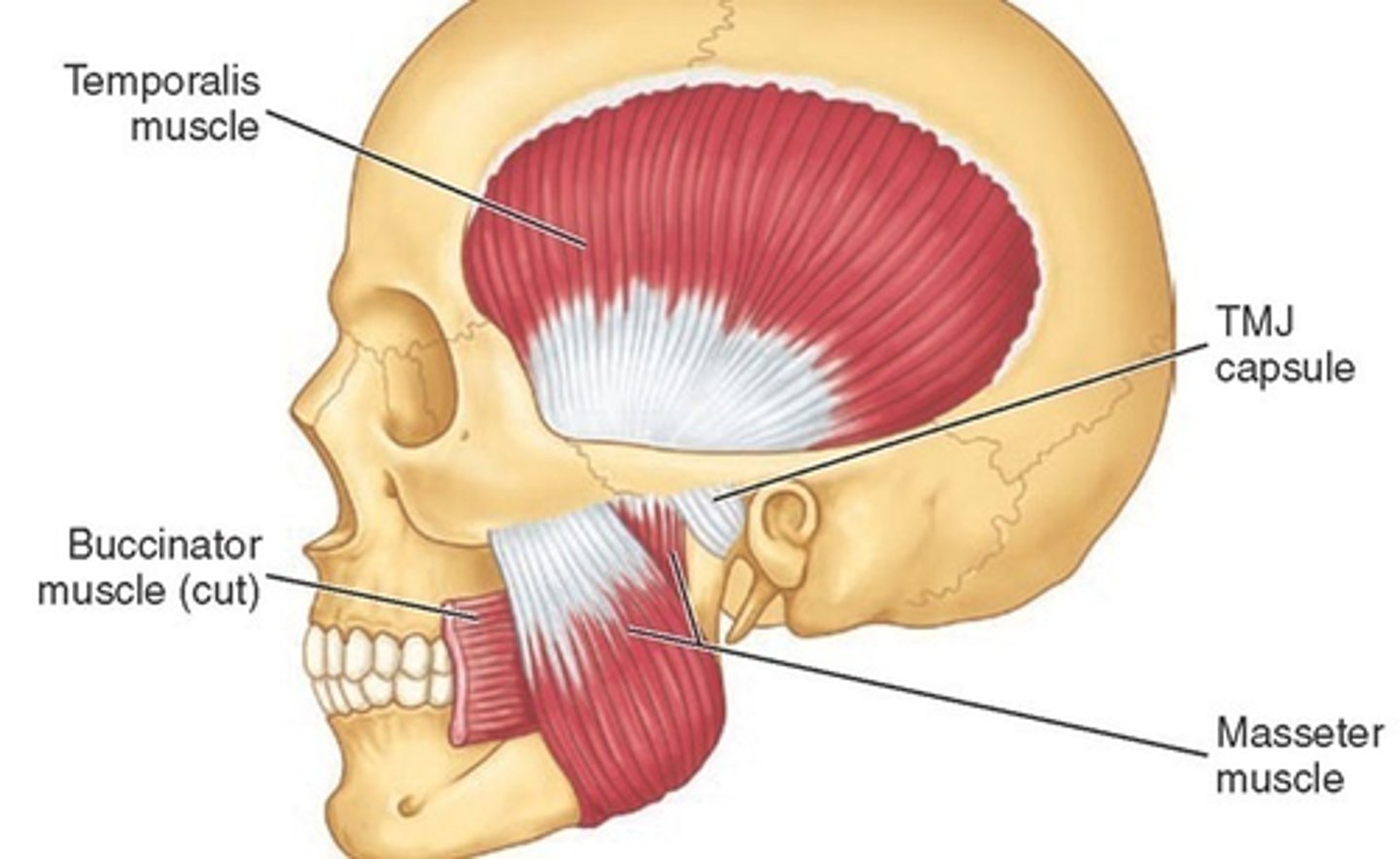
Masseter
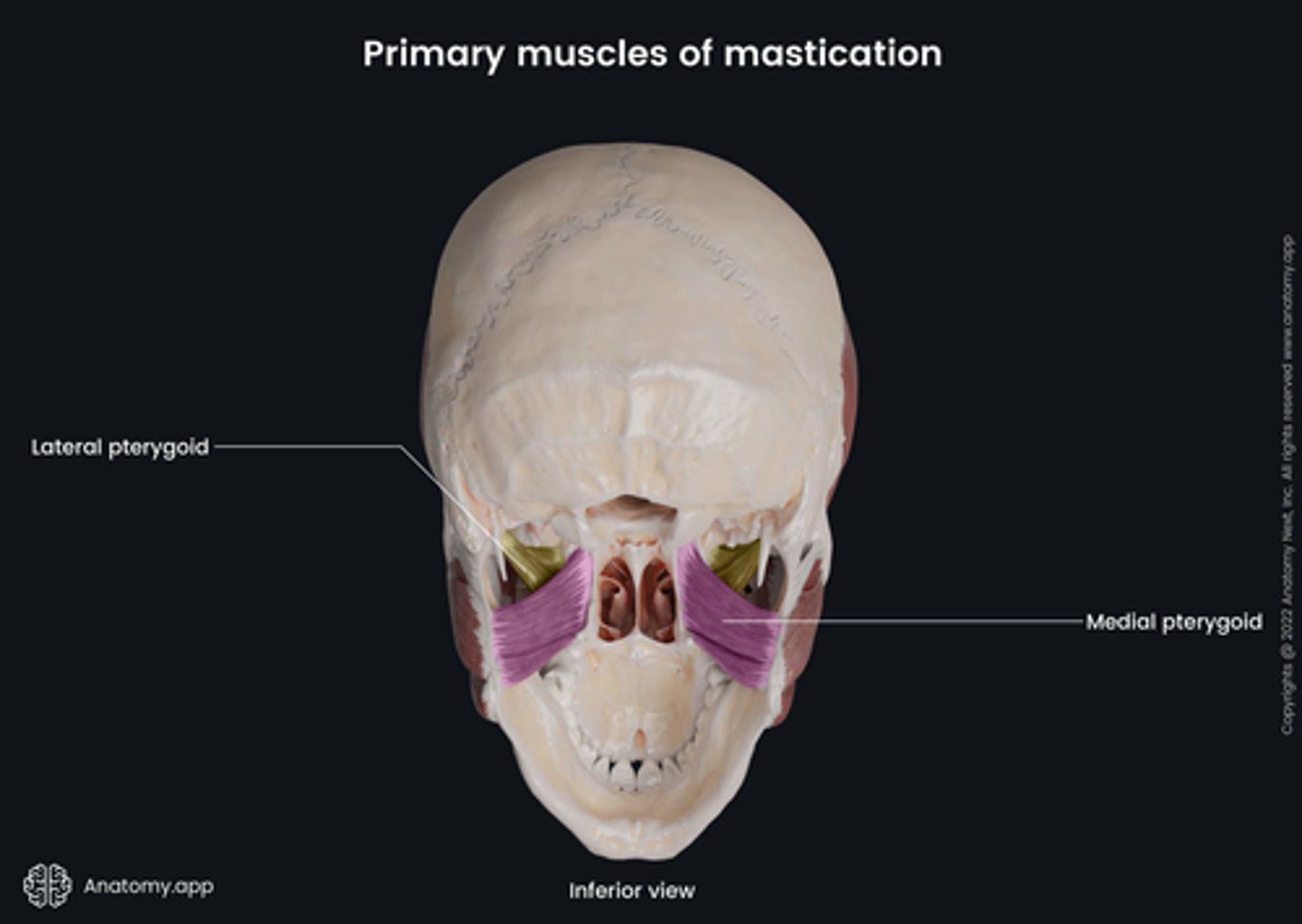
Medial pterygoid
Taphonomy
The study of the history of an organism after it dies:
Sequence:
Death of an organism
Burial
Fossilization
Geological damage
Age of fossil os not equal to completeness, nor is fossilization is a key to age
Neontological
deals with now living (recent) organism. Opposite of paleontology
Paleontology
the study of fossils
Thomas Burnet
"The Sacred Theory of the Earth" argued that the Earth went through 7 phases starting as a fiery ball and ending as a dead planet. Thought the Great Flood was a natural consequence of the Earth's surface cracking and drying.
Stratigraphy
the study of rock layers and the sequence of events they reflect
Strata
layers of rock
Lithostratigraphy
the study of geologic deposits and their formation, stratigraphic relationships, and relative time relationships based on their lithologic (rock) properties
C14 dating
a technique used to date fossils that uses the known disintegration rate of radioactive carbon; the amount of carbon-14 remaining in fossils indicated their age
Biostratigraphy
a relative dating technique based on the regular changes seen in evolving groups of animals as well as the presence or absence of particular species
Potassium-Argon Dating
a method of dating rocks from the relative proportions of radioactive potassium-40 and its decay product, argon-40.
Argon-Argon Dating
A more accurate method of potassium-argon dating that involves converting potassium to argon before the isotope ratios are measured.
Fission-Track dating
an absolute dating method based on the measurement of the number of tracks left by the decay of uranium-238
Paleomagnetic Dating
An absolute dating method based on the reversals of Earth's magnetic field.
Electron spin resonance
electron trap technique that measures the total amount of radioactivity accumulated by a specimen such as tooth or bone since burial.
Half-life
length of time required for half of the radioactive atoms in a sample to decay
Absolute Dating
A technique used to determine the actual age of a fossil, using the ages of rock around it
Relative Dating
Method of determining the age of a fossil by comparing its placement with that of fossils in other layers of rock
Tertiary
Paleocene
Eocene
Oligocene
Miocene
Pliocene
Quarternary
Pleistocene & Holocene
Paleocene
Earth was warm and wet as Antarctica and Australia split.Faunal diversity rose, but many European mammals went extinct and early primates declined as rodents spread in Asia.
Eocene
Earth reached its warmest temperatures before gradually cooling.North America and Europe began to split, and euprimates, anthropoid-grade primates, and early New World monkeys appeared.
Miocene (short)
Earth was warm but became drier and cooler over time, with Africa shifting from forest to savanna.Apes thrived early in Africa and Europe but declined as Old World monkeys diversified and dominated by the end of the epoch.
Miocene (long)
(23–16 mya), the climate was warm and humid, supporting dense forests across Africa and Eurasia where apes first diversified and thrived.During the Middle Miocene (16–11 mya), conditions began to cool and dry slightly, leading to the expansion of woodlands and grasslands while apes spread into Europe and Asia.Old World monkeys also began to diversify, gradually becoming more abundant as ape populations declined.In the Late Miocene (11–5 mya), global cooling intensified, reducing forest habitats and favoring open savannas.Ape diversity and population density dropped sharply, with most primitive African apes disappearing and some surviving only in Asia.By the end of the epoch, monkeys dominated Europe while apes became rare, setting the stage for later human evolution in Africa.
What is the order of the three thingies?
Era/Period/Epoch