IB 303- Muscles
 Call Kai
 Learn
Learn Practice Test
 Spaced Repetition
 Match
Match Flashcards
 Knowt Play
1/46

There's no tags or description
Looks like no tags are added yet.
Name | Mastery | Learn | Test | Matching | Spaced | Call with Kai | Chat |
|---|
No analytics yet
Send a link to your students to track their progress
47 Terms
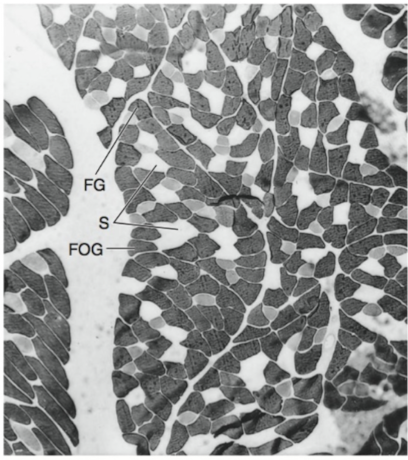
Red vs white muscle
classification by color based on the amount of myoglobin
not used much anymore
red- contracts slowly, high endurance, lots myoglobin(dark meat)
white- low myoglobin, rapid, fatigue easily, quick reactions(white meat)
Somatic muscle
attach to bone or cartilage
Visceral muscle
attach to organs, vessels, and ducts
ex. stomach
voluntary muscle
under conscious control
involuntary muscle
muscles that are not consciously controlled
Smooth muscle
unstriated (filaments aligned in even rows) muscle
mononucleate(one nuclei), short and fusiform in shape
cells joined in sheets that wrap around organs(visceral and involuntary)
maintain force without fatigue

Cardiac Muscle
Striated, mononucleate muscles in the heart
short cells joined by intercalated disks

Skeletal Muscle
Voluntary, striated, multinucleate
elongate(up to 40mm) unbranched fibers from fusion of several cells
filled with sarcomeres
apart of urinary tract

Head of muscle
Origin of muscle that attached to the immobile bone
Insertion of the bone
“slip” attached to the mobile bone
Muscle Action
muscle can only pull(contraction)
often paired as antagonistic sets(opposite matching muscles, quad and ham)
synergistic (build on each other, pull in same direction, quad set)
Skeletal muscle structure
composed of muscle bundles
bundles contain multiple muscle cells
surrounded by epimysium

Tendons
connective tissue for muscle to bone
connect to periosteum
less energetically costly than muscle
Muscle Russian doll cell structure
packed together in bundles called Fascicles surrounded by Perimysium
endomysium surrounds each cell
cell packed of myofibrils

Myofibril Structure
Chain of repeating units called sarcomeres(unit of contraction), separated by z-bands(the black lines)
two types of overlapping filaments:
Myosin: thick filament with protruding head
Actin: thin filament with two other proteins attached

Resting State
no stimulation from nerves
muscle is soft, but shape is maintained by collagenous fibers
no force, can be stretched
Active state
nerve stimulation
contraction, generates tensile force
resistance to this is load
Muscle contraction
Sarcomeres shorten during contraction(the white region shortens, just actin)
actin shifts and overlies with myosin, this shortens sarcomere
thick filament(myosin) pulling on thin filament(actin)

Myosin Heads
composed of coiled subunits with protruding heads
little heads of myosin moving across actin
get ATP, release move and grab actin, phosphorylize, become ADP to release to then be released again
Velocity vs force
binding and unbinding of myosin heads takes time, so tradeoff to velocity and force
limitation

tonic fibers
sustained low force, postural
rare in mammals(only in eyes)

twitch fibers
found in all vertebrates
fast contraction/higher forces
can be divided into slow and fast
is all relative

fiber mechanics: control
myosin heavy chain- isoforms are often used to identify fiber types
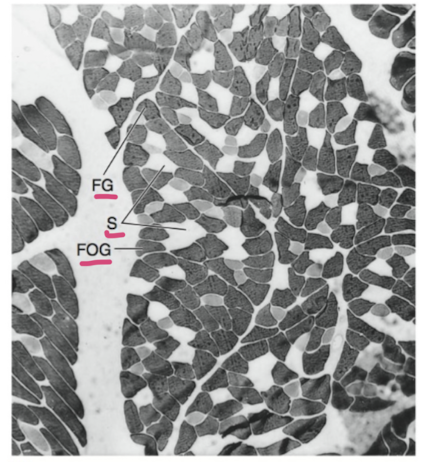
slow twitch fibers- rely on ATP from aerobic respiration, looks red bc of myoglobin
fast twitch- relies on ATP from anaerobic respiration, looks white bc of less myoglobin
order to initiation:
-slow twitch activated→fatigue-resistant fast twitch turn on→ fatiguable-fast twitch activated for final push
Graded force
activation of muscle is all or none
Rate modulation controls the rate that nerve impulses are delivered to muscle
alters how many motor units (single neuron and the set of fibers it innervates) are activating
Cross sectional area
cross-sectional area- proportional to the total force a muscle can produce, length of muscle does nothing for force
Morphological cross section of overall muscle
Physiological sum of the cross-sectional area of the muscle fibers in muscle(what you want to look at)

Fiber orientation
parallel fibers- fibers lie along the line of force(with the muscle), lighter loads through long distance
pinnate fibers- fibers lie like arrow feathers to the force generation, insert on a common tendon, better for force generation bc more myofibers can fit, but cannot shorten as much, heavier loads a short distance

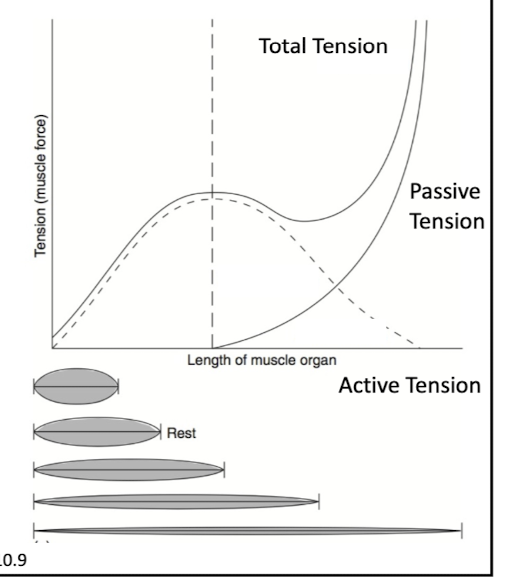
Total Tension
Active tension(from muscle) + Passive tension(from elastic tendons)= total tension
tendons help give power to muscle through elasticity
Low Gear Muscles
more force advantage, used to overcome inertia during initial movement
-synergistic muscles
High Gear muscles
more speed advantage to create rapid movements
-synergistic muscles
Types of contraction
concentric-muscle contracts(force+shortening)
isometric- contraction and no length change(force+ no motion)
eccentric- contraction with lengthening(extend+force)

Depressor mandibulae
depress the lower jaw

digastric muscle
depresses the lower jaw

Paraxial mesoderm
the embryonic tissue that arises the skeletal muscle
tissue is first divided into somites that further divides into other tissues
the tissues for muscles are myotomes

Fish musculature
segmented structure, zigzag pattern, for flexion- myomeres
my-septa- the white “walls” between myomeres
horizontal septa- runs length of the body, splits axial muscle into epaxials(dorsal) and hypaxials(ventral)

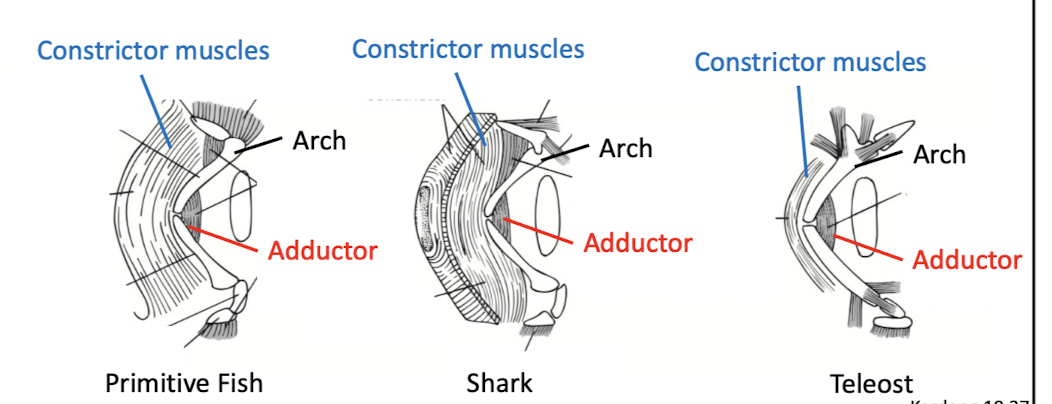
Constrictor and adductor muscle in fish
constrictor- straightens the brachial arches in fish
adductor- bend the arches
the agnostic action of these together pump water over gills
mandibular arch
modified brachial arch
the muscle becomes the adductor mandibulae
the bite muscle

Jaw adductors
sharks developed a muscle that aids adductor called pre-orbitals
evolution: tetrapods adductor remains one big muscle
the muscle changes and attaches to the cranium itself instead of a separate palatoquadrate bone(lost in tetrapods)
adductor been seperated into two muscles: masseter and temporalis(synergistic)

Constrictor colli
facial muscles: constrictor colli
mammalian facial muscle

Branchial muscles
aid in gill-based respiration
reduced in tetrapods, contribute to larynx
some of the elevator muscle along the dorsal end become apart of the pectoral sling- holds anterior portion of the body up

Chronic overload
sustained muscle activity for training
working harder than normal
hypertrophy
term for the increase in tissue size/mass because of stimuli
muscle growth
more myofilaments are added, increasing cross-sectional area
Slow twitch: better for endurance
fast twitch: better for burst activity
there is evidence that type of activity can influence which twitch fibers grow
Duchenne Muscular dystrophy(DMD)
most common, generally fatal in the 20s
adverse affects on bone development too due to lower loads on bones
caused by a gene mutation on X chromosome that codes for dystrophin
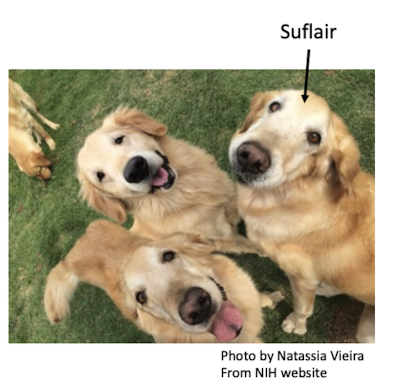
discovery: dogs that have an up regulation of gene for cell repair can counteract the DMD, seeming normal
dystrophin
important protein complex that creates a mechanical link between myofilaments and signaling to muscle fibers

Becker
similar to DMD but later onset with slower progression
Steinerts disease
adult-onset that affects face and neck. prevents relaxation of muscles and can cause cataracts, sleepiness, and arrhythmia
congenital
early onset with variable progression, effects both males and females