Protein Synthesis (Transcription & Translation) and Mutations
 Call Kai
 Learn
Learn Practice Test
 Spaced Repetition
 Match
Match Flashcards
 Knowt Play
1/33

There's no tags or description
Looks like no tags are added yet.
Name | Mastery | Learn | Test | Matching | Spaced | Call with Kai | Chat |
|---|
No analytics yet
Send a link to your students to track their progress
34 Terms
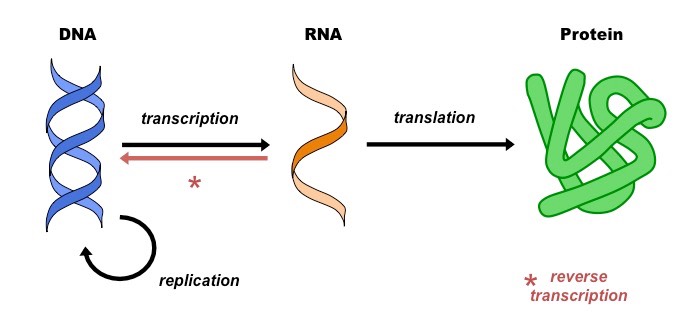
What is the Central Dogma of molecular biology?
DNA → mRNA → protein
DNA carries the instructions to build all the proteins, but is transcribed into mRNA because it cannot leave the nucleus.
In the cytosol, ribosomes translate the mRNA into a polypeptide chain.
What is gene expression?
Refers to the transfer of genetic information from DNA to RNA to protein.
What is RNA?
AKA ribonucleic acid
Nucleic acid
Plays a role in creating protein
Single stranded helix
What is the monomer for RNA?
Ribonucleotide
What is the structure of ribonucleotide?
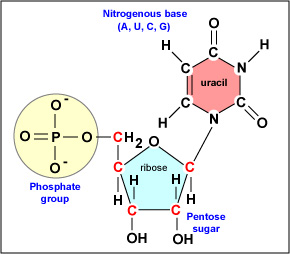
Ribose (pentose/ 5C sugar)
Phosphate group
Nitrogenous base
Adenine, guanine (purines, 2 rings)
Uracil, cytosine (pyrimidines 1, ring(
Glycosidic bonds hold these components together
What are the 3 types of RNA?
mRNA - Messenger
tRNA - Transfer
rRNA - Ribosomal
What are the 3 stages of protein synthesis?
Transcription, RNA processing (only in eukaryotes), and translation
What is mRNA?
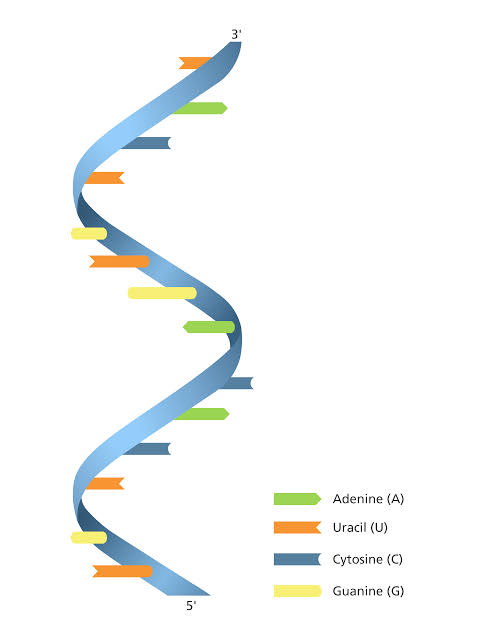
messenger RNA
Single stranded
Composed of ribonucleotide
Carries the code for making proteins from DNA to the ribosomes in the cytoplasm
The “blueprint”
What are the 3 parts of transcription?
Initiation, elongation, and termination
What is transcription?
DNA → mRNA
Occurs inside of the nucleus
This process uses: DNA template strand, mRNA, RNA polymerase, mRNA
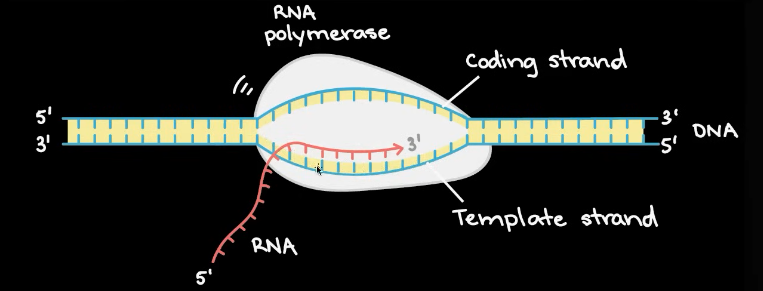
What is the template strand?
Aka antisense strand
The DNA strand being transcribed
What is the coding strand?
Aka sense strand
The DNA strand that is not being transcribed
What happens during initiation in transcription?
RNA polymerase binds to the recognition site/promoter region of the DNA
It unwinds the DNA and separates the template strand from the coding strand
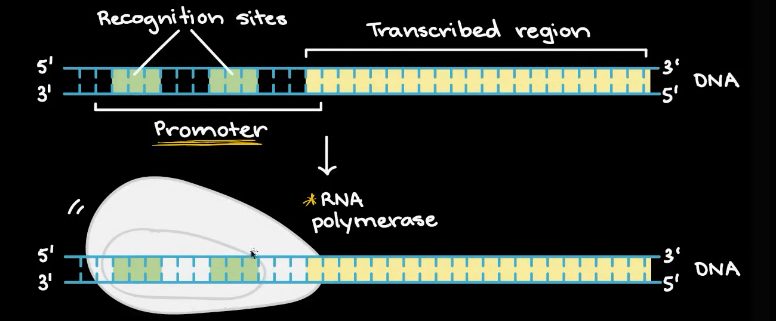
What are the 3 key characteristics about the promoter region?
Determines where transcription begins
Usually rich in adenine and thymine (“TATA” box)
Allows RNA polymerase to bind to the correct strand in the correct orientation
What happens in elongation in transcription?
RNA polymerase encodes towards the 5’ end of the template strand
It moves downstream, attaching ribonucleotides along the template strand following complementary base pairing
The coding strand and RNA are essentially the same sequence except….
A is paired with U rather than with T
After transcription, pre-mRNA is formed, DNA immediately recoils, and RNA polymerase detaches
Note: Several RNA polymerases can work on a single gene at once
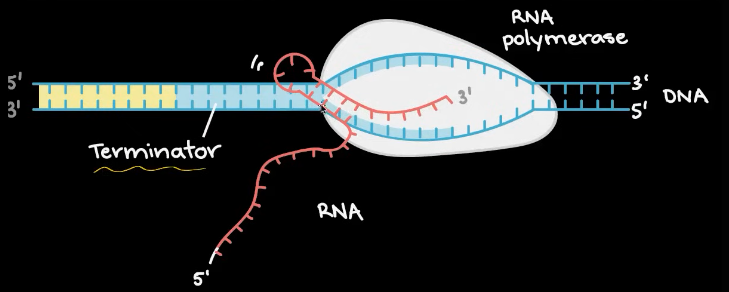
What happens in termination in transcription?
RNA polymerase comes across the terminator sequence/signal
The mRNA creates a “hair pin loop” which impairs RNA polymerase to keep going causing it to snap off
Rho termination protein binds to the end of mRNA and moves toward RNA polymerase, eventually stopping it from transcribing
What happens in RNA processing?
Only occurs in eukaryotes
This stage protects the RNA from the caustic cytosol
RNA gets a 5’ cap (or G cap) and 3’ poly-A tail
5’ cap or G cap
Modified guanines added to 5’ end of mRNA (7-methyl guanosine)
3’ poly-A tail
About 50-250 adenines are added to the 3’ end of mRNA
Splicing additionally occurs
What happens in splicing?
Spliceosomes contain proteins and snRNPs (small nuclear ribonucleic proteins)
It rearranges exons (coding regions) and removes introns (non-coding regions)
Alternative splicing allows the rearrangement of exons to produce different proteins when translated by ribosomes
This process results in Mature mRNA
What are the 3 stages of translation?
Initiation, elongation, and termination
What happens in translation?
mRNA → protein
Occurs in the cytosol and/or often in the rough endoplasmic reticulum (RER)
Ribosomes read the mRNA and then translate these instructions into an amino acid sequence
This process uses: rRNA, tRNA, ribosomes,
What are ribosomes?
Site of protein synthesis
Composed of: 60% rRNA and 40% protein
2 subunits (small and large)
E site = exit site - ejects
P site = peptidyl site -pairs
A site = acceptor/ aminoacyl site - attaches
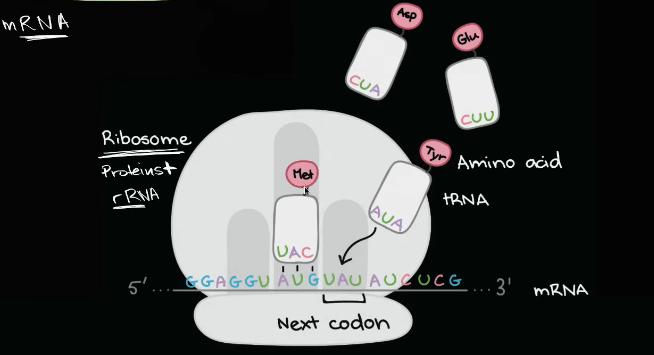
What is a codon?
1 codon = a group of 3 consecutive bases on the mRNA transcript
Codes for 1 amino acid
Redundant: 2+ codons code for the same amino acid
64 possible combinations of codons
But 20 amino acids, which make the code…
Non-ambiguous: No codon codes for more than 1 amino acid
Continuous: the code is read as a series of 3-letter codons
Universal: Almost all organisms build proteins with the same genetic code
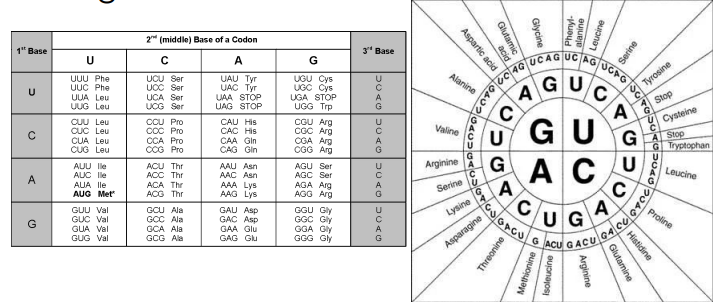
What is the start codon?
AUG (Methionine)
What are the 3 stop codons?
UAA, UAG, and UGA
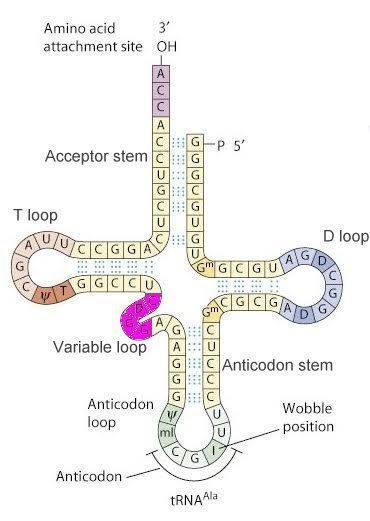
What is tRNA?
transfer RNA
Attached to an amino acid by the enzyme aminoacyl-tRNA synthetase, forming an aminoacyl-tRNA complex
Each tRNA molecule has an anticodon sequence, which is complementary to the mRNA transcript
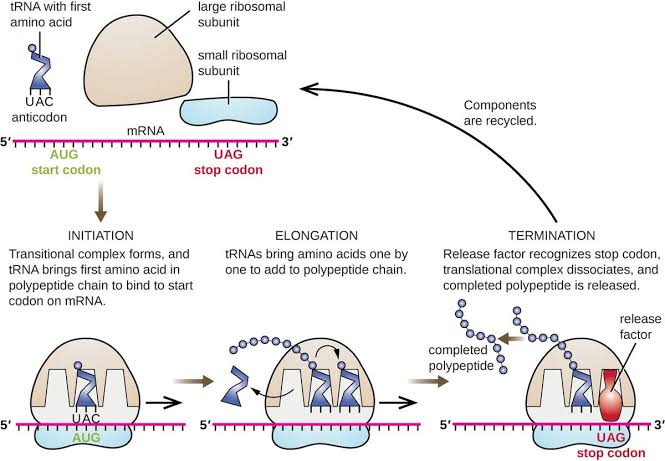
What happens in initiation in translation?
mRNA binds to the small ribosomal subunit (30S in prokaryotes or 40S in eukaryotes)
The large ribosomal subunit (50S) binds to the complex
The translation of the mRNA begins at 5’ end
An initiator tRNA pairs with the start codon on mRNA
It is initially located on the P site
What happens in elongation in translation?
A tRNA with the anticodon for the 2nd codon is placed at the A site
The polypeptide chain is translocated from the tRNA at the P site to the tRNA on the A site
Resulting in the formation of a peptide bond by peptideyl transferase (A ribozyme)
This increases the growing polypeptide chain one amino acid at a time
The ribosome shifts position one codon at a time and progresses toward the 3’ end of the mRNA
What is termination in translation?
The process repeats until a stop codon (UGA, UAA, UAG) reaches the A site
A release factor binds to the stop codon
The polypeptide is hydrolyzed (released) from tRNA at the P site
The entire complex disassembles
mRNA can be reused
The polypeptide is folded into a protein
What is a mutation?
Changes in the DNA sequence that are inherited
What are the 2 types of mutations?
Gene mutations - those that produce change in a single gene
Chromosomal mutations - those that produce changes in whole chromosomes
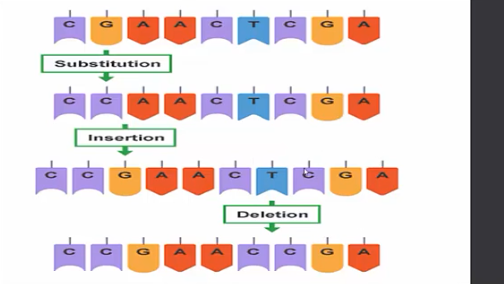
What are point mutations?
Involve changes in one or a few nucleotides and occurs at a single point on a gene
What are the 3 types of point mutations?
Substitutions: One base is changed to a different base.
Usually affects one amino acid
Silent mutations - Substitution of the base has no effect because of:
The redundant nature of the genetic code
Substitution occurs in introns, which are cut out of the mRNA anyway, so it will never surface
Missense mutation
A change in the base sequence of DNA alters a codon
Leading to a different amino acid being placed in the protein sequence
e.g. sickle cell anemia
Nonsense mutation
A change in the DNA sequence causes a stop codon to replace a codon
Often lethal to the cell
Frameshift mutation - a mutation that causes the reading frame of codons to change, usually resulting in different amino acids being incorporated into the polypeptide
Insertions: Point mutation in which one base is inserted into the DNA sequence
The effects can be dramatic
Codons are read in groups of 3 and adding one base makes the entire sequence to be misread
Deletions: Point mutation in which one base is deleted.
Deleting one base cause the entire sequence to be misread because they are still read in groups of 3
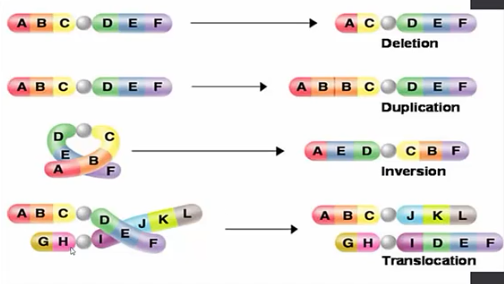
What are the 4 types of chromosomal mutations?
Deletion: involves the loss of all or part of a chromosome.
Duplication: produces an extra copy of all or parts of a chromosome
Inversion: Reverse the direction of parts of a chromosome
Translocation: Occurs when parts of one chromosome breaks off and attaches to another
What are the causes for mutations?
Spontaneous mutations - occuring as a result of errors made in DNA replication
Induced mutations - mutations caused by a chemical agent or radiation
mutagenic agents are chemicals or radiation which causes mutations