binding affinity
 Call Kai
 Learn
Learn Practice Test
 Spaced Repetition
 Match
Match Flashcards
 Knowt Play
1/14

There's no tags or description
Looks like no tags are added yet.
Name | Mastery | Learn | Test | Matching | Spaced | Call with Kai | Chat |
|---|
No analytics yet
Send a link to your students to track their progress
15 Terms
what is binding affinity?
strength of non-covalent interaction between a receptor and ligand
determines how tightly two molecules bind together
how is binding affinity typically quantified?
typically quantified using equilibrium dissociation constant, Kd
what is the equilibrium dissociation constant, Kd?
the concentration of ligand required to occupy half of the available binding sites at equilibrium
measured in M (molar)
what do a low and high Kd represent
Low Kd = high affinity (tight binding), low concentration of ligand required
ligand binds faster, RL complex lasts longer
High Kd = low affinity (loose binding), high concentration of ligand required
ligand will bind slower and RL complex dissociates faster
how can Kd be calculated
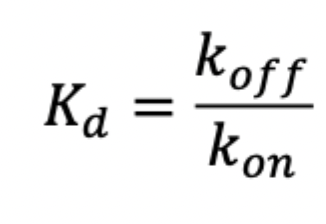
by using koff and kon
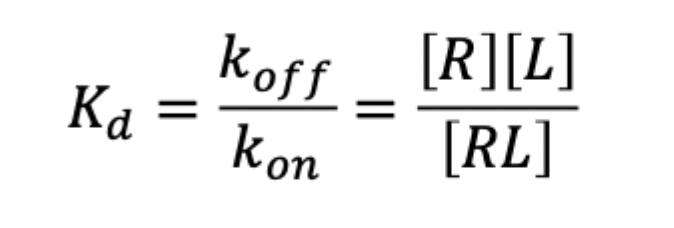
by using concentration of receptor, ligand and receptor-ligand complex at equilibrium
what is kon?
kon is the kinetic rate constant that accounts for the forward binding reaction of receptor and ligand
measured in M-1s-1
R+L → RL
what is koff?
koff is the kinetic rate constant that accounts for the reverse unbinding (dissociation) of the R-L complex
measured in s-1
RL → R+L
what is the equation for Kd using koff/kon?
what is the equation for Kd using concentrations at equilibrium?
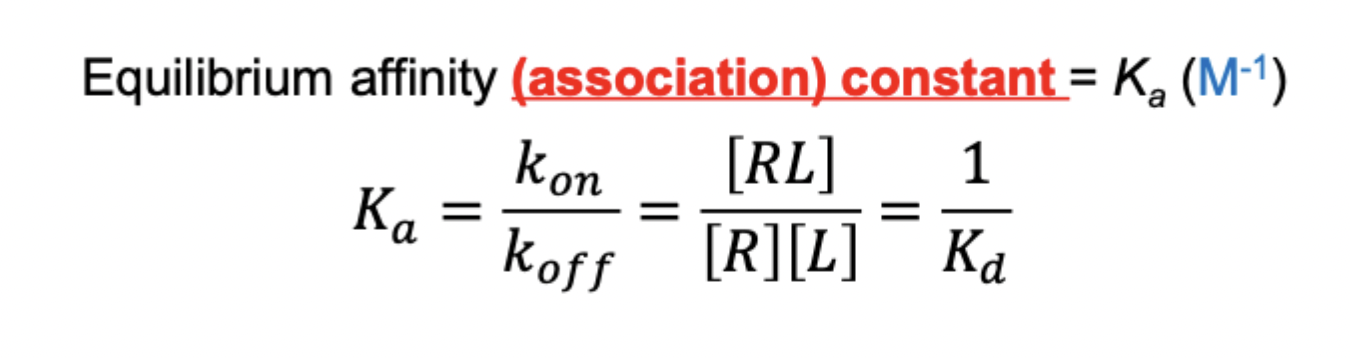
what is the equation for Ka (reverse of Kd)?
why is binding affinity a useful?
can be used in drug design to identify drug candidates
a higher binding affinity means that a lower concentration of drug is required, reducing potential side effects
how is binding affinity determined?
in a lab through experimentation
vary the concentration of ligand in a solution containing a low, fixed concentration of receptor
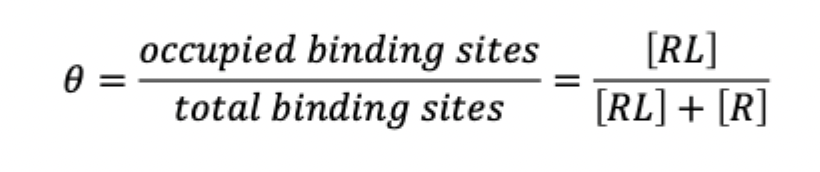
at each concentration of ligand, measure the fraction of occupied binding sites, θ
what is the equation for θ?
what is the new equation when you make θ a function of [L]?
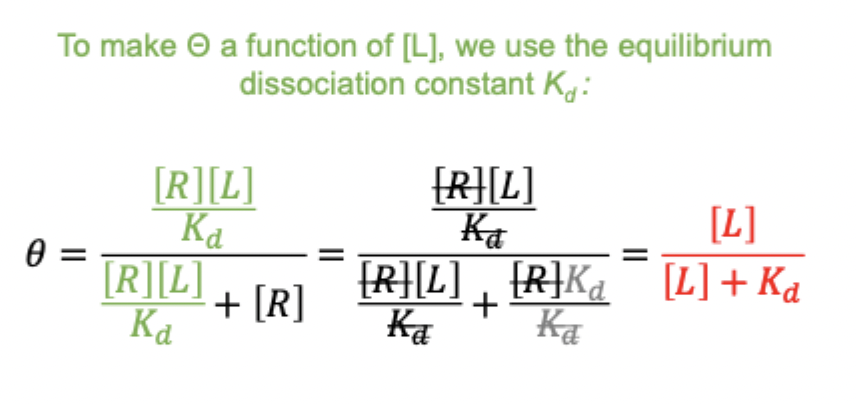
what is the range of θ?
0 to 1
0 when [L] = 0
1 when [L] = ∞
when θ = 0.5, [L]=Kd