Sensory Processing (ch.9)
 Call Kai
 Learn
Learn Practice Test
 Spaced Repetition
 Match
Match Flashcards
 Knowt Play
1/24

There's no tags or description
Looks like no tags are added yet.
Name | Mastery | Learn | Test | Matching | Spaced | Call with Kai | Chat |
|---|
No analytics yet
Send a link to your students to track their progress
25 Terms
Sensory Processing
Means by which individuals obtain information about the world and their own bodies
1. Noticing a stimulus
2. Recognizing or classifying the stimulus
3. Understanding or giving meaning to the stimulus
4. Responding to the stimulus
Hyperresponsivity
Responding too intensely to stimuli
Hyporesponsivity
Lacking necessary response to stimuli
SHARE Framework
Sensory health: A relational and embodied (SHARE) framework for occupation
Lived sensory experiences are:
selective and focused
Prereflective and habitual
Embodied and emplaced
Relational
Polysensorial
Aesthetic
Political
Visual Sysrem
Provides information about an object’s properties
o Shape
o Size
o Color
o Distance
• Associated with community and social functioning
Auditory System
Provides information about sounds and helps to locate things in the
environment
• Humans are (usually) able to selectively attend to auditory input
• Input comes in waves
Tactile System
Detected through sensory receptors in the skin
o Superficial and deep
o Touch
o Pressure
o Thermoreceptors
o Nociceptors
• Localizing and discriminating touch
- More sensitive distally
Skin can adapt to stimuli
Tactile sensitivity in food preferences
Olfactory and Gustatory System
Olfactory – Smell
o Molecules enter the nasal cavity and are detected by olfactory receptors that extend into the nostril as cilia or hair
• Gustatory – Taste
o A chemical on the tongue activates the receptors in taste buds
o Some taste is attributed to smell because they are usually co-occurring
• Chemical sensory systems that are highly connected
• Smell is the only sense directly connected to the amygdala and hippocampus
• Taste and smell are important in food selection and avoidance
Proprioceptive System
Proprioception – awareness of the body’s position in space
• Proprioceptive receptors detect changes in position of muscles and joints
which helps us understand where our body is. They do NOT detect info about the outside environment.
o Muscle spindles- provide information about muscle length and velocity of
stretch
o Golgi tendon organs- provide information at the site where the tendon meets muscle
• Most important for movements done without visual input
Vestibular System
Responsible for balance through detection of the position and movement of the head in space
• We are least conscious of this system unless it becomes dysregulated
o Dizziness
o Nausea
• Receptors are located in the semicircular canals of the inner ear.
• Receptors lie in three different planes to detect movement
Interoceptive System
Recognition and interpretation of the body’s internal cues
• Plays a significant role in typical daily functioning
o Emotional regulation
o Decision-making
o Learning
o Independence
• Can be supported by habits and routines
Sensory Modulation Disorder
Dysfunction in the brain’s ability to respond appropriately to the sensory environment and to remain at the appropriate level of arousal or alertness
o Over-responsivity- exaggerated response of the nervous system to sensory input
o Under-responsivity- lack of or insufficient response to sensory input
o Sensory seeking- nervous system requires intense input for it to be properly registered in the brain
Children with Psychiatric Conditons
ADHD
Developmental Trauma
ASD
ASD Sensory Processing
Symptom of autism
Greater hypo responsiveness in infants/toddlers
Greater hyper responsiveness in adults
Auditory, visual, and tactile MOST affect
OTPs help increase their control of the sensory environment
Adults with Psychiatric Conditions
Schizophrenia and Schizoaffective Disorder
Mood Disorders
PTSD
OCD
PTSD: Adults with Psychiatric Conditions
Re-experiencing trauma is usually accompanied by vivid sensory stimuli (e.g. visual hallucinations; memories of sounds, smells, images)
o Tend to attune to stimuli related to trauma
o Higher scores in Low Registration, Sensory Sensitivity, Sensation Avoiding
o Lower scores in Sensation Seeking
OCD: Adults with Psychiatric Conditions
General difficulty with filtering sensory information and inhibiting responses (e.g. may be more likely to startle to unexpected sound)
o Higher scores in Sensory Sensitivity, Sensation Avoiding, and Low Registration
Sensory Assessments
Infant Sensory Profile 2
Toddler Sensory Profile 2
Short Sensory Profile 2
School Companion 2
Adolescent Adult Sensory Profile
Sensory Processing Measure
Highly Sensitive Person Scale
Sensory Profile Interoception
Informal Observation: Sensory
Does the person notice relevant stimuli?
• Can he or she screen out or habituate to irrelevant information?
• Can the person identify the sensory stimulus correctly?
• Does the person use the information effectively to better understand the
environment or their own body?
• Does the person respond in a way that is productive or adaptive?
• Is the time of day relevant to the person’s observed sensory processing and level of arousal?
• Are specific combinations of sensory stimuli barriers to occupation?
Sensory Integration
Jean Ayre’s theory
Used most commonly with autistic children
Child-directed approach using play activities that target specific senses to elicit an adaptive response and support optimal levels of arousal
• Activities are individualized based on assessment of sensory processing and integration needs
• Primarily targets:
o Tactile system
o Vestibular system
o Proprioceptive system
Sensory Based Interventions
Therapist/caregiver directed approaches to help children regulate arousal levels
Zones of Regulation
Alert Program
Deep Pressure Touch
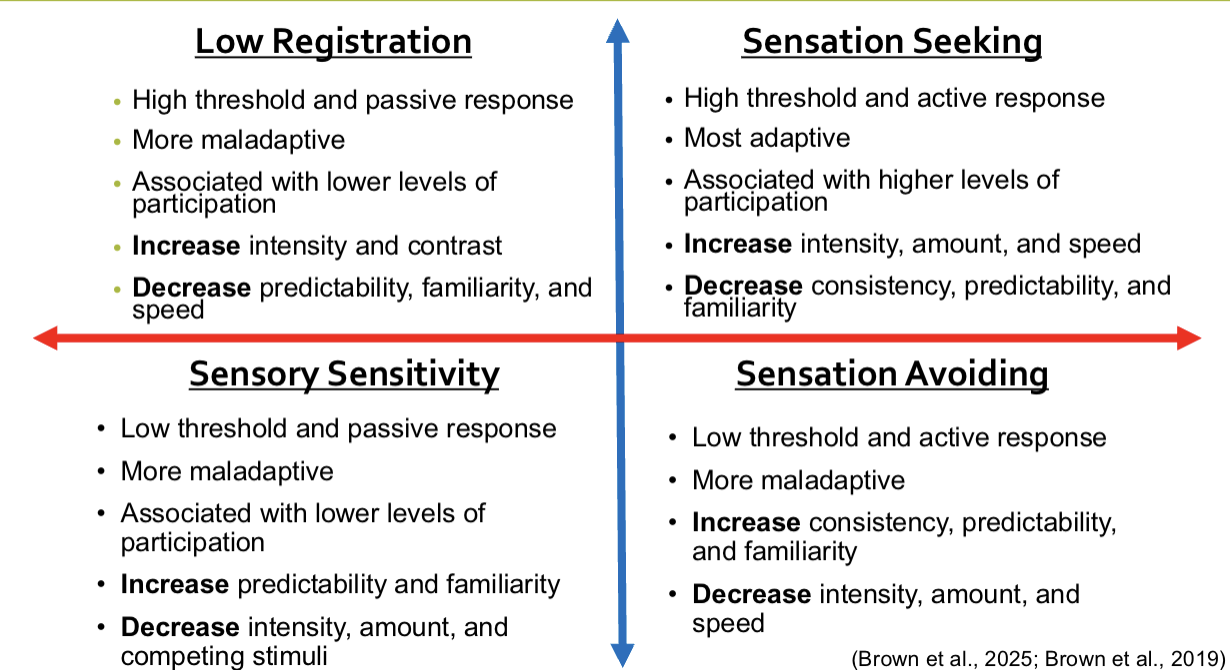
Dunn Model of Sensory Processing
Neurological threshold continuum: LOW (sensitization) → HIGH (habituation)
o Low threshold- it takes less sensory stimuli or less intense stimuli for nervous system to notice it
o High threshold- requires more or increased intensity to notice sensory stimuli
• Behavioral response continuum: PASSIVE → ACTIVE
o Passive response- individual responds in accordance with their threshold
o Active response- intentionally controlling, choosing, or changing environments to manage sensory input
• The intersection of the continua result in the four quadrants
Characteristics of the Sensory Environment
Intensity
Amount
Repetition
Competing Stimuli
Predictability
Familiarity
Speed
Contrast
Snoezelen Environmet
Snuffelen (seek) + Doezelen (relax)
o Intended to reduce agitation and anxiety and promote relaxation
o Two components
1. Environment: sensory stimulation and opportunities for exploration and control, includes different areas that target different sensory systems
2. Staff: guide the experience to promote exploration and enrichment
o Found to be underused due to lack of staff training (potential role for OT)
Sensory Rooms
Used to promote self-regulation and decreased use of seclusion and restraints
o Typically found in inpatient settings
o Activities should provide the appropriate type of sensory input (calming or alerting)