LM 26: nondisjunction in meiosis onramps bio
 Call Kai
 Learn
Learn Practice Test
 Spaced Repetition
 Match
Match Flashcards
 Knowt Play
1/17

There's no tags or description
Looks like no tags are added yet.
Name | Mastery | Learn | Test | Matching | Spaced | Call with Kai | Chat |
|---|
No analytics yet
Send a link to your students to track their progress
18 Terms
Nondisjunction
Chromosome occurs when homologous chromosome pairs fail to separate during meiosis I, or chromatids fail to separate during meiosis II
Leads to gametes with one too many or one too few chromosomes
Aneuploidy
An abnormal chromosome #
Monosomy
2N-1 = 45, 1 chromosome lost
Trisomy
2N + 1 = 47, an extra chromosome gained
Change in # of autosomes
In humans, monosomy in autosomes (chromosomes other than sex chromosomes) is a fatal condition, with no monosomic individuals surviving to birth
Trisomy in autosomes is a near fatal condition
Change in sex chromosomes
Aneuploidy in sex chromosomes has a much higher survival rate than in autosomes.
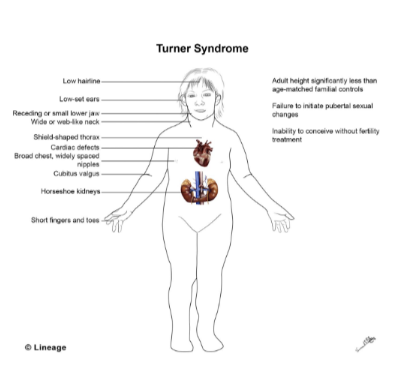
Turner syndrome
Genotype: XO
1 in 2500 female births
20% do not survive to birth
75% caused by abnormal sperm
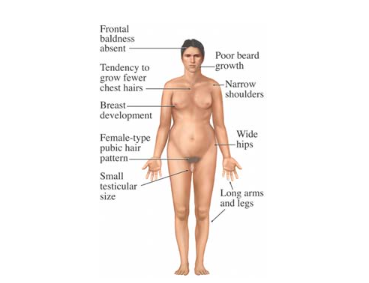
Klinefeter’s syndrome
Genotype: XXY
1 in 1000 male births
Karyotype of an individual with Klinefelter Syndrome
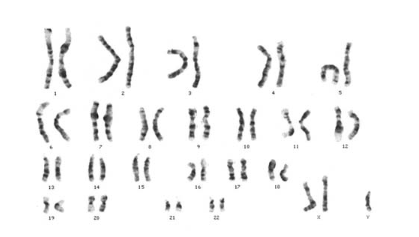
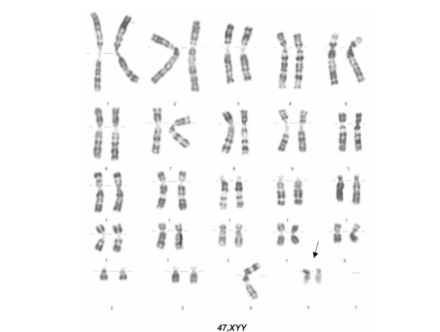
XYY syndrome
Genotype: XYY
Phenotypically male
1 in 1000 male births
XYY males are taller than average
XXX Syndrome
Genotype: XXX
Phenotypically female
1 in 1000 female births
XXX females taller than average
Symptoms often extremely mild or not present at all
Chromosomal Rearrangement
In some cases, chromosomes distribute to the gametes correctly, but undergo rearrangement in the genes they carry
2 major classes of chromosome rearrangements
Inversions
Translocations
Inversions
Chromosome inversion
Pericentric inversion
Paracentric inversions
Chromosome inversion
Occurs when a portion of a chromosome detaches, flips, and reattaches to the chromosome
Pericentric inversions
Include the chromosome’s centromere
Paracentric inversions
Don’t include the centromere
Translocation
Sometimes, a portion of a chromosome detaches and then reattaches to a different, non-homologous chromosome