Cell Bio Module 5 Quiz
 Call Kai
 Learn
Learn Practice Test
 Spaced Repetition
 Match
Match Flashcards
 Knowt Play
1/39

There's no tags or description
Looks like no tags are added yet.
Name | Mastery | Learn | Test | Matching | Spaced | Call with Kai | Chat |
|---|
No analytics yet
Send a link to your students to track their progress
40 Terms
1,2-diacylglycerol (DAG) and inositol 1,4,5-trisphosphate (IP3) are cleaved from phosphatidylinositol 4,5- bisphosphate (PIP2) by the enzyme:
Phospholipase C
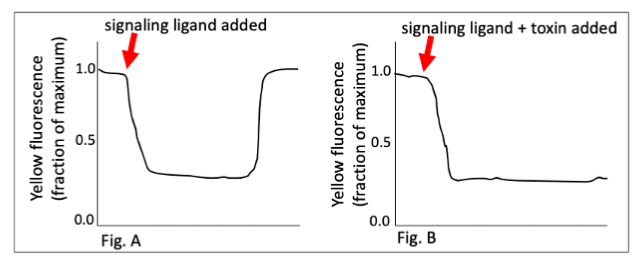
You have isolated a new species of infectious bacteria. The bacterium releases a toxin that you believe is adversely affecting heterotrimeric Gs (stimulatory) protein-based signaling. To explore this hypothesis, you use an epithelial cell line that is expressing a cyan fluorescent protein (CFP)-labeled α subunit and a yellow fluorescent protein (YFP)-labeled β subunit of a heterotrimeric Gs protein. CFP emits blue light and has excitation and emission wavelengths of 440 nm and 490 nm, respectively. YFP emits yellow light and has excitation and emission wavelengths of 490 nm and 527 nm, respectively. To test your hypothesis, you perform two experiments. First, you apply a signaling ligand known to activate this Gs protein and track yellow fluorescence (Fig. A). Second, you apply the signaling ligand and the purified bacterial toxin simultaneously and track yellow fluorescence (Fig. B).
Which of the following conclusions will you draw based on the above experimental data:
A. Application of the ligand and bacterial toxin will likely cause cAMP levels to decrease
B. Application of the ligand and bacterial toxin will likely cause cAMP levels to increase
C. Application of the ligand and bacterial toxin will likely activate Protein kinase C
D. Application of the ligand and bacterial toxin will likely inhibit Adenylyl cyclase
B. Application of the ligand and bacterial toxin will likely cause cAMP levels to increase
Diacylglycerol (DAG) formation aids in cell signaling by acting as a:
Specific docking site to activate a downstream kinase
Which type of experimental evidence shows that the intrinsic GTPase activity of the Gα subunit is important for terminating effector activation?
A nonhydrolyzable GTP analog that can bind to the Gα subunit but cannot be hydrolyzed by the intrinsic GTPase, thereby activating the effector protein longer upon ligand-induced activation of the receptor.
Transcriptional activation downstream of the MAPK pathway involves:
Binding of transcription factors to the SRE of c-Fos
DAG activates:
PKC
Of the components of a heterotrimeric G protein, which subunit is able to activate downstream responses:
A. All of the other answer choices are correct
B. The γ subunits
C. The β subunits
D. The α subunit
A. All of the other answer choices are correct
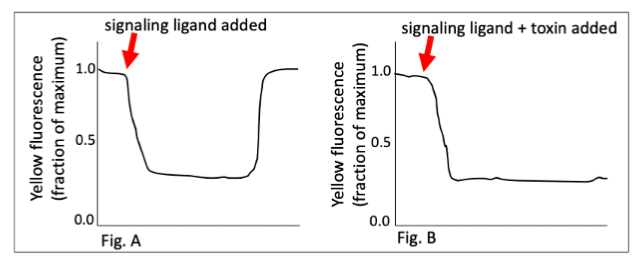
You have isolated a new species of infectious bacteria. The bacterium releases a toxin that you believe is adversely affecting heterotrimeric Gs (stimulatory) protein-based signaling. To explore this hypothesis, you use an epithelial cell line that is expressing a cyan fluorescent protein (CFP)-labeled α subunit and a yellow fluorescent protein (YFP)-labeled β subunit of a heterotrimeric Gs protein. CFP emits blue light and has excitation and emission wavelengths of 440 nm and 490 nm, respectively. YFP emits yellow light and has excitation and emission wavelengths of 490 nm and 527 nm, respectively. To test your hypothesis, you perform two experiments. First, you apply a signaling ligand known to activate this Gs protein and track yellow fluorescence (Fig. A). Second, you apply the signaling ligand and the purified bacterial toxin simultaneously and track yellow fluorescence (Fig. B).
Which of the following conclusions will you draw based on the above experimental data:
A. The toxin locks the α subunit in the “off” state.
B. The toxin has no effect on heterotrimeric G-protein signaling.
C. The toxin locks the α subunit in the “on” state.
D. It is impossible to draw conclusions from these data.
C. The toxin locks the α subunit in the “on” state.
All the following statements about cholera toxin are true EXCEPT:
A. It leads to continuous activation of adenylyl cyclase.
B. It prevents hydrolysis of bound GTP to GDP.
C. It is a G protein-coupled receptor.
D. It chemically modifies the Gsα protein.
C. It is a G protein-coupled receptor.
Which statement about adenylyl cyclase stimulation/inhibition in adipose cells is TRUE:
A. Prostaglandin E1 stimulates adenylyl cyclase
B. Epinephrine stimulates adenylyl cyclase
C. Glucagon inhibits adenylyl cyclase and epinephrine stimulates adenylyl cyclase
D. Glucagon inhibits adenylyl cyclase
B. Epinephrine stimulates adenylyl cyclase
Which of the following mechanisms can terminate an intracellular signaling pathway once the concentration of an external signal decreases:
A. Deactivation of a signal transduction protein
B. Degradation of the second messenger
C. Desensitization of receptors
D. All of the answer choices are correct.
D. All of the answer choices are correct.
Which of the following is NOT a common intracellular second messenger:
A. 1,2 diacylglycerol (DAG)
B. 3'–5' cyclic guanine monophosphate (cGMP)
C. Adenosine triphosphate (ATP)
D. Inositol 1,4,5-trisphosphate (IP3)
C. Adenosine triphosphate (ATP)
Which of the following statements about receptor tyrosine kinase signaling is FALSE:
A. Sos activates the Ras/MAPK signaling cascade by acting as a GEF for Ras.
B. SH3 domains, such as those on GRB2, bind to proline-rich sequences in downstream signaling molecules.
C. The GRB2 adaptor protein binds sequentially and mutually exclusively to the RTK and Sos.
D. The GRB2 adaptor protein associates with RTKs via its SH2 domain.
C. The GRB2 adaptor protein binds sequentially and mutually exclusively to the RTK and Sos.
Muscarinic acetylcholine receptors are GPCRs that slow the rate of heart muscle contraction upon ligand binding/activation. Activation of this receptor leads to opening of potassium channels triggered by decreases in cAMP levels. The muscarinic acetylcholine receptor likely couples to:
Giα
GTPases serve in many signal transduction pathways, and the presence of GTP or GDP dictates whether the pathway is on or off, respectively. Which of the following statements is TRUE regarding guanine nucleotide exchange factors (GEFs) and the role in these signaling pathways:
A. They hydrolyze GTP into GDP and Pi
B. They catalyze the dissociation of GDP on the G-protein and promote the replacement of GTP
C. They decrease the GTPase activity of the G-protein
D. None of the answers is correct
B. They catalyze the dissociation of GDP on the G-protein and promote the replacement of GTP
Ras is a(n):
A. None of the answers is correct
B. Guanine nucleotide exchange factor
C. Adapter protein
D. Kinase
E. Protease
A. None of the answers is correct
The order of events in a signaling pathway can be determined by the analysis of mutants. Cells that express a mutant defective Raf protein cannot be stimulated to proliferate uncontrollably by constitutively active RasD (dominant active). This indicates:
A. Ras is upstream of Raf in the signaling pathway.
B. Raf is upstream of Ras in the signaling pathway.
C. Ras mutants are recessive to Raf mutants.
D. All of the answer choices are correct
A. Ras is upstream of Raf in the signaling pathway.
Which statement is NOT true about the role of adapter proteins in the activation of Ras by receptor tyrosine kinases:
A. Following dimerization and autophosphorylation of receptor tyrosine kinases, GRB2 and Sos proteins couple to the receptor
B. GRB2 and Sos proteins couple the receptor to the inactive Ras·GDP complex
C. Sos acts as a GAP, which helps convert Ras·GDP to active Ras·GTP
D. GRB2 interacts with Sos via its SH3 domain
C. Sos acts as a GAP, which helps convert Ras·GDP to active Ras·GTP
Which protein stabilizes an intermediate and facilitates GTP exchange with GDP in the membrane-bound Ras protein, in the RTK (Receptor tyrosine kinase) signaling cascade?
Sos
Signal amplification is an important part of GPCR-mediated signaling. Which step does NOT directly amplify the signal?
Binding of second messenger to target protein/ion channel
Phosphatidylinositol 4,5-bisphosphate (PIP2) is cleaved by phospholipase C into:
1,2-diacylglycerol (DAG) and inositol 1,4,5-trisphosphate (IP3)
Phospholipase C is activated by:
Gqα
A PIP2 molecule has ________ phosphates where was an IP3 molecule has ___________ phosphates.
3, 3
Which statement explains why Ras is activated quickly by RTKs:
A. Ras is maintained at the plasma membrane through a lipid-mediated attachment
B. Ras changes conformation upon ligand binding to prepare for activation
C. RTKs phosphorylate Ras
D. Ras binds phosphotyrosine residues on RTKs
A. Ras is maintained at the plasma membrane through a lipid-mediated attachment
In heterotrimeric G proteins, GTP binds to the:
α subunit.
1,2-diacylglycerol (DAG) and inositol 1,4,5-trisphosphate (IP3) are cleaved from phosphatidylinositol 4,5- bisphosphate (PIP2) by the enzyme:
Phospholipase C
Cholera toxin can make you sick through overactivation of a Gsα pathway even if your body stops making the ligand associated with activation of the pathway. Knowing this, which statement CANNOT be true about cholera toxin:
A. It leads to continuous activation of adenylyl cyclase
B. It prevents hydrolysis of bound GTP to GDP
C. It chemically modifies the Gsα protein
D. Cholera toxin activates a ligand-activated G protein-coupled receptor
D. Cholera toxin activates a ligand-activated G protein-coupled receptor
A mutation renders a Gqα subunit constitutively active (also known as dominant active). Which of the following effects might you observe in a cell with this mutation:
A. Beta/gamma subunits are less active
B. PIP2 levels in the cell membrane diminish
C. PKC activity decreases
D. IP3 is sequestered at the membrane
B. PIP2 levels in the cell membrane diminish
Which type of experimental evidence shows that the intrinsic GTPase activity of the Gα subunit is important for terminating effector activation:
A. A nonhydrolyzable GTP analog that can bind to the Gα subunit but cannot be hydrolyzed by the intrinsic GTPase, thereby activating the effector protein longer upon ligand-induced activation of the receptor.
B. A dominant-negative (no activity) GEF causes stimulation of the effector protein for longer upon ligand- induced activation of the receptor.
C. A dominant-active (constant activity) GEF causes stimulation of the effector protein for longer upon ligand-induced activation of the receptor.
D. A nonhydrolyzable GTP analog causes displacement of GDP with the modified GTP resulting in continuous activation of the receptor because the bound GTP analog cannot be hydrolyzed to GDP.
A. A nonhydrolyzable GTP analog that can bind to the Gα subunit but cannot be hydrolyzed by the intrinsic GTPase, thereby activating the effector protein longer upon ligand-induced activation of the receptor.
Before ligand binding, receptor tyrosine kinases:
Contain activation lip (loop in proteins) tyrosines within the kinase active site
GTPases serve in many signal transduction pathways, and the presence of GTP or GDP dictates whether the pathway is on or off, respectively. Which of the following statements is TRUE regarding guanine nucleotide exchange factors (GEFs) and the role in these signaling pathways:
A. They catalyze the dissociation of GDP on the G-protein and promote the replacement of GTP
B. They decrease the GTPase activity of the G-protein
C. None of the answers is correct
D. They hydrolyze GTP into GDP and Pi
A. They catalyze the dissociation of GDP on the G-protein and promote the replacement of GTP
All genes regulated by PKA (Protein Kinase A) contain a cis-acting DNA sequence that binds to the phosphorylated form of a transcription factor called:
CREB
The following happens downstream of signaling by PKA EXCEPT:
Activation of adenylyl cyclase
Which of the following mutations in the Gα (alpha) subunit could render a Gs-protein-coupled receptor signaling pathway constitutively INACTIVE:
A. If the Gα subunit of the Gs-protein cannot bind to GTP by replacing the GDP
B. If the Gα subunit produces a lot of cAMP due to the mutation
C. If a mutation in the Gα subunit of the Gs-protein constitutively turns on adenylyl cyclase
D. All of the other answer choices are correct
A. If the Gα subunit of the Gs-protein cannot bind to GTP by replacing the GDP
When the regulatory domain of PKA is bound to cAMP:
The released catalytic subunit travels to the nucleus where it can phosphorylate CREB
Binding of hormone to a receptor tyrosine kinase causes all of the following EXCEPT:
Hydrolysis of GTP bound to Ras
Which of the following events occur during the adrenaline/epinephrin-stimulated conversion of glycogen to glucose-1- phosphate:
A. All of the answer choices are correct
B. Activation of glycogen phosphorylase
C. Activation of phosphorylase kinase
D. Activation of PKA by cAMP
A. All of the answer choices are correct
An SH2-containing protein contains a mutation that changes its binding pocket such that tyrosine and phosphotyrosine bind with equal affinity. As a result, MEK activity:
Does not change with receptor dimerization and transautophosphorylation
Serum response factor (SRF) is phosphorylated by:
p90RSK
Calmodulin:
Is a ubiquitous protein in eukaryotic cells that binds Ca2+ in a cooperative fashion