chemical bonding
 Call Kai
 Learn
Learn Practice Test
 Spaced Repetition
 Match
Match Flashcards
 Knowt Play
1/52

There's no tags or description
Looks like no tags are added yet.
Name | Mastery | Learn | Test | Matching | Spaced | Call with Kai | Chat |
|---|
No analytics yet
Send a link to your students to track their progress
53 Terms
metallic bonding
electrostatic forces of attraction between the lattice of cations and delocalised electrons
strength of metallic bond is determined by
number of delocalised electrons (more electrons given out = stronger)
charge on the cation
radius of cation (smaller = stronger attraction)
Na+ vs Mg2+ , which has higher MP
Na has one delocalised electron per atom while Mg has 2 delocalised electrons per atom
the charge of Mg is more than Na
Radius of Na is larger than Mg
Mg has stronger metallic bonding than Na , requiring more energy to overcome strong metallic bonds
Mg has higher MP
physical properties of metals
good conductor of electricity
good thermal conductivity
malleable (shaped under pressure)
ductile (drawn into thread)
high melting point
metals are good conductors of electricity because
delocalised electrons are highly mobile , can move through the metal structure in response to an applied voltage
application : electrical wires
metals are good thermal conductors because
delocalised electrons and closely packed ions enable efficient transfer of heat energy
cooking utensils
malleable + ductile (metallic bonding)
movement of delocalised electrons is non directional and random through the cation lattice , the metallic bond remains intact while the conformation changes under applied pressure
why do metals have high MP
a lot of energy is needed to overcome the strong metallic bonds
alloy
mixture of 2 or more elements (including carbon)
metal x (non metal/metal)
the addition of another element disrupts the regular arrangement of metal cations in metal lattice
alloy characteristics
stronger
more resistant to corrosion
more chemically stable
because : the addition of another element disrupts the regular arrangement of metal cations in metal lattice
steel alloy
iron + carbon + other elements
high tensile strength but corrodes , used as structural materials
stainless steel (alloy)
iron + carbon + other elements (nickel/chromium — discourage corrosion)
widely used in domestic and industrial appliances due to strength and corrosion resistance
bronze alloy
copper+ tin
coins , medals ,tools
ionic compounds have
giant ionic lattice structure with strong ionic bonds
metal x non metal
ionic bonding
electrostatic forces of attraction between oppositely charged ions in an ionic lattice
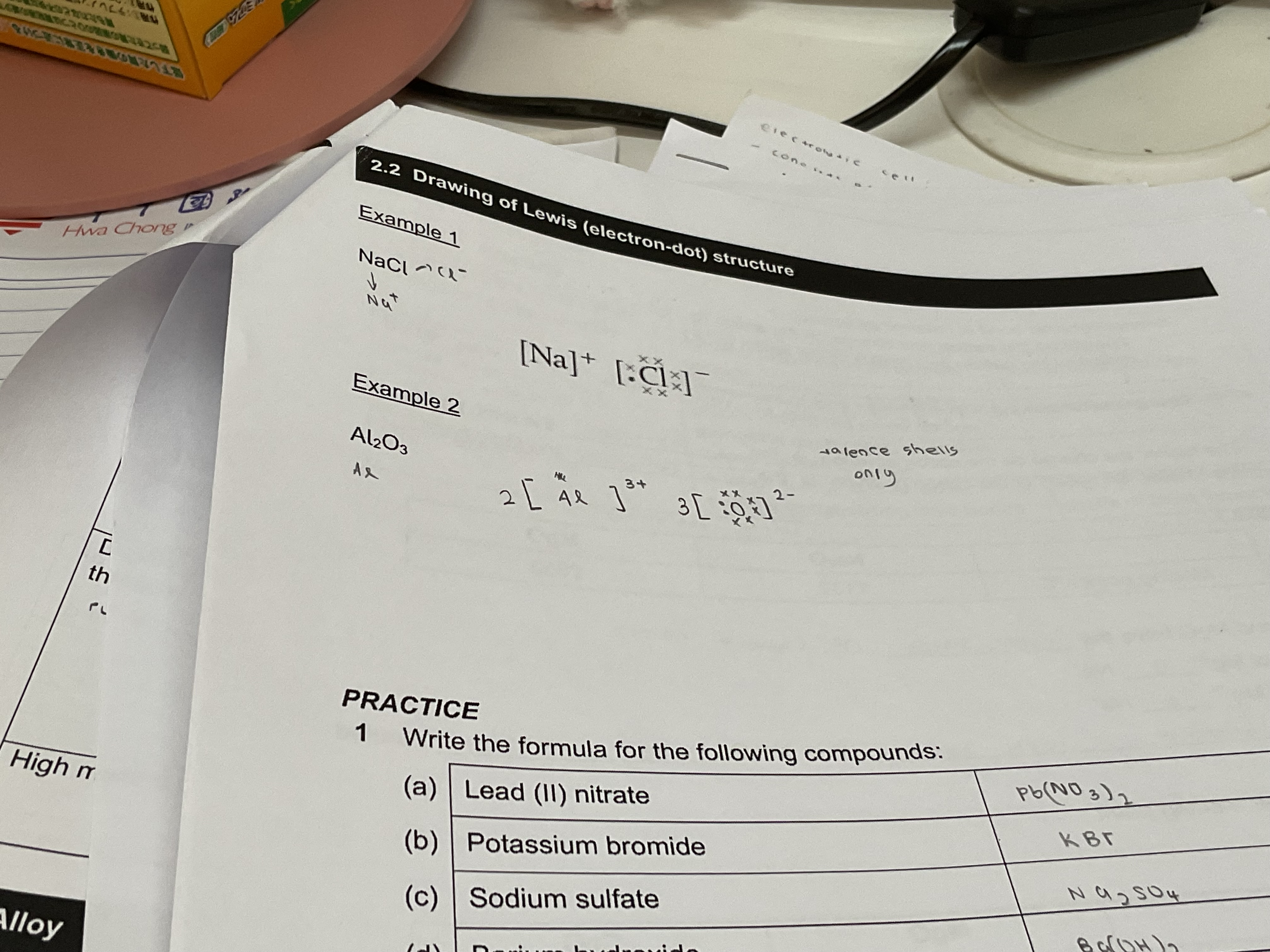
lewis structure
use valence electrons (latest shell)
strength of ionic bond is determined by
charge on the cation and charge on the anion (higher = stronger)
if same anion ignore it and compare cation charge
radius of the cation and radius of the anion (smaller=stronger)
charge x charge / sum of ionic radius
MgO vs CaO , which has higher MP
both have the same anion
charge of Mg and Ca are the same
Radius of Ca is larger than Mg
MgO has stronger ionic bonding + more energy needed to over stronger electrostatic forces of attraction/ionic bonds
MgO has higher MP
physical properties of ionic compounds
good electrical conductivity in molten/aq state
brittle
high MP
ionic compound —good electrical conductivity in molten/aq state
ions are mobile , can move in response to applied voltage
application : electrolytes
ionic compound—brittle
movement of ions within the lattice places ions of the same charge alongside each other , repulsive forces causes it to split (because when pushed together cation may bump into cation)
application : electric wires and cables
ionic compound —high MP
alot of energy is needed to overcome the strong ionic bonds
application : MgO is used to Lin the walls of blast furnace (?)
covalent bonding
electrostatic forces of attraction between 2 nuclei of non metals and the shared pair of electrons
covalent bonds are formed when
non metal atoms share valence electrons to achieve noble gas configuration
single bond/double bond/triple bond
sharing of __ pair of electrons between atoms
strength of covalent bond is
proportional to the number of bonds between atoms (triple=strongest)
inversely proportional to bond length (longer bond length , weaker bond)
VSEPR theory ( valence shell electron pair repulsion)
electron domains are placed as far apart as possible in space to minimise repulsion
allow the shape of the molecule to be determined by repulsion between electron domains
the electron domain geometry is determined by the
total number of electron domains found the central atom
spatial arrangement of all the electron domains
molecular geometry of molecule is determined by
number of bonding electron domains (bond pair) and number of non bonding electron domains (lone pair) around the central atom
when number of electron domain =2 , Eg: CO2
electron domain geometry : linear
number of bonding electron domains : 2
number of non-bonding electron domain : 0
molecular shape : linear (180)
when number of electron domain =3 , Eg: BF3
electron domain geometry : trigonal planar
number of bonding electron domains : 3
number of non-bonding electron domain : 0
molecular shape : trigonal planar (120)
when number of electron domain = 3 , Eg: SO2
electron domain geometry : trigonal planar
number of bonding electron domains : 2
number of non-bonding electron domain : 1
molecular shape : V shaped (117)
when number of electron domain =4 , Eg : CH4
electron domain geometry : tetrahedral
number of bonding electron domains : 4
number of non-bonding electron domain : 0
molecular shape : tetrahedral (109.5)
when number of electron domain =4, Eg:NH3
electron domain geometry : tetrahedral
number of bonding electron domains : 3
number of non-bonding electron domain : 1
molecular shape : trigonal pyramidal (107)
when number of electron domain =4 , Eg: H2O
electron domain geometry : tetrahedral
number of bonding electron domains : 2
number of non-bonding electron domain : 2
molecular shape : V shaped (105)
giant covalent structure / macromolecular structure
atoms linked together by covalent bonds to form a lattice structure
allotropes
different forms of an element in the same physical state
graphite structure (allotrope)
Each C atom is covalently bonded to 3 other C atoms , forming hexagons in parallel layers with bond angles of 120
The layers are held by weak van Der waals’ forces of attraction and can slide over each other
graphite electrical conductivity
good conductor of electricity
each C contains one non bonded electron which is delocalised along the parallel layers
graphite appearance + special properties + uses
appearance : non lustrous , grey crystalline solid
special properties : soft and slippery, brittle , high MP
uses : dry lubricant , in pencil , electrode rod in electrolysis
diamond (allotrope) structure
Each C atom is covalently bonded to 4 other tetrahedrally arranged in a regular repetitive pattern with bond angles of 109.5
diamond electrical conductivity
non conductor of electricity . All valence electrons of C are involved in covalent bond formation
diamond appearance + special properties + uses
appearance : highly transparent , crystalline solid
special properties : cannot be scratched , brittle , high MP
uses: jewellery , tools and machinery for cutting glass
simple covalent structure
covalent bonds hold atoms together in a molecule while intermolecular forces of attraction hold molecules together
non metal x non metal
strength of intermolecular forces determines the
physical properties of a substance — MP and BP
intermolecular forces include
van der Waals forces
hydrogen bonding
Properties of simple covalent molecules
no electrical conductivity — no delocalised electrons/mobile ions
low MP and BP — little energy needed to overcome weak intermolecular forces of attraction
van der Waals forces strength is determined by
number of electrons in the molecule (greater=stronger, as more energy is required to overcome…)
which has higher MP , CH4 or C2H6
*count the MR of each first , MR is proportional to electrons
C2H6 has higher Mr
More electrons
strength of van Der Waals forces of attraction is higher , more energy needed to overcome
MP increases
electronegativity
measure of the ability of its atoms to attract electrons in a covalent bonding
electronegative atom
when a molecule contains hydrogen and is covalently bonded to
fluorine
oxygen
nitrogen
they are attracted to each other by hydrogen bond
hydrogen bond
strongest form of intermolecular forces of attraction
BP of molecules forming hydrogen bonds are higher
stronger than van Der Waals
CH4 vs H2O , which has higher MP
both have simple covalent structure
H2O has hydrogen bonded to very electronegative O atom and can form stronger hydrogen bonds between molecules
CH4 forms weak van Der Waals forces between molecules
more energy needed to overcome stronger hydrogen bonds
H2O higher MP