lymphatic system, immune system
 Call Kai
 Learn
Learn Practice Test
 Spaced Repetition
 Match
Match Flashcards
 Knowt Play
1/164

There's no tags or description
Looks like no tags are added yet.
Name | Mastery | Learn | Test | Matching | Spaced | Call with Kai | Chat |
|---|
No analytics yet
Send a link to your students to track their progress
165 Terms
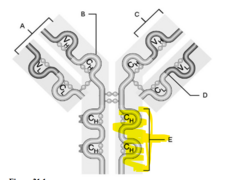
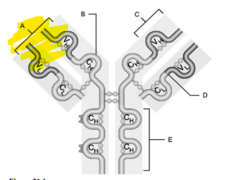
Heavy chain
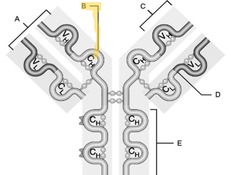
Light chain
Variable region
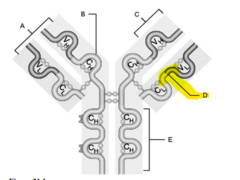
Constant region
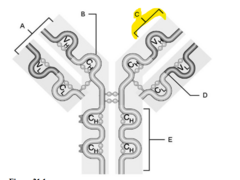
antigen binding site
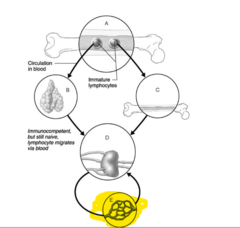
Area where B cells become immunocompetent.
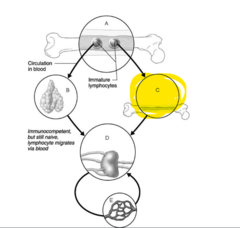
Area where T cells become immunocompetent.
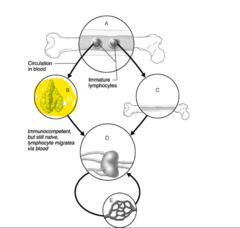
Area where activated immunocompetent B and T cells recirculate.
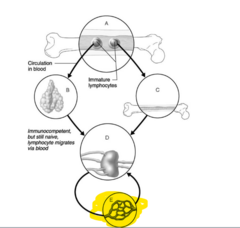
Area seeded by immunocompetent B and T cells.
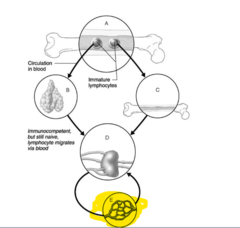
Area where antigen challenge and clonal selection are most likely to occur.
First line of defense.
intact skin, mucous membranes
Second line of defense.
inflammatory response
Third line of defense.
immune response
Innate defense system.
Inflammatory response and skin and mucous membranes
Adaptive defense system.
immune response
Enables quick and efficient response to secondary exposure to antigen.
Memory cell
Absence results in no immune response.
T helper cell
Forms antibody-producing cells.
B cell
Kills cancer cells and virus infected body cells.
cytotoxic T cell
Slows or stops the immune response.
regulatory T cell
Main antibody of both primary and secondary immune response
IgG
Protects mucosal barriers
IgA
Involved in allergies.
IgE
Along with IgM, this is a B cell receptor
IgD
First to peak during a primary immune response.
IgM
Natural killer cells destroy target cells or pathogens by ingestion and destruction of particulate
matter in a process called phagocytosis.
FALSE
Viral infection will provoke cell mediated immunity but will not activate a humoral response.
FALSE
Monoclonal antibodies are used in clinical laboratory diagnosis because they bind to many
antigenic determinates.
FALSE
B cells must accomplish double recognition: they must simultaneously recognize self and
nonself to be activated.
FALSE
In a case of immediate hypersensitivity, the immune system responds with an allergic
response on the first exposure to the allergen
FALSE
Subacute hypersensitivities are categorically less harmful than acute (immediate)
hypersensitivities.
FALSE
An advantage to adaptive immunity is ________.
its memory cells that provide quicker, larger and more efficient immune response upon second exposure to an antigen
A cellular component of the innate defenses includes ________.
natural killer cells
B lymphocytes are categorized as part of the adaptive branch of the immune system for all of the following reason but one. Which of the following is NOT one of the reasons B lymphocytes are considered part of the adaptive immunity?
They are a first line of defense that can begin killing pathogens immediately.
T cells are differentiated into two groups based on their glycoproteins: CD4 or CD8. Which of the following is true of CD4 T cells?
They become T helper cells.
Which of the following examples below describes an autoimmune disease?
Antibody binding to acetylcholine receptors of the motor end plate resulting in muscle
weakness.
Which of the following does NOT describe actions of interferon (IFN)?
IFN can penetrate the viral capsid and destroy the virus.
A vaccine is effective because ________.
the secondary response of the adaptive immunity is faster and more efficient than the primary
response
A flu vaccine is needed seasonally to be effective but a polio vaccine is only needed once. The best explanation of this is ________.
the flu has several strains that change seasonally
All of the following are true of the classical pathway of complement activation except one.
Select the one answer that does NOT describe the classical pathway of complement activation.
It activates T helper cells by presenting antigen to them.
Vaccines work by
priming the adaptive immunity with a relatively harmless primary exposure
Inflammation ________.
brings more leukocytes to the sight of infection
Membrane attack complex (MAC) kills by ________.
disrupting the selectively permeability of a bacteria's plasma membrane
All but one of the following occurs during the inflammatory response. Select the example
below that does NOT describe the process of inflammation.
Vasoconstriction prevents excessive blood loss due to injury.
During inflammation, fluids will passively diffuse out of blood vessels into the nearby
infected tissues. This implies all of the following EXCEPT ________.
B-lymphocytes will differentiate to become plasma cells
Which of the following is true of antigens?
Antigens are substances that activate the adaptive immune response.
Which of the following is true of incomplete antigens (haptens)?
Incomplete antigens are only immunogenic when attached to protein carriers
Allergens differ from antigens because ________.
allergens produce an abnormally large immune response to what is an otherwise harmless
particle
Without the positive selection process in lymphocyte maturation ________.
T cells would not be able to properly bind to APC's and therefore not be activated by them
Lymphocyte "education" refers to ensuring that T cells _______.
that do not recognize self-MHC proteins undergo apoptosis
Plasma cells ________.
have a great deal of rough endoplasmic reticulum reflecting the fact that they secrete a
tremendous amount of protein (antibody)
Which of the following is associated with passive immunity?
passage of IgG antibodies from a pregnant mother to her fetus
Which of the following is NOT a type of T cell?
antigenic
B lymphocytes develop immunocompetence in the ________.
bone marrow
Which of the following is NOT a function of the inflammatory response?
replaces injured tissues with connective tissue
The redness and heat of an inflamed area are due to a local hyperemia caused by ________.
vasodilation
In clonal selection of B cells, which substance is responsible for determining which cells will
eventually become cloned?
antigen
Which of the following statements regarding NK cells is a false or incorrect statement?
NK cells are a type of neutrophil.
Small molecules that bind with self-proteins to produce antigenic substances are called
________.
haptens
Which of the following is NOT a role of activated complement?
prevention of immediate hypersensitivity reactions
Interferons ________.
interfere with viral replication within cells
Regulatory T cells ________
may function in preventing autoimmune reactions
Which of the statements below does NOT describe antigens?
Antigens only come from microbes.
Activated T cells and macrophages release ________ to mobilize immune cells and attract
other leukocytes into the area.
cytokines
Which of the following would be a component of the body's first line of defense?
mucous membranes
Which of the following is characteristic of complete antigens?
reactivity with an antibody
B cells respond to the initial antigen challenge by ________.
producing progeny cells that include plasma cells and memory cells
T-cell activation requires ________.
antigen binding and co-stimulation
Cancer cells and virus-infected body cells can be killed before activation of adaptive
immunity by ________.
natural killer cells
Complement proteins and antibodies coat a microorganism and provide binding sites,
enabling macrophages and neutrophils to phagocytize the organism. This phenomenon is termed
________.
opsonization
Monoclonal antibodies are used for the diagnosis of all of the following EXCEPT ________.
elevated blood glucose
Innate immune system defenses include ________.
phagocytosis
Which of the following statements is incorrect or false?
Class II MHC molecules appear only on the surface of antigen-presenting cells, thymic cells,
and T cells that have been activated by exposure to antigens.
Phagocyte mobilization involves ________.
mainly neutrophil and macrophage migration into inflamed areas
Fever ________.
production is regulated by chemicals that reset the body's thermostat to a higher setting
Immunocompetence ________.
is the ability of individual cells to recognize a specific antigen by binding to it
Select the correct statement about active and passive immunity.
Active and passive humoral immunity are both mechanisms of adaptive immunity that use
antibodies.
Cytotoxic T cells ________.
can directly attack and kill other cells of the body
T helper cells ________.
function in the adaptive immune system activation
Immediate and subacute hypersensitivities are caused by ________ that trigger the release of
_________.
antibodies; histamine
Natural killer (NK) cells ________.
can kill cancer cells before the immune system is activated
Select the correct statement about antigens.
One antigen may have many different antigenic determinants and may therefore cause the
formation of more than one antibody.
Clonal selection of B cells ________.
results in the formation of plasma cells
The primary immune response ________.
has a lag period while B cells proliferate and differentiate into plasma cells
Tissue rejection after an organ transplant is least likely due to the action of _________.
regulatory T cells
Which of the following is NOT a mechanism for the development of autoimmune disorders?
a second exposure to an allergen
Which of the following is activated by the binding of proteins to sugars on the surface of
microorganisms?
lectin pathway
Antibody functions include all of the following EXCEPT ________.
cross-linking cell-bound antigens on red blood cells when blood types are properly matched
Which statement is true about T cells?
Their proliferation is enhanced by interleukins 1 and 2
What is the role of interferon in defense against disease?
protects cells that have not yet been infected by viruses
Which of the following statements is a false or incorrect statement?
After becoming immunocompetent, the naive T cells and B cells are exported to the bone
marrow where the encounters with antigens occur.
Which immunoglobulin class is the most abundant antibody in plasma?
IgG
Suppressor factors are ________ that suppress the immune system.
cytokines
Pure antibody preparations specific for a single antigenic determinant are called ________
antibodies.
monoclonal
The most common type of immediate hypersensitivity is ________.
allergy
Natural killer cells can lyse and kill cancer cells and virus-infected body cells ________ the
immune system is activated.
before
Septic shock is a dangerous condition where the ________ are released unchecked, making
the capillaries very leaky and thus depleting blood fluids.
cytokines
Harmful or disease-causing microorganisms are called ________.
pathogens
A group of at least 20 plasma proteins that normally circulate in an inactive state and are a
major mechanism for destroying foreign substances in the body are referred to as ________.
complement
he antibody that becomes bound to mast cells and basophils and causes the cells to release
histamine and other chemicals is ________.
IgE