Public protection, punishment & rehabilitation
 Studied by 0 people
 Call Kai
 Learn
Learn Practice Test
 Spaced Repetition
 Match
Match Flashcards
 Knowt Play
1/30

Earn XP
Description and Tags
his majesty prison, priorities for custodial setneces, risk factors & public protection
Name | Mastery | Learn | Test | Matching | Spaced |
|---|
No study sessions yet.
31 Terms
Prison Reform Trust, Bromley Briefing (2023)
42% of adult offenders reoffend within 12 months of release
58% if they served a sentence of 12 months or less
58% of female offenders reoffend within 12 months of release
73% if they served a sentence of 12 months or less
63% of youth offenders reoffend within 12 months of release
70% if they offender served a sentence of 12 months or less
Rt Hon David Gauke MP - Prison reform speech
Depriving someone of their liberty for a period of time is one of the most significant powers available to the State and must be imposed with respect for the rule of law and with purpose.
Prison is the sharp end of our justice system. By imposing this serious sanction, we must be clear about what prison is for.
I believe its purpose is threefold:
First, protection of the public – prison protects the public from the most dangerous and violent individuals.
Second, punishment – prison deprives offenders of their liberty and certain freedoms enjoyed by the rest of society and acts as a deterrent. It is not the only sanction available, but it is an important one.
And third, rehabilitation – prison provides offenders with the opportunity to reflect on, and take responsibility for, their crimes and prepare them for a law-abiding life when they are released.
It is only by prioritising rehabilitation that we can reduce reoffending and, in turn, the numbers of future victims of crime
International Centre of Prison Studies (2018)
US over 700 per 100,000
Russia
England/wales rather in the middle
Nigeria & India lower level
Across the EU we prison a higher proportion
Prison population (MoJ 2021)
Prison population of England & Wales x4 in size between 1900 -2018
½ of this increase taking place since 1990
Projections forecast that the prison population will be between 93,100 & 106,300 by March 2027.
a rise due to expected longer determinate sentences & increasing police numbers leading to higher charge rates.
take into account a fall in the number of prisoners aged over 50 & the continuing decline in the number of prisoners serving indeterminate sentences (imprisonment for the public protection (IPP)
Prisons in England & Wales
124 prisons
11 female (2 ‘open’), 16 private (SERCO, G4S, Sodexo; revert to public control after 25 yrs)
8 category A, 43 cat B, 43 cat C, 10 cat D, 13 HMYOI
24 built since 1995 (around 40 built before 1901)
Record high of 88,521 (98.8% capacity) (2024)
94.7% men
Decrease of 5,500 due to COVID
total current pop = 87,323 - 97.8% capacit
Cost of prisons (Statista, 2023)
£7.41 Billion (2025)
£56,987 per year per prisoner (2023)
£35,182
cost of community sentence £2,500-8,00 year
cost of probation £1,600
prison population sentencing
3,833 serving sentences < 12 months (4.4%) 91% of whom are male
56% serving 4+ years, 23% serving 1-3 years,
13,186 serving life/indeterminate sentences (19.6%), 97% male
But additional 16,196 on remand (awaiting trial or sentencing) (MoJ, Sept 2023)
Those sentenced in 2018 (59,000): (Prison Reform Trust, 2019)
69% committed a non-violent crime
46% were sentenced to 6 months or less in prison
63% sentenced to less than 12 months
Priorities for the CJS
Protect the public
To punish
To rehabilitate
protect the public priority for CJS
prisons should be physically secure places in order to prevent the escape of offenders who pose an unacceptable risk to the public
To punish priority for CJS
prisons should not be comfortable places
public should be confident that offenders are not treated favourably
To rehabilitate priority for CJS
prisons should offer solutions to the causes of offenders’ illegal behaviour, in order to prevent or at least reduce reoffending upon release
Prison population: offence type
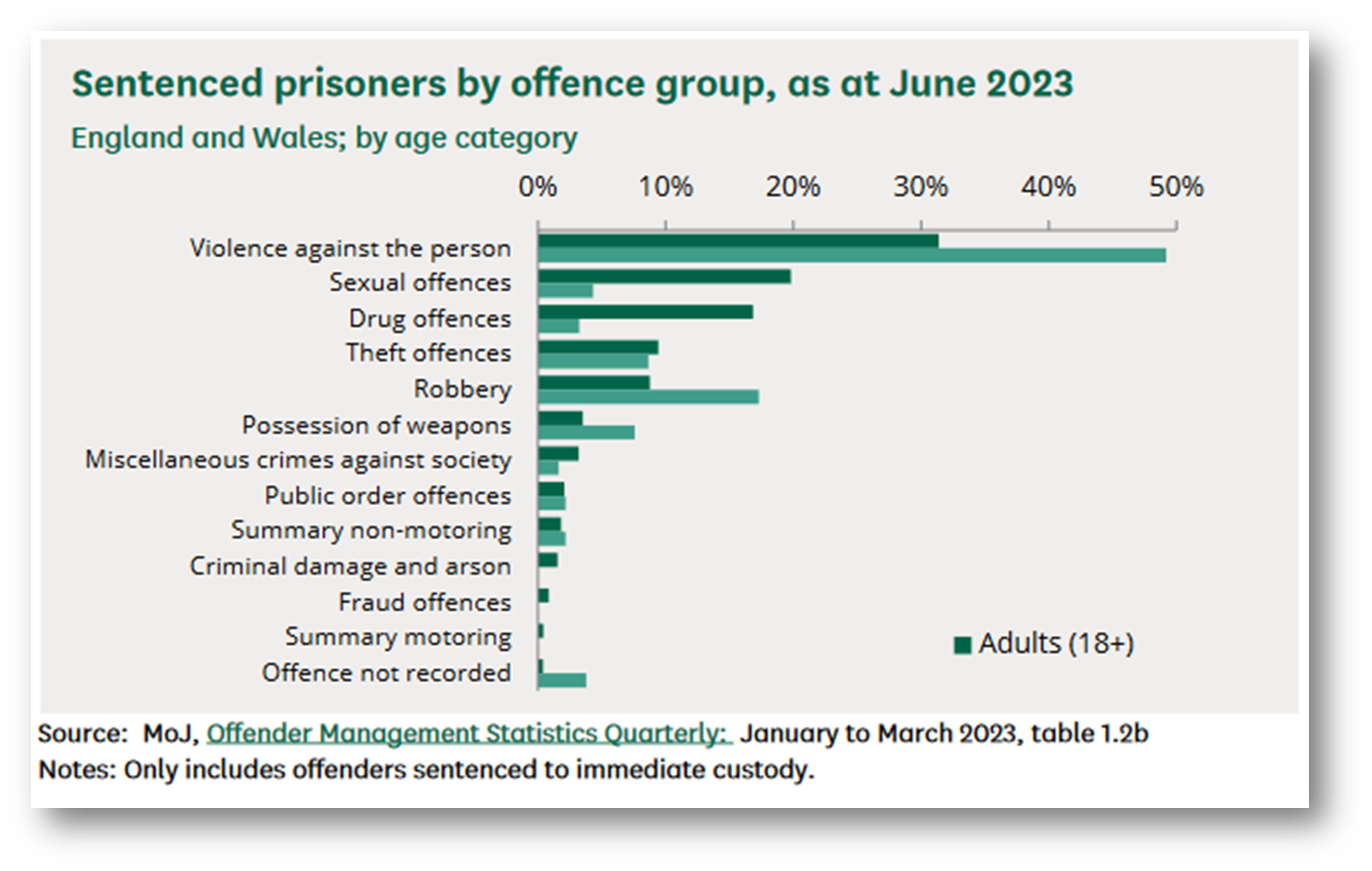
Prison population’s age (MoJ 2023)
The prison population is ageing:
In 2002, 15% were under the age of 21 compared to 5% in 2021
Number over the age of 50 increased from 7% in 2002 to 18% in 2023.
Offence type by gender
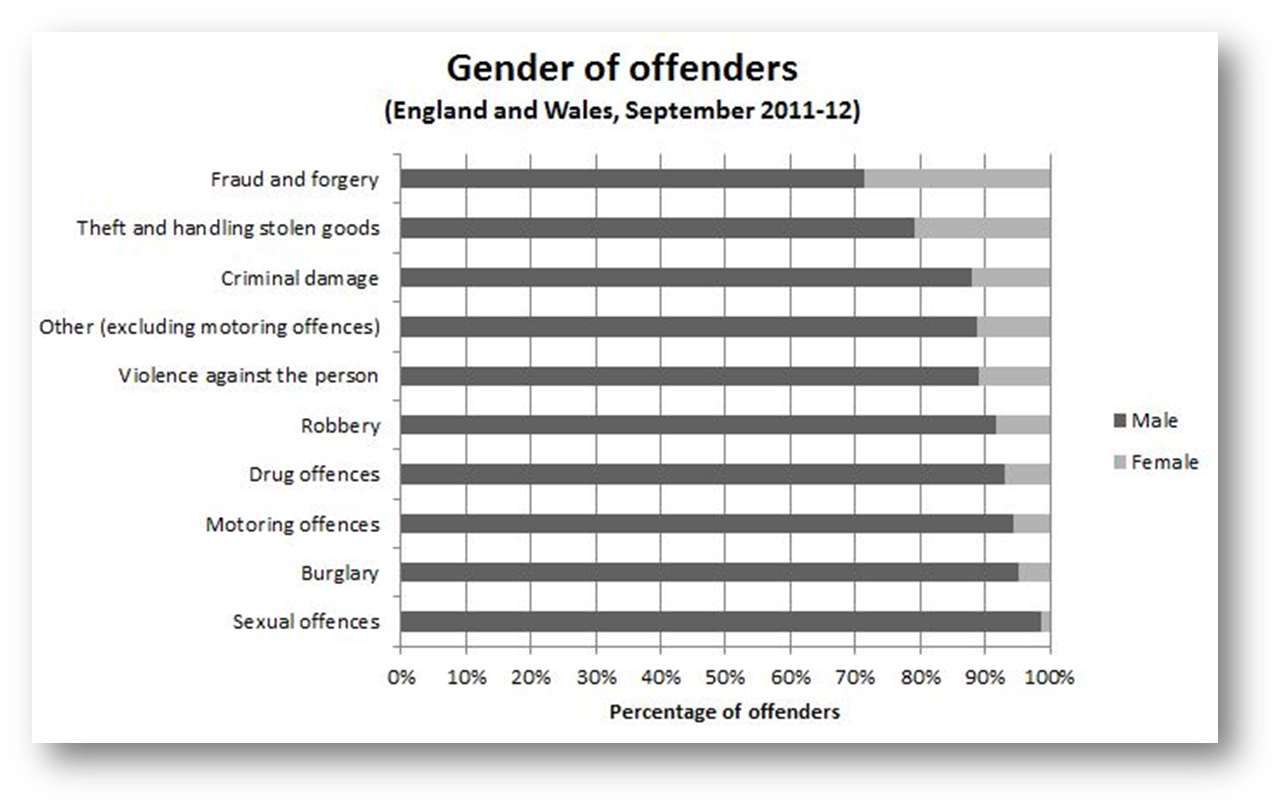
in every catergoy men outway women
fruadry is most unbalanced
prison population gender
Corston review (2006) of vulnerable women in CJS following the deaths of 6 women at Styal prison, stated:
“Community solutions for non-violent women offenders should be the norm.”
The report concluded that:
“There must be a strong consistent message right from the top of government, with full reasons given, in support of its stated policy that prison is not the right place for women offenders who pose no risk to the public.”
indended to be taken out of pp
Marget Thatcher’s removing the residentual care home
made it “care in the community”
resulted in higher rates of homelessness and crime
Lifestyle stability of prisoners in england & wales (HoCL, 2013)
64% in receipt of benefits within 12 months of start of sentence
Around 70% suffer from two or more mental disorders, compared with general population figures of 5% (men) and 2% (women)
5% were sleeping rough and 31% had no permanent residence immediately prior to imprisonment
50% of women in prison report having suffered domestic violence, 33% of women had experienced sexual abuse
Childhood experiences of prisoners’ in England & Wales (HoCL, 2013)
24% of prisoners (31% for women) had lived in foster care, an institution or had been taken into care in childhood
29% experienced emotional, physical or sexual abuse as a child, with women (53%) more likely than men (27%)
41% had observed violence in the home in childhood
37% family member convicted on criminal offence (non-motoring)
Educational history of prisoners’ in England & Wales (HoCL, 2013)
59% report regularly playing truant from school
47% have no academic qualifications (vs 15% of general pop.)
67% have numeracy skills at or below the level expected of an 11 year-old
50% have reading ability and 82% have writing ability at or below that expected of an 11 year-old
3% have university degrees
Organised crime within (March, 2018)
The fact is, there are around 6,500 prisoners who have links to organised crime.
At the moment, these offenders are spread across the estate and are helping to perpetuate the cycle of crime by drawing fellow prisoners into the clutches of the gangs.
So, I want to rethink how we categorise prisoners – that means looking again at who goes to higher security-level prisons.
Rather than just considering their length of sentence and risk of escape in determining which prison an offender goes to – or moves to – I want to look, as well, at their behaviour in prison and their risk of directing crime and violence whilst in prison.
type of offenders (Corbett, 1995)
Conformers
always comply w/relevant law
Deterred
need reminding offending is unacceptable
Manipulators
only comply if increased chance of detection or severe punishment
Defiers
behaviours don’t appear affected by anything
Prisons Reform Speech (2018)
“Depriving someone of their liberty for a period of time is one of the most significant powers available to the State and must be imposed with respect for the rule of law and with purpose.
Prison is the sharp end of our justice system. By imposing this serious sanction, we must be clear about what prison is for.”
Rt Hon David Gauke MP
Types of offender (Corbett, 1995)
conformes = always comply
Deterred = need to remind the offending is unacceptable
manipulators = only comply is an increased chance of detection or more severe punishment if caught offending gains
would see the camera but accelerate beyond
slow down for the camera, but then speed up
defiers = behaviours don’t appear to be affected by anything, less than 5%
what is justice
Perceptions of fairness, legitimacy, what is considered to be ‘right’ depend on a range of factors
Treatment of offenders must be perceived as ‘just’
Retribution
Harm done by offenders requires society to rectify the imbalance by punishing them appropriately
Related to concerns about status and power
An offender gains an unfair advantage over those who adhere to the law
an eye for an eye
proportionality based on moral offense
Magnitude of harm
Perpetrator’s intentions
Mitigating or aggravating circumstances
Deterrence
adverse consequences (Ipunishment) will make (re)offending less likely
specific or general deterrence effects (Stafford & Warr, 1993)
Circumstance of crime
Capital crimes
Deterrence vs incentivisation
Range of sentence length
Minimum sentence imposed
E.g., compare:
10 to 12-year sentence w/15% time off for good behaviour
Range 8.5 – 10.2 years
14 to 20-year sentence w/40% time off for good behaviour
Range 8.4 – 12.0 years
Rehabilitation
constructive efforts to provide education, training or other services to enable offenders to become reintegrated in society & reduce reoffending
Short prison sentences less effective than community sentences in reducing offending, yet use of community sentences has halved in ten years 2009-2019 (Prison Reform Trust, 2019)
what support is offered on release for prisoners
£75 ‘discharge grant’
(increased from £46 in 2020 after 25 years with no change)
No access to any other form of social support for six weeks
Restoration
Offenders make reparations to victims for the harms they have caused
often through a carefully managed negotiation & reconciliation process
Dialogue between offender & victim related to concerns about shared values
‘Making amends’ → “The repair of justice through reaffirming a shared value-consensus in a bilateral process” (Wenzel et al, 2008)
Treats transgressions/offences as examples of conflict
Such conflicts should be returned to their owners for resolution
Impact statements
Imprisonment for Public Protection (IPP)
Created by the Criminal Justice Act (2003)
Started to be used in 2005 → Abolished in 2012
Convicted offenders sentenced to minimum term
Having served minimum term, referred to Parole Board
“The Parole Board will release an offender only if it is satisfied that it is no longer necessary for the protection of the public for the offender to be confined” (MoJ)
Being used too extensively (7% of convicted offenders)
2,000 prisoners still serving IPPs