MODULE 2 LESSON 3 - STAGES OF LABOR
 Call Kai
 Learn
Learn Practice Test
 Spaced Repetition
 Match
Match Flashcards
 Knowt Play
1/17

There's no tags or description
Looks like no tags are added yet.
Name | Mastery | Learn | Test | Matching | Spaced | Call with Kai | Chat |
|---|
No analytics yet
Send a link to your students to track their progress
18 Terms
stages of labor
first stage - dilation of the cervix
second stage - complete cervical dilation (10cm)
third stage - birth of the baby;delivery of the placenta
fourth stage - recovery phase. last after 2 hours of birth
3 phase of FIRST stage
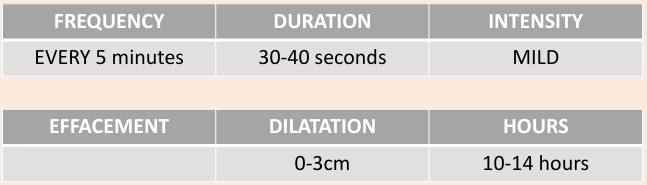
early / latent phase (0-3cm)
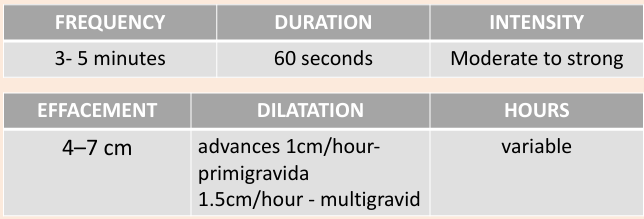
active phase (4-7cm)
transitional phase (8-10cm)
LATENT PHASE
Begins with the establishment of regular contractions (labor pains).
ACTIVE PHASE
Characterized by more active contractions. During the active labor phase, the woman becomes more focused on each contraction and tends to draw inward in an attempt to cope with the increasing demands of the labor
TRANSITION PHASE
The most intense phase of labor. the laboring woman may feel that she can no longer continue or she may question her ability to cope with much more. Other sensations include rectal pressure, an increased urge to bear down, an increase in bloody show, and spontaneous rupture of the membranes (if they have not already ruptured)

LATENT PHASE: Presence Anticipatory guidance
ACTIVE PHASE: Promotion of comfort (positional changes) Deep-breathing exercises Personal comfort measures
TRANSITION PHASE: Coaching on pushing
ASSIST NURSE (nursing care during the first stage of labor)
Friedman curve
A labor curve assessment tool
120-160 bpm
normal FHR baseline
Fetal Acceleration
Increase in the FHR of 15 bpm above the fetal heart baseline that lasts for at least 15 to 30 seconds. Accelerations are considered a sign of fetal well-being when they accompany fetal movement. Accelerations may occur before, during, or after a contraction.
Fetal Deceleration
are defined as any decrease in FHR below the baseline FHR. Decelerations are further defined according to their onset and are characterized as early, variable, and late
2nd Stage of Labor
The second stage of labor begins with full dilation of the cervix and ends with the birth of the infant.
Second Stage in Nulliparous Women
The second stage often involves 1 to 2 hours of pushing.
Second Stage in Multiparous Women
Multiparous women typically experience a much shorter second stage, and childbirth may occur within minutes following full cervical dilation.
Crowning
This is when you can see the top of the baby's head through the opening of the vagina. This moment happens during the second stage of labor, when the mother pushes and delivers her newborn
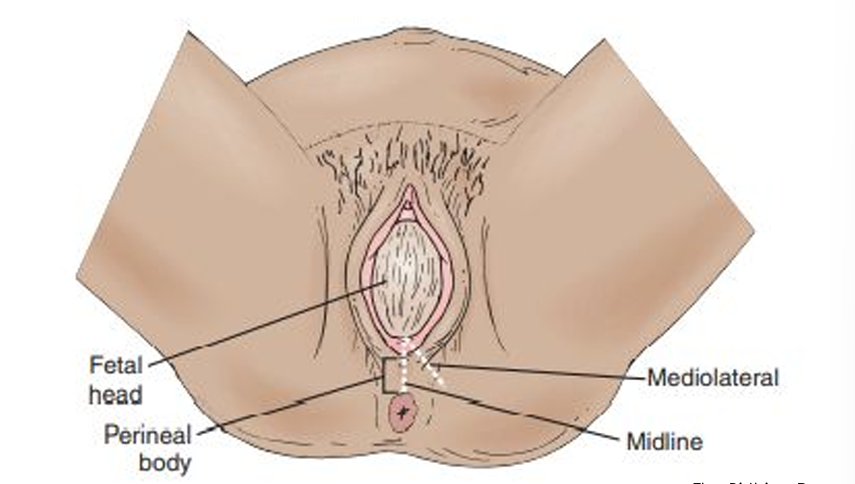
EPISIOTOMY
a surgical incision of the perineum that is performed to facilitate birth. The most common method is the midline or median. An incision is made from the vaginal opening downward toward the rectum
D - escent
F - lexion
I - nternal rotation
E - xtension
R - estitution
E - xternal rotation
E - xpulsion
THE CARDINAL MOVEMENTS
clamping of the umbilical cord
two Kelly clamps on the umbilical cord, and may invite the father or birth support person to cut the cord between the two clamps.
nurse places a plastic clamp on the umbilical cord approximately 0.5–1 inch (1.2–2.5 cm) from the newborn’s abdomen, avoiding the abdominal skin.
Umbilical Cord Vessel Assessment
The nurse observes the cut umbilical cord for three blood vessels: two arteries and one vein.