Fish Phys. CIRCULATION
 Call Kai
 Learn
Learn Practice Test
 Spaced Repetition
 Match
Match Flashcards
 Knowt Play
1/28

There's no tags or description
Looks like no tags are added yet.
Name | Mastery | Learn | Test | Matching | Spaced | Call with Kai | Chat |
|---|
No analytics yet
Send a link to your students to track their progress
29 Terms
sinus venosus
the 1st chamber blood flows thru. in the heart, received from the veins
thin walled receptacle
stretches when blood fills
stretching activates cardiocytes
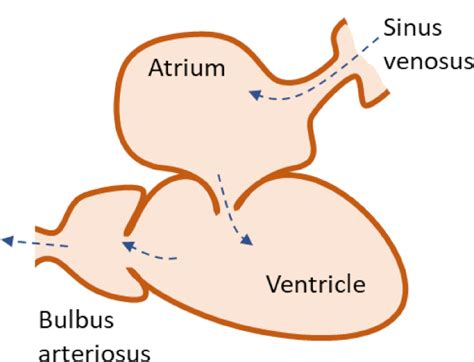
atrium
1st acceleration point, relatively thin walls with some musculature
collects blood from the sinus venosus
accelerates blood via relaxing/contracting

ventricle
main pump w/ the most acceleration, heavy walls of cardiac muscle
contracting pumps blood
relaxing refills the heart
2 layers
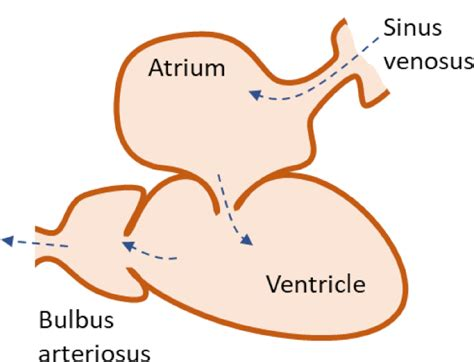
outer layer of the ventricle
cortex — neural connection
needs its own O2
dense muscle fibers
inner layer of the ventricle
spongy myocardium
myocardium = the heart’s muscular wall
bulbus arteriosus
elastic chamber that dampens blood flow, which reduces pressure
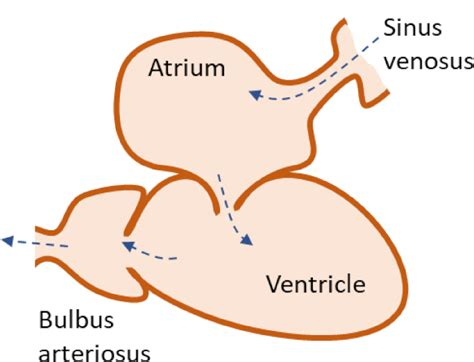
conus arteriosus
similar to the bulbus arteriosus, but for primitive fishes
cardiac output (Q) is determined by ______ & _______
heart rate
stroke volume
cardiac output (Q) units
ml per minute
cardiocyte
cell(s) in the sinus venosus that set the pace of heartbeat
adrenergic
stimulation that increases heartbeat
causes tachycardia
tachycardia
increased heartbeat
adrenergic
cholinergic
stimulation that usually decreases heartbeat
causes bradycardia
bradycardia
decreased heartbeat
cholinergic
stroke volume is based on?
contractility — increases with respiration (exercise), stress (O2 demand), temperature
filling time — impacted by pressure change in chambers & valves
preload — volume of blood left after contraction
afterload — pressure of the arteries that the ventricle must overcome
elasmobranch VS teleost
burst swimming
fast acceleration in a short duration
white muscle fibers
anaerobic
initial reduction of heart rate (Q)
Q increases during recovery
sustained swimming
long-term slow movement
aerobic
red muscle
heart rate (Q) is steady and constant
difference between teleosts and elasmobranchs regarding stroke volume
Teleosts — heart rate increases with stroke volume
Elasmobranchs — heart rate remains constant
how does temperature impact heart rate?
lower temp. = higher viscosity of blood
higher viscosity = needs more pressure to pump blood
results in decreased Q
how does oxygen impact heart rate?
low / no oxygen (hypoxia) = cholinergic
decreased Q
diastolic pressure
force of blood pushing out against walls between contractions
resistance
increases with friction (against walls)
systolic pressure
force generated by the heart
systole
the heart contracting after getting blood
diastole
the heart relaxing when refilling with blood
true / false — if you move a fluid from a smaller container to a larger one, its pressure decreases
true
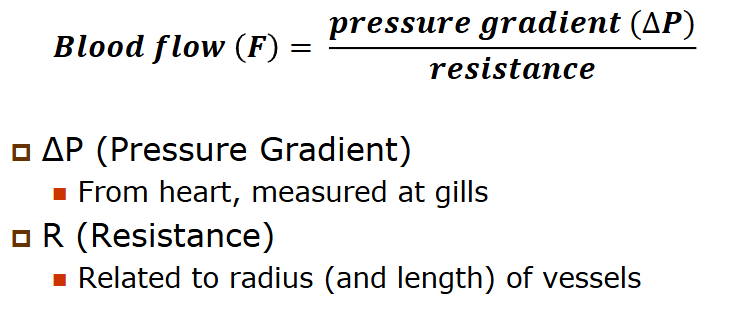
blood flow formula
afferent
coming to
efferent
going away