IVC Political Science Exam Cram
 Call Kai
 Learn
Learn Practice Test
 Spaced Repetition
 Match
Match Flashcards
 Knowt Play
1/63

There's no tags or description
Looks like no tags are added yet.
Name | Mastery | Learn | Test | Matching | Spaced | Call with Kai | Chat |
|---|
No analytics yet
Send a link to your students to track their progress
64 Terms
Political Science
The systematic study of government and politics.
Pluralism
A theory of American politics that holds that society’s interests are substantially represented through the activities of groups and that, in most policy decisions, government is chiefly responsive to the interest group most directly affected by the policy.
Democracy
A form of government in which the people govern directly or through elected representatives.
Concurrent powers
powers exercised over the same policy areas between national and state
Implied powers
powers that are not listed in the Constitution but that are related to the exercise of the listed powers.
Enumerated Powers
Powers specifically listed in the Constitution that are given to Congress.
American Political Culture
liberty, equality, self-government, and individualism; serves as Americans’ common bond
Republic
A government where elected representatives make decisions, emphasizing deliberation and limiting majority power to protect individual liberties.
Checks and balances
An elaborate system established by the U.S. Constitution to control government power, dividing authority among branches (e.g., executive, legislative, judicial) and methods of selecting national officers.
Articles of Confederation
The Articles of Confederation were the first U.S. government, giving most power to the states and creating a weak national government because Americans feared strong centralized power after British rule.
Devolution
The passing down of authority from the national government to the state and local governments.
McCulloch v. Maryland
The Supreme Court ruled that Congress has implied powers (like creating a national bank) and that states cannot tax or interfere with the federal government because federal law is supreme.
Selective Incorperation
The process by which certain rights (for example, freedom of speech) contained in the Bill of Rights become applicable through the Fourteenth Amendment to actions by the state governments.
Freedom of Religion
government cannot establish a religion or prevent people from practicing their religion.
Exclusionary Rule
The legal principle that government is prohibited from using in trials evidence that was obtained by unconstitutional means (for example, illegal search and seizure).
Civil Rights v. Civil Liberties
Civil liberties: Protect individual freedoms from government interference (e.g., free speech).
Civil rights: Ensure equal treatment and protect against discrimination.
Affirmative Action
Programs that help women, minorities, and other disadvantaged groups receive equal opportunities in jobs, education, and other areas
Regents of the University of California v. Bakke
Race can be considered in college admissions, but strict racial quotas are unconstitutional.
Plessy v. Ferguson
It allowed racial segregation under the "separate but equal" doctrine, even though facilities were often unequal.
Primary Socializing Agents
Primary agents: Family—shape early political beliefs and values
Secondary Socializing Agents
Secondary agents: Friends, school, media, work, and leaders—influence political views later in life.
Public opinion polls
A survey of a sample of people used to estimate the opinions of the entire population.
Random Sampling
Selecting individuals randomly from a population so the sample represents the larger group and reduces bias.
Midterm elections
Congressional elections held halfway between presidential elections.
Proposals to increase voter turnout
By making registration and voting easier, such as allowing same-day registration and reducing barriers to participation.
Voter registration
The process of getting one’s name on the official list of eligible voters before being allowed to vote.
Party Polarization
The growing divide between political parties on major issues, making it harder for them to cooperate across party lines.
Issues of Democracy
Higher taxes on the rich/corporations, expanding social welfare programs, defending civil/minority rights, abortion access, LGBTQ+ rights, and environmental protection. Less supportive of military action.
Caucus
A local, in-person gathering where registered party members meet to discuss candidates and vote publicly by grouping together in designated areas of a room, rather than casting a secret ballot.
Issues of Republican
Sweeping tax cuts, deregulation, high tariffs, cutting federal programs, opposing liberal social policies (e.g., abortion access), and prioritizing military strength.
Interest Groups
Organizations that actively seek to influence public policy. (See also citizens’ [noneconomic] groups; economic groups.)
Function of interest groups
Influence public policy, represent shared interests, and encourage political participation.
Reasons to join interest groups
To gain benefits, support causes, and influence government decisions.
Super PACs
Election committees that are unrestricted in their fundraising and spending as long as they do not coordinate their campaign efforts with that of a candidate.
Agenda Setting
The power of the media through news coverage to focus the public’s attention and concern on particular events, problems, issues, personalities, and so on.
Echo chambers
Refers to media outlets where audience members are exposed to messages that support what they already believe.
Watergate Scandal
A 1970s scandal where journalists exposed Nixon administration wrongdoing, leading to Nixon’s resignation and strengthening the media’s watchdog role.
Gerrymandering
The process by which the party in power draws election district boundaries in a way that enhances the reelection prospects of its candidates.
House vs Senate incumbents
House incumbents: Benefit from gerrymandering/redistricting and safer districts; usually face weaker challengers.
Senate incumbents: Do not benefit from redistricting; face stronger statewide challengers (like governors or attorneys general).
Impeachment of the President
The House of Representatives’ power to formally charge the president, vice president, or other federal officials with treason, bribery, or other high crimes and misdemeanors.
Pork-barrel spending
Government-funded projects that benefit a specific state or district, such as building a hospital, highway, or research center, often used by members of Congress to gain support from constituents.
Presidential veto
The power of the president to veto an act of Congress. A veto can only be overridden by a two-thirds vote of the House and Senate.
Expressed powers of president
Commander in chief, chief diplomat, chief executive, and chief legislator (military, foreign policy, enforcing laws, and making/vetoing laws).
Powers of vice president
President of the Senate and tie-breaking vote; other duties depend on the president.
Electoral College
Electors who cast the states’ electoral votes for the president of the United States.
Judicial Review
Courts decide constitutionality of government actions.
Judicial Restraint
Judges follow precedent and avoid overturning laws.
Judicial Activism
Courts create broader interpretations and may overturn policies/laws.
Tenure for federal judges
Life tenure → protects judges from political pressure and keeps the judiciary independent.
Fiscal policy
Government’s use of taxing and spending to manage the economy
Inflation
A general increase in the average level of prices of goods and services.
Unemployment insurance
Provides temporary income to unemployed workers; funded by employer taxes.
Medicaid
Health insurance program for low-income individuals; created in 1965.
Medicare
National health insurance for the elderly and disabled; created in 1965.
Affordable Care Act (ACA, Obamacare)
2010 law that expanded health insurance access and banned coverage denials
Recall of Gavin Newsom
2021 recall attempt against Gov. Gavin Newsom over his liberal policies and COVID-19 restrictions; voters rejected the recall by nearly 2–1.
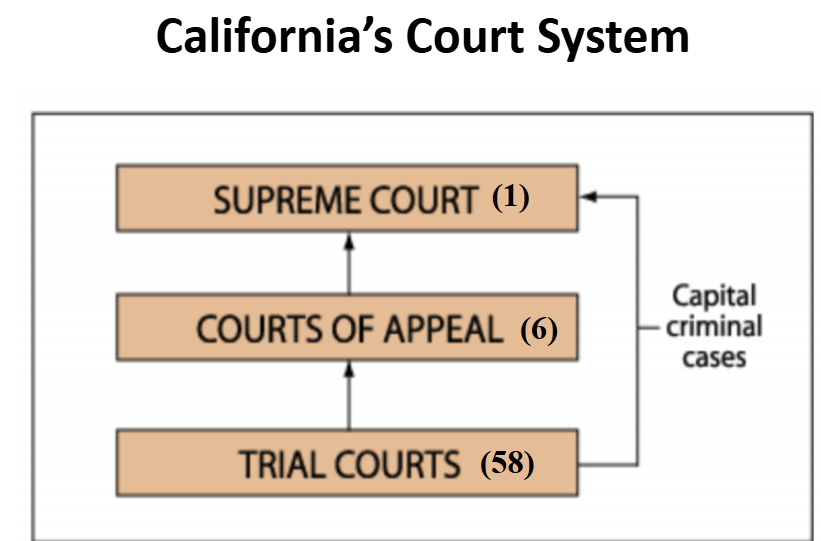
California Court Structure
Amending the Constitution
California’s Constitution is easier to amend (500+ times); U.S. Constitution requires ¾ of states for ratification.
FRQ Prompt #1: From the lecture on political parties, explain four reasons why third parties in the United States have been so weak historically.
Third parties struggle because the winner-take-all system makes it difficult to win elections. They face challenges getting on ballots, raising money, and gaining media attention. As a result, most political offices are controlled by Democrats and Republicans.
FRQ Prompt #2: From Patterson, identify and explain five functions of the media
Signaling function: Media informs people about important events and issues.
Common-carrier function: Media allows leaders to communicate with the public.
Watchdog function: Media investigates and exposes government wrongdoing.
Partisanship function: Media promotes certain political views or parties.
Entertainment function: Media attracts audiences through entertaining content.
FRQ Prompt #3: From Patterson, identify and explain five pitfalls of incumbency or Senate and House incumbents
Disruptive issues – Voters may blame incumbents for unpopular issues.
Misconduct – Scandals can hurt reelection chances.
Low midterm turnout – Fewer voters can weaken the president’s party.
Primary challengers – Incumbents can lose to rivals from their own party.
Strong challengers/funding – Opponents with money and support can defeat incumbents.
FRQ Prompt #5: Define the Electoral College and explain the unit rule. From the lecture, what are the two arguments for and two arguments against the Electoral College?
Electoral College: System where electors vote for president; 270 of 538 votes needed to win.
Unit Rule: State winner gets all electoral votes (except Maine/Nebraska).
FOR:
Constitutional — Framers created it.
Protects small states — Prevents only large states from deciding elections.
AGAINST:
Ignores popular vote — A candidate can win without the most votes.
Favors swing states — Candidates focus on battleground states.