Bonding
 Call Kai
 Learn
Learn Practice Test
 Spaced Repetition
 Match
Match Flashcards
 Knowt Play
1/71

Earn XP
Description and Tags
Name | Mastery | Learn | Test | Matching | Spaced | Call with Kai | Chat |
|---|
No analytics yet
Send a link to your students to track their progress
72 Terms
What is ionic bonding?
When oppositely charged ions are held together by electrostatic forces of attraction.
What is the charge of an ion derived from:
a) A group 1 element?
b) A group 2 element?
c) A group 3 element?
d) A group 5 element?
e) A group 6 element?
f) A group 7 element?
a) 1+ (+)
b) 2+
c) 3+
d) 3-
e) 2-
f) 1- (-)
Give the symbol formula for:
a) A hydroxide ion.
b) A nitrate ion.
c) An ammonium ion.
d) A sulfate ion.
e) A carbonate ion.
a) OH-
b) NO3-
c) NH4+
d) SO42-
e) CO32-
Give an example of an ionic substance that is a giant ionic lattice.
Sodium chloride.
Give three general features of a giant ionic lattice.
Regular structure.
Cubic shape.
Giant repeating pattern.
True or false? All ionic compounds are insoluble in water.
False. MOST IONIC COMPOUNDS DISSOLVE IN WATER.
Why are ionic compounds often water-soluble?
They are polar compounds (as they contain oppositely charged ions) meaning they dissolve in polar solvents (like water, as water molecules are polar). Water molecules attract the positively charged and negatively charged ions, breaking up the ionic substance.
Why do ionic substances conduct electricity when molten and dissolved in solution?
The ions are free to move around.
True or false? Ionic compounds have high melting points.
True.
Why do ionic compounds have high melting points?
Ionic compounds contain many strong electrostatic forces of attraction between oppositely charged ions that require lots of energy to overcome to melt the substance.
What is covalent bonding?
The sharing of a pair of electrons (each atom gives one electron for the bonding pair) between two atoms in order to fill both their outer shells, the covalent bond itself is the electrostatic attraction between the shared pair of electrons (negatively charged) and the nucleus (positively charged) of each atom.
How many electrons are there per covalent bond?
Two electrons.
What is a dative covalent/coordinate bond?
A covalent bond where both of the electrons in the shared pair come from one atom.
How do you represent a dative covalent bond in a displayed formula?
An arrow going from the atom that gives both electrons for the bonding pair going to the atom that shares this bonding pair.
What structures do metals form?
Giant metallic lattices. Positive metal ions in a sea of delocalised electrons (delocalised electrons came from metal atoms that are now metal ions).
What is metallic bonding?
The electrostatic attraction between the positively charged metal ions and the negatively charged delocalised electrons.
How does the melting point of a metal change as the number of delocalised electrons and charge of metal cations in the giant metallic lattice increases? Explain your answer.
Melting point increases. The charge density of the metal ions increases meaning the electrostatic attractions between the positively charged metal ion and negatively charged delocalised electrons becomes stronger and requires more energy to overcome.
Give four general properties of (solid) metals.
High melting point.
Good thermal conductors.
Good electrical conductors.
Insoluble
Why do metals have high melting points?
The strong electrostatic attractions between positively charged metal ions and negatively charged delocalised electrons require large amounts of energy to overcome.
Why are metals good thermal conductors?
The delocalised electrons (moving freely) can transfer kinetic energy.
Why are metals good electrical conductors?
The delocalised electrons are mobile so can carry a current.
Why are solid metals insoluble?
The metallic bonds are too strong to break.
Give two examples of giant covalent substances.
Diamond.
Graphite.
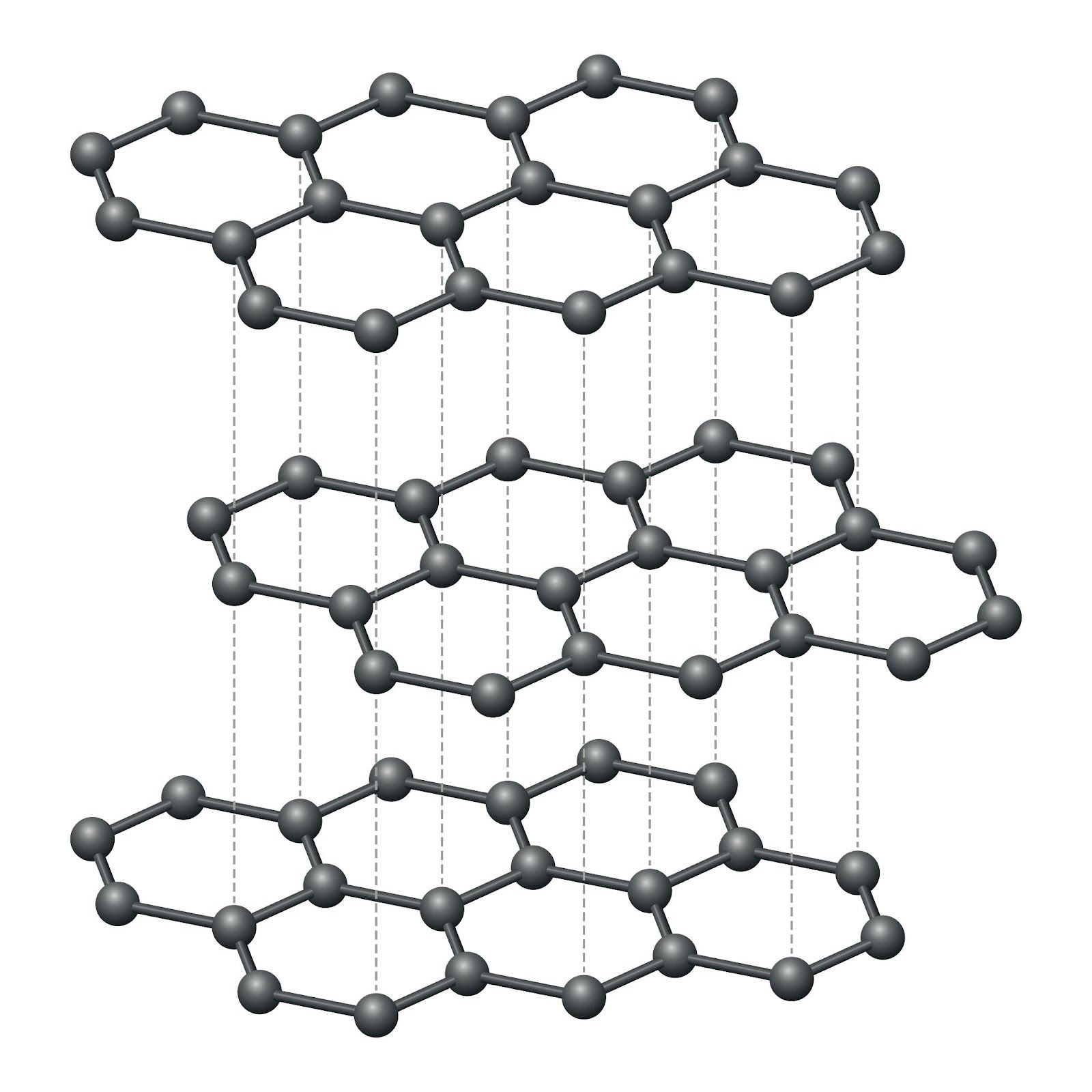
Describe the structure of graphite.
Each carbon atom forms three strong covalent bonds with other carbon atoms, the fourth electron from each carbon is delocalised and between the layers. Layers of these carbons sheets with intermolecular forces between each other.
Why does graphite have a high melting point?
The strong covalent bonds between carbon atoms require large amounts of energy to overcome.
Why do the layers in graphite easily slide over one another?
The weak intermolecular forces between the layers can be easily broken, allowing the layers to slide over each other.
Why does graphite carry a charge?
Delocalised electrons between the layers are mobile so can carry a charge.
Why does graphite have a low density?
The layers are far apart compared to the length of the covalent bonds.
Why is graphite insoluble?
The covalent bonds between carbon atoms are too strong to break.
Describe the structure of diamond.
Each carbon atom is bonded to four other carbon atoms, tetrahedral shape.
Why does diamond conduct heat well?
The tightly packed and rigid arrangement allows heat to be conducted well.
Why does diamond have a high melting point and why is it hard?
The strong covalent bonds between carbon atoms require lots of energy to overcome.
Why does diamond not conduct electricity well?
There are no delocalised electrons in diamond to carry a charge.
Why is diamond insoluble?
The strong covalent bonds require too much energy to overcome for diamond to be soluble.
Why do molecules have specific shapes and bond angles?
The bonds (electrons in bonds) repel each other equally.
True or false? A bonding pair of electrons next to a bonding pair of electrons repels more than a lone pair of electrons next to a bonding pair of electrons. Two lone pairs of electrons repel the least.
False. A LONE PAIR OF ELECTRONS NEXT TO A BONDING PAIR OF ELECTRONS REPELS MORE THAN A BONDING PAIR OF ELECTRONS NEXT TO A BONDING PAIR OF ELECTRONS. TWO LONE PAIRS OF ELECTRONS TOGETHER REPEL THE MOST.
In general, for every lone pair of electrons in a molecule, by how much does the bond angle (without lone pairs) decrease?
2.5 degrees decrease per lone pair.
Name the shape of a molecule with 2 bonding pairs and 0 lone pairs. Draw the shape of this molecule. What is the bond angle in this molecule?
Linear.

180 degree bond angle.
How many bonding pairs and lone pairs does a trigonal planar molecule have? Draw the general shape of this molecule. What is the bond angle?
3 bonding pairs, 0 lone pairs.

120 degree bond angle.
Name the shape of a molecule with 4 bonding pairs and 0 lone pairs. Draw the shape of this molecule. What is the bond angle?
Tetrahedral.

109.5 degree bond angle.
How many bonding pairs and lone pairs are in a trigonal bipyramidal molecule? Draw the shape of this molecule. What are the bond angles?
5 bonding pairs, 0 lone pairs.

90 degrees bond angle (between atoms on different planes), 120 degrees bond angle (between atoms on the same plane).
Name the shape of a molecule with 6 bonding pairs and 0 lone pairs. Draw the shape of this molecule. What is the bond angle?
Octahedral.

90 degrees bond angle.
How many bonding pairs and lone pairs does a pyramidal molecule have? Draw the shape of this molecule. What is the bond angle?
3 bonding pairs, 1 lone pair.
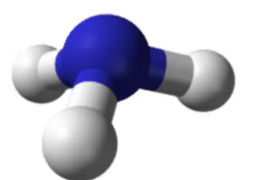
107 degrees bond angle.
Name the shape of a molecule with 2 bonding pairs and 2 lone pairs. Draw the shape of this molecule. What is the bond angle?
Bent.
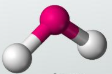
104.5 degrees bond angle.
Name the shape of a molecule with 3 bonding pairs and 2 lone pairs. Draw this molecule. What is the bond angle?
Trigonal planar. T SHAPED
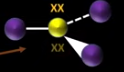
120 degrees bond angle.
How many bonding pairs and lone pairs does a square planar molecule have? Draw this molecule. What is the bond angle?
4 bonding pairs, 2 lone pairs.
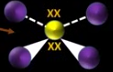
90 degrees bond angle.
What is electronegativity?
The ability for an atom to attract electrons towards itself in a covalent bond.
True or false? The further up and right you go on the periodic table, the greater the electronegativity of the element.
True.
When does bond polarity arise?
When the atoms bonded to each other have differences in electronegativity.
True or false? The greater the difference in electronegativity of two elements bonded to each other, the lower the bond polarity.
False. THE GREATER THE DIFFERENCE IN ELECTRONEGATIVITY OF TWO ELEMENTS BONDED TO EACH OTHER, THE GREATER THE BOND POLARITY.
In a polar bond, what signs do you put next to the most electronegative element and the least electronegative element?
Most electronegative element

Least electronegative element

True or false? If the polar bonds are arranged symmetrically in a molecule, the molecule has no overall polarity.
True.
Name three types of intermolecular forces in order from weakest to strongest.
Van der Waals, (permanent) dipole-dipole, hydrogen bonds.
Explain how Van der Waals intermolecular forces (induced dipole-dipole) form.
Electrons move around atoms/molecules, this creates a temporary dipole, this temporary dipole only exists though when two atoms/molecules are near each other. The delta positive end of one atom/molecule will be attracted to the delta negative end of an adjacent atom/molecule, this creates a weak force of attraction.
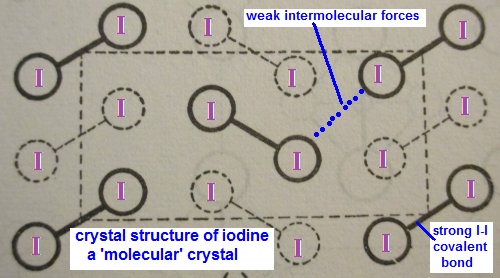
Which intermolecular forces hold iodine molecules in a crystal structure?
Van der Waals.
Describe the structure and bonding in iodine. Draw this.
Every two iodine atoms are held together by strong covalent bonds. Weak Van der Waals intermolecular forces hold the iodine molecules together.
True or false? The larger an atom/molecule, the fewer Van der Waals there are. Explain your answer.
False. THE LARGER AN ATOM/MOLECULE, THE MORE VAN DER WAALS FORCES THERE ARE. THIS IS BECAUSE THERE ARE LARGER ELECTRON CLOUDS.
When a liquid is being boiled, is it the intermolecular forces of the bonds being broken?
Yes.
True or false? The longer and straighter a hydrocarbon chain, the more Van der Waals.
True.
Why do branched hydrocarbons have lower boiling points?
As they are branched they can’t pack together as tightly meaning the Van der Waals intermolecular forces between the molecules are weakened meaning they require less energy to overcome.
What are dipole-dipole intermolecular forces?
When molecules with permanent dipoles have a weak electrostatic force of attraction (dipole-dipole interaction) between the delta negative end of one molecule and the delta positive end of an adjacent molecule.
True or false? It’s impossible for molecules with dipole-dipole interactions to have Van der Waals too.
False. MOLECULES WITH DIPOLE-DIPOLE INTERACTIONS ALSO HAVE VAN DER WAALS.
How can you test for if a liquid is polar?
Place a charged rod near a steady stream of the liquid. If the liquid bends towards the rod that means it is polar as either the delta negative/delta positive (depending on charge of the rod) ends of the molecules that make up the liquid or orienting themselves to face the rod.
When does hydrogen bonding occur?
When hydrogen is bonded to one of the three most electronegative elements (nitrogen, oxygen, and fluorine).
What is hydrogen bonding?
The electrostatic attraction between the delta positive end of one bond (where hydrogen is bonded to one of the three most electronegative elements) and the delta negative end of another bond (where hydrogen is bonded to one of the three most electronegative elements).
True or false? For molecules to have stronger intermolecular forces they must also have the weaker ones that come before them.
True.
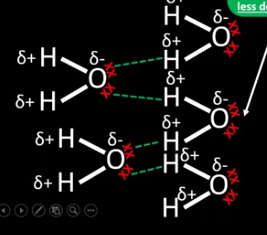
Describe the structure of ice. Draw a diagram to support it.
Water molecules are held together by hydrogen bonding. The water molecules are further apart so ice is less dense than water. Regular structure.
Describe the particle model for solids.
Particles packed tightly together in a regular arrangement, so high density. Particles vibrate on the spot, so can’t be compressed.
Describe the particle model for liquids.
Particles are packed tightly together in a random arrangement, so high density. Particles move freely, so difficult to compress. Particles have more energy than in solids.
Describe the particle model for gases.
Particles spaced out randomly, so low density. Particles move freely, easier to compress. Particles have higher energy than in both liquid and solid.
What shape does magnesium crystalize in?
Hexagon.
True or false? When a molecule is symmetrical, all dipoles (polar bonds) cancel out, making the molecule non-polar.
True.