Unit 1 - Lecture 7
 Call Kai
 Learn
Learn Practice Test
 Spaced Repetition
 Match
Match Flashcards
 Knowt Play
1/95

There's no tags or description
Looks like no tags are added yet.
Name | Mastery | Learn | Test | Matching | Spaced | Call with Kai |
|---|
No analytics yet
Send a link to your students to track their progress
96 Terms
Proteins
Enzymes are usually __
Catalytic RNA (Ribozymes)
What enzymes are not proteins?
Catalysts
Enzymes are excellent __
Increase
Enzymes __ rates of reaction under very mild conditions in aqueous solution
Enzymes
Allow biomolecules and metabolites to be synthesized and degraded under physiological conditions, where otherwise the chemical reactions would not proceed at a meaningful rate
Cofactors
In many enzymes the catalysis is accomplished by the protein alone. In others the activity requires __
Do
Enzymes are classified according to what they __
Oxidoreductases
Type of enzymes that transfer electrons
Transferases
Type of enzymes that have group transfer
Hydrolases
Type of enzymes that are involved in hydrolysis reactions
Lyases
Type of enzymes that add groups to double bonds or form double bonds by removal of groups
Isomerases
Type of enzymes that transfer groups within molecules to yield isomeric forms
Ligases
Type of enzymes that catalyze the joining together of two molecules, coupled with the hydrolysis of ATP
Substrates
Enzymes are highly specific for their __
Substrate; S
In an enzyme-catalyzed reaction : __ (__) is a reactant
Product; P
In an enzyme-catalyzed reaction : __ (__) is a result of the reaction
Active Site
The portion of the enzyme to which the substrate binds and where the reaction takes place
Noncovalent
What type of force (bond) occurs at the active site between the enzyme and substrate?
Hydrogen Bonding
Electrostatic Attractions
Van Der Waals Attractions
What are three examples of noncovalent forces?
Speed; Alter
Enzymes can __ up reactions but cannot __ the equilibrium constant or the free energy change
Free Energy Change
ΔGo is the standard __ for reactants (R) → products (P) under standard conditions
Products; Reactants
An enzymes reaction favors __ since its free energy is lower than the __
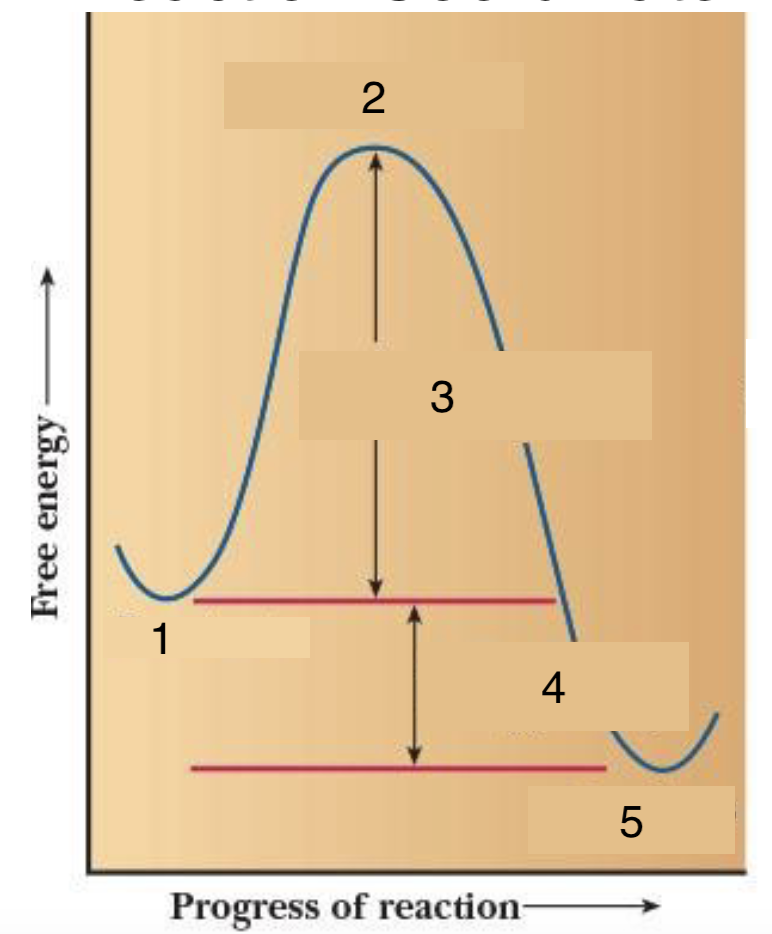
Activation Energy
ΔGo‡ is the __ of the reaction
Even though the reaction is favorable, it will not proceed due to this activation energy barrier
Uncatalyzed; Catalyzed
ΔGo‡ for an __ reaction is higher than that for a __ reaction
Activation Energy
ΔGo‡ represents what?
Lowering
Enzymes catalyze reactions by __ the activation energy (ΔGo‡) of the transition state
Don’t
Enzymes __ determine the direction of a reaction or change the equilibrium
Unchanged
Catalysts remain __ before and after the reaction
Complementary
All enzymes are __ to their transition states
1) By stressing, bending, or stretching critical chemical bonds
2) By directly participating in the reaction
3) By creating a microhabitat that is conducive to the reaction
4) By simply orienting substrate molecules in place so that they can be modified
An enzyme can reduce the activation energy in what four ways?
1) General acid-base catalysis
2) Covalent catalysis
3) Metal ion catalysis
What 3 common catalytic strategies do enzymes employ?
General acid-base catalysis
What type of catalysis : often the enzyme provides additional functional groups that aid in catalysis once the substrate is bound
General acids and bases are some of the most important contributors
Covalent Catalysis
What type of catalysis : is characterized by the formation of a covalent bond between the enzyme and substrate at some point during catalysis and must be broken later in the catalytic cycle in order to release product and regenerate the free enzyme
Multiple
Enzymes can employ __ catalytic strategies
Metal Ion Catalysis
What type of catalysis : have __ with positive charges that stabilize negatively charged transition states
1/3
About __ of all enzymes use metal ions
Equilibrium Constants
Enzymes are controlled by __
Enzyme
Equation : E + S → ← ES → ← EP → ← E + P
E represents what?
Substrate
Equation : E + S → ← ES → ← EP → ← E + P
S represents what?
Products
Equation : E + S → ← ES → ← EP → ← E + P
P represents what?
Equilibrium
The equation E + S → ← ES → ← EP → ← E + P is for what?
Keq
Change in free energy is related to the equilibrium constant __
Right; Not Proceed
In the overall equilibrium S → ← P, if [S] is high, the reaction is driven to the __. If [S] is too low, the reaction will __
Substrate Concentration
Rate of a reaction with an enzyme is dependent on __
Low
At __ substrate concentration Vo increases almost linearly with increasing [S]
Initial Velocity
Vo represents what?
High
At __ substrate concentration the rate reaches a maximum, Vmax
Enzyme Substrate
ES represets what?
Slow; Rate-Limiting
The breakdown of ES to form E + P is the __ step and hence __
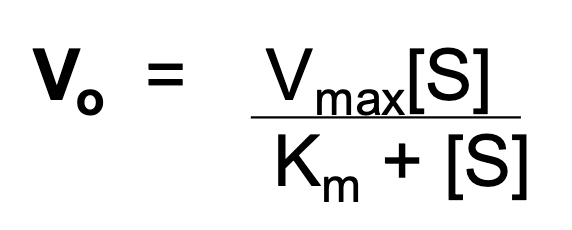
Michaelis Menton Equation
This is a simple algebraic relationship between the substrate concentrations and initial rate (Vo)
The concentration of the k-2 product is negligible and can be ignored
[ES] is constant
What are the two assumptions are associated with the Michaelis Menton Equation
Steady State
ES is constant and is considered to be the __
Rate Constants
k1, k-1, k2 and k-2 in the Michaelis Menton Equation are __ for individual steps
ES
In the Michaelis Menton Equation, the Vo is determined by the rate of breakdown of __ to form product
Hyperbolic
The Michaelis Menton Equation equation describes a __ function
1/2
When [S] = Km, Vo = __ Vmax
Km
__ is equal to the concentration of substrate at 1/2 Vmax
Km
__ is an indication of how tightly an enzyme binds substrate
Lower; Higher
The __ the Km, the tighter binding (higher affinity) while a __ Km suggests weaker binding (lower affinity)
Rate Limiting
Initial velocity is controlled by a __ step
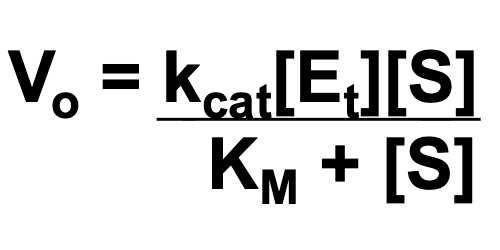
Kcat
What is used to reference the generic rate limiting step
Turnover Number
kcat is a rate constant (time-1) that is often called the __
Diffusion
Very efficient enzymes are limited by the rate of __
pH; Temperature
Enzymes activities are dependent upon __ and __
Kcat/Km
The catalytic efficiency equation is written as what?
Michaelis Menton Equation
What is being shown?
Michaelis Menton Equation with a rate-limiting step
What is being shown?
Reactants
1
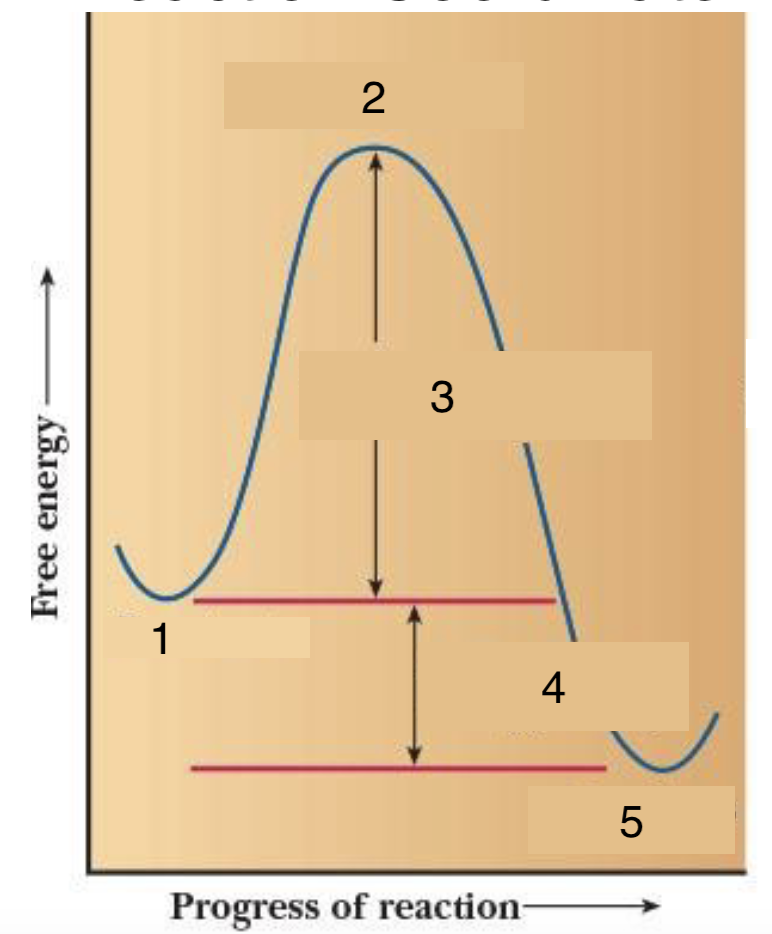
Transition State
2
Free Energy of Activation (ΔGo‡)
3
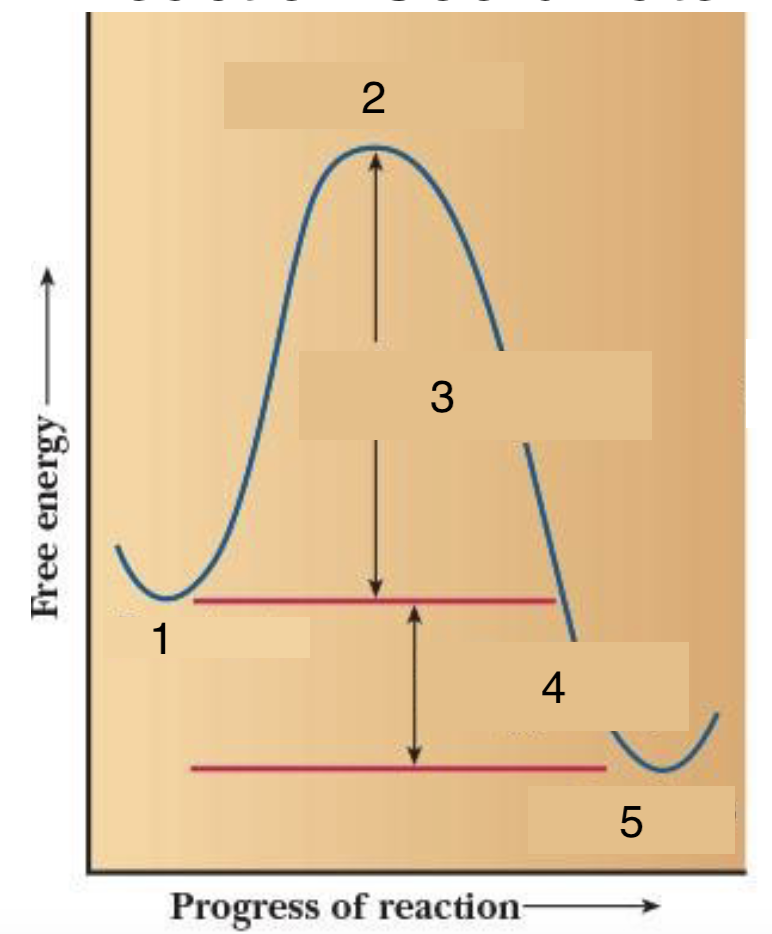
Free Energy Change (ΔGo)
4
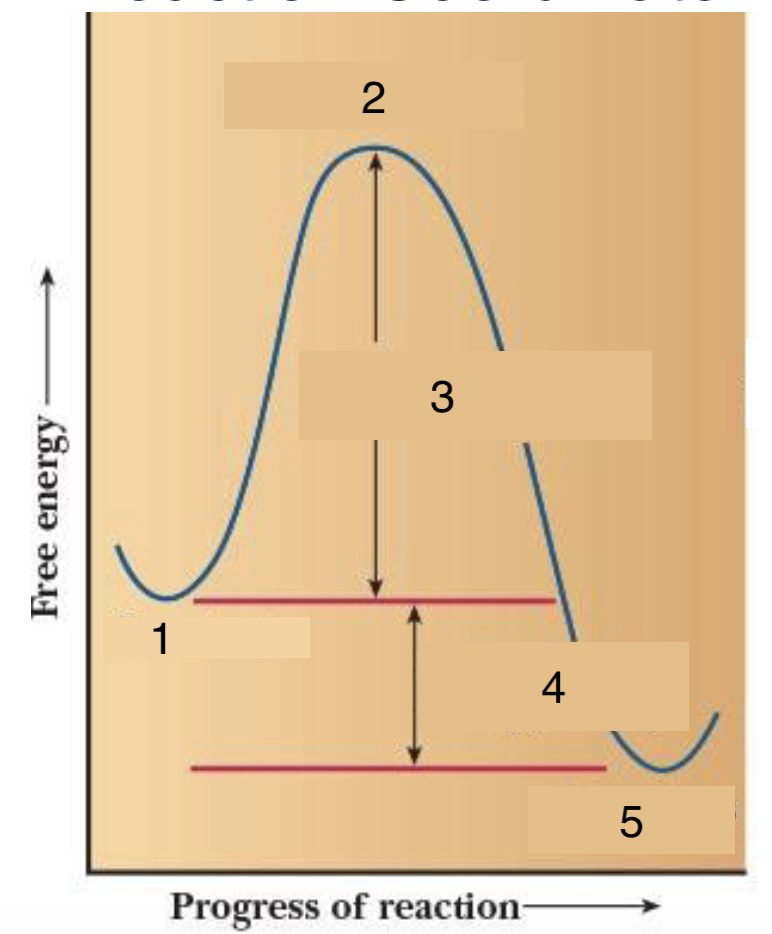
Products
5
B
A or B?
Vmax
1
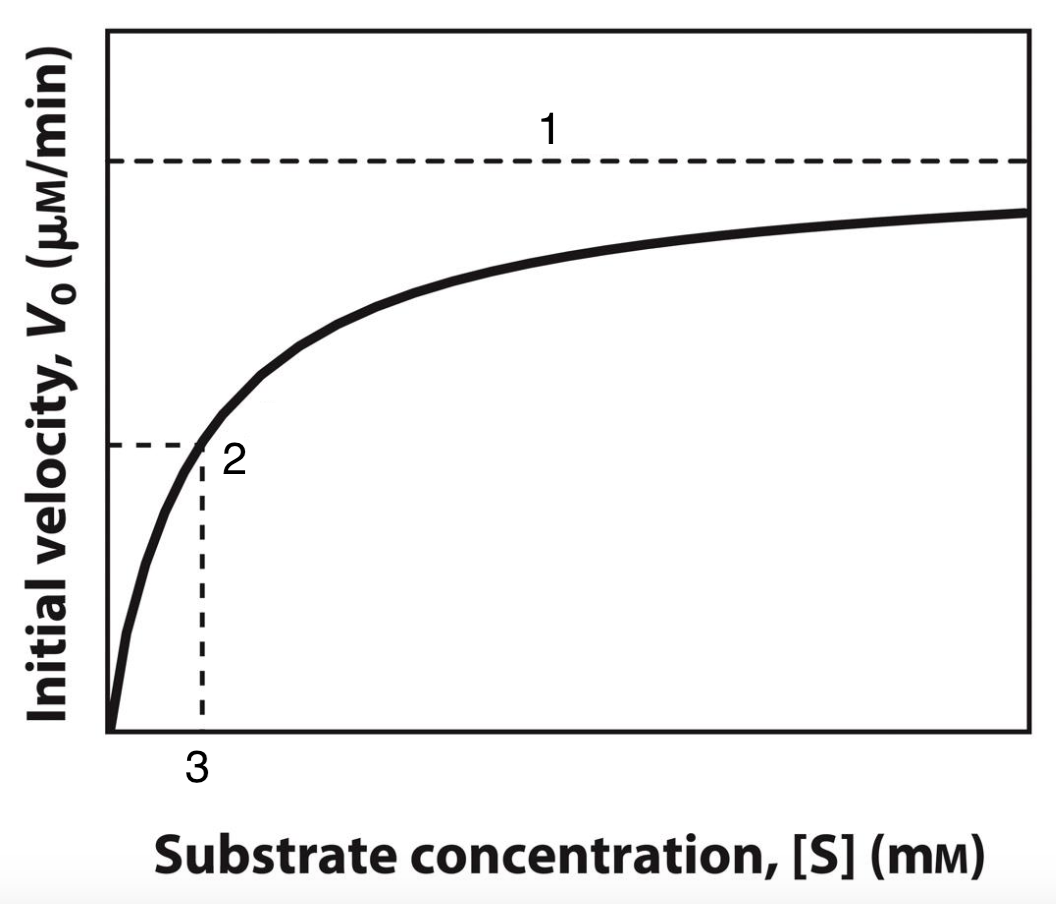
1/2 Vmax
2
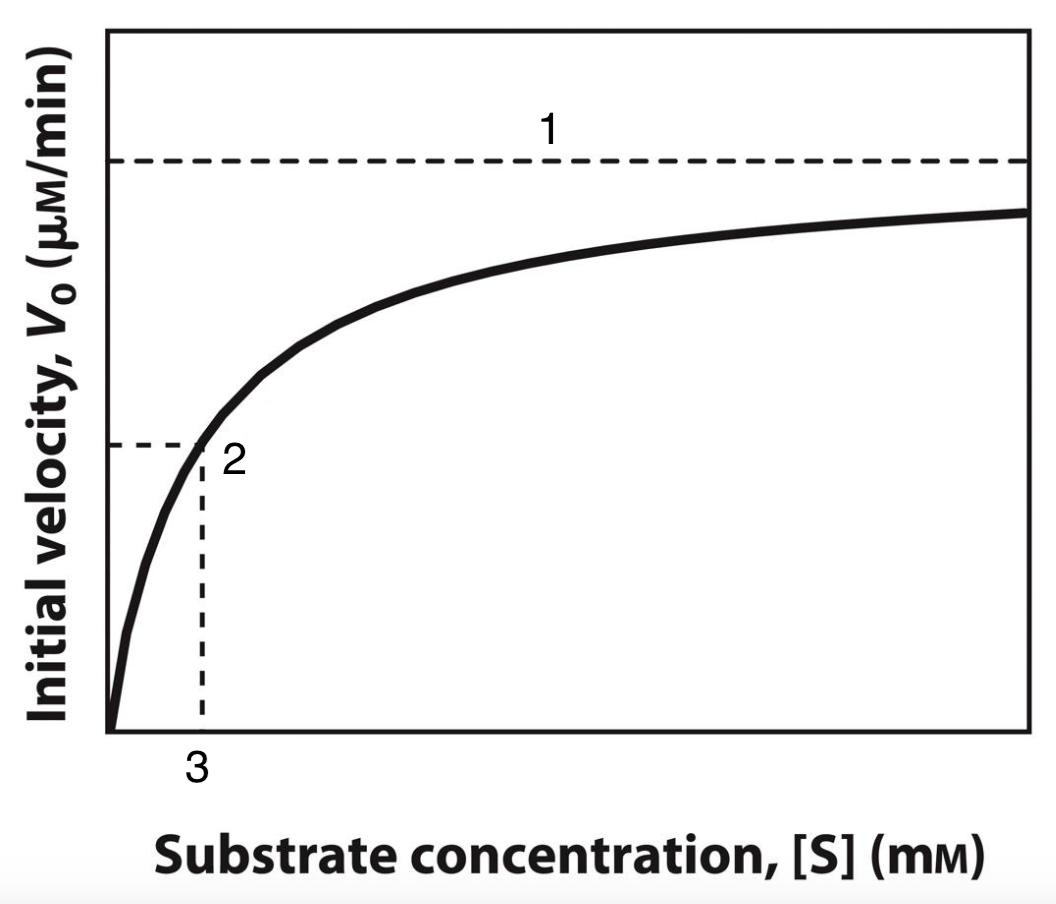
Km
3
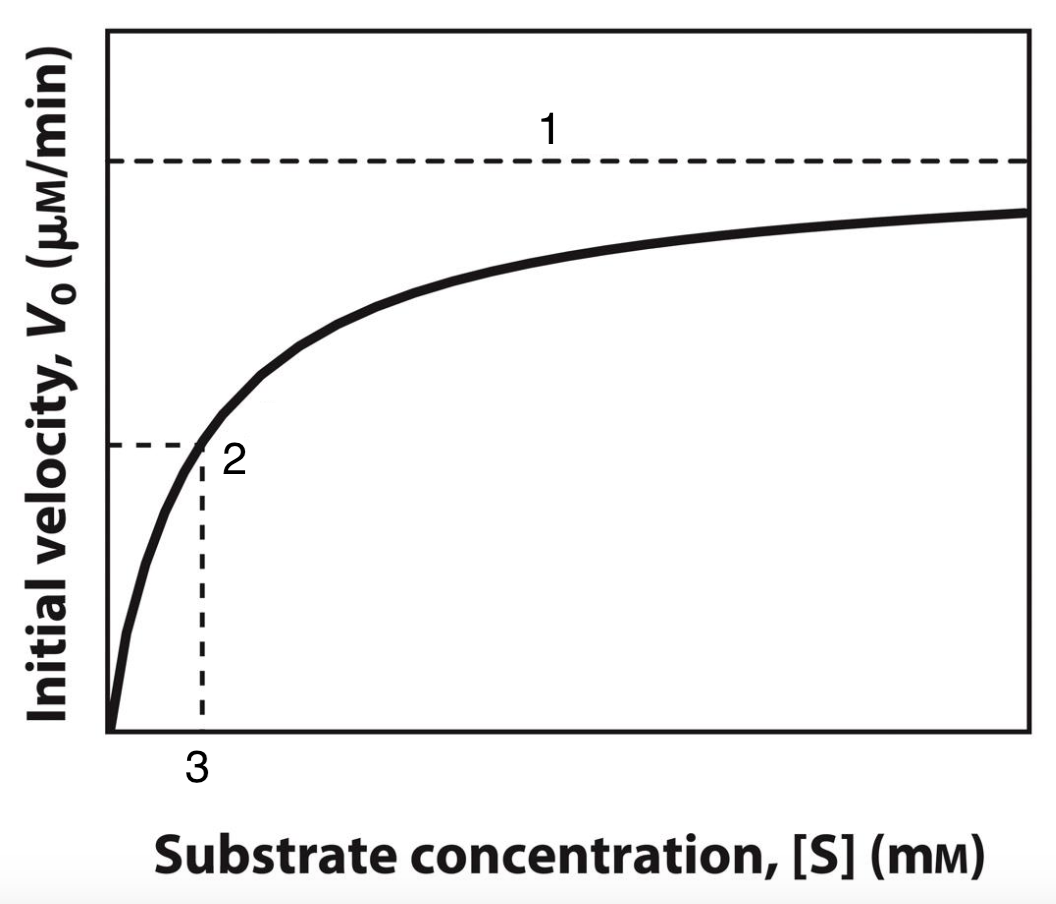
C
A, B or C?
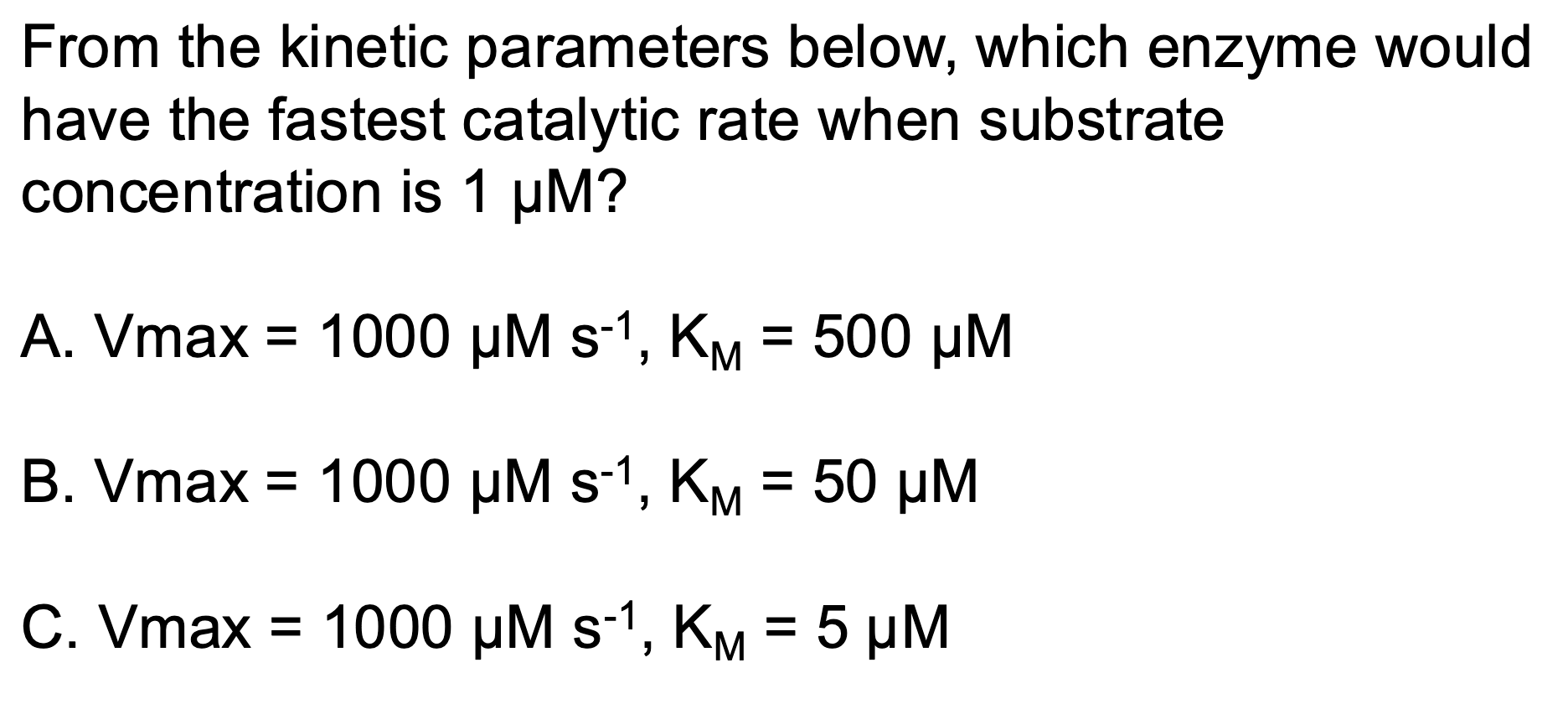
Ligands
Cofactors are usually __
The Same Molecule
Isomerases move groups to __
Another Molecule
Transferases move groups to __
Acid/Base Reactions; Redox
What type of reactions are oxidoreductases involved in?
Enzyme
-ase means what?
Conformational Change
The active site undergoes a __ when the substrate and enzyme are close to other another
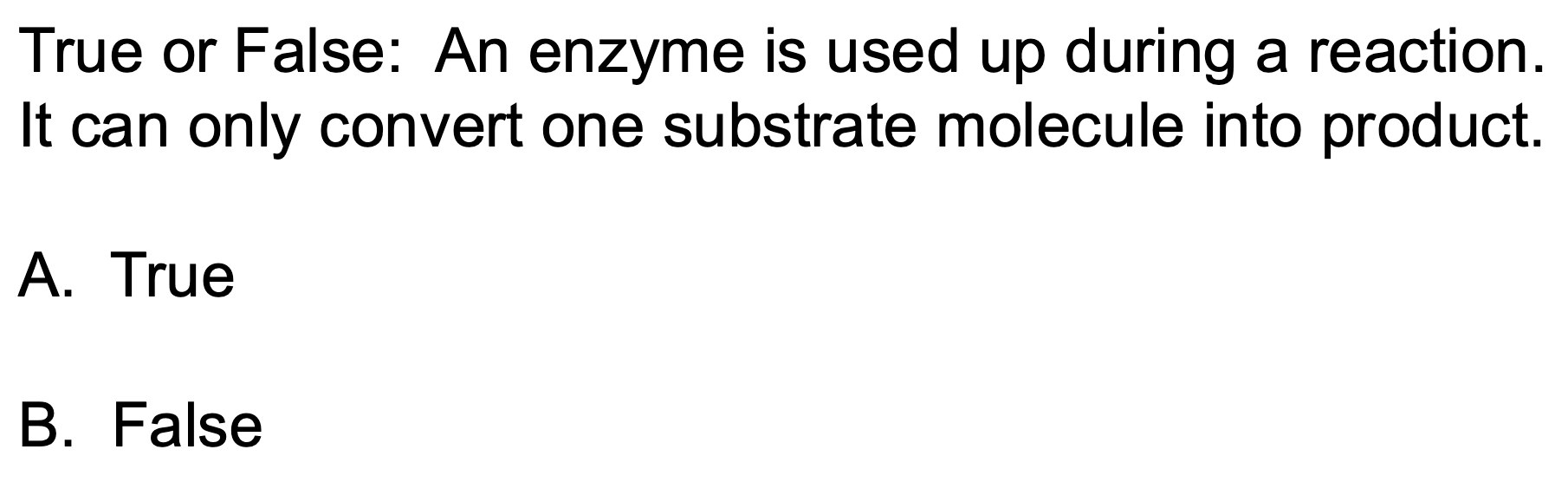
Yes
Can enzymes change during a reaction?
Weak Acids and Bases
General acid base catalysis uses what?
Acid/Base and Covalent
Chymotrypsin undergoes what type of catalysis?
Stable
Metal ion catalysis works because in order for an enzyme to be effective, the transition state needs to be __. Therefore the metal iron needs to bind to the enzyme to do so.
Protease
Chymotrypsin is a type of __
Smaller Fragments
Proteases chop up proteins into what?
Does Not
A large (high) Km means that the enzyme __ work well on the substrate
Diffusion
E+S →← ES is __ controlled
Faster
A lower Km means the reaction proceeds __
High
Low Km = __ binding affinty
Higher
A high Kcat means the turnover rate is __
Rate-Limiting Step
Kcat is a __
Vmax
Enzymes are limited by the __. (Diffusion)