Psychological Assessment
 Call Kai
 Learn
Learn Practice Test
 Spaced Repetition
 Match
Match Flashcards
 Knowt Play
1/58

There's no tags or description
Looks like no tags are added yet.
Name | Mastery | Learn | Test | Matching | Spaced | Call with Kai | Chat |
|---|
No analytics yet
Send a link to your students to track their progress
59 Terms
Psychological testing
process of measuring psychology-related variables by means of devices or procedures designed to obtain a sample of behavior
Psychological Assessment
gathering and integration of psychology-related data for the purpose of making psychological evaluation
Parts of a psychological test
Content
Form
Item
Admin procedure
Scoes
Scoring
Cut score
Psychometric soundness
Subject matter
form, plan, structure, arrangement, layout
a specific stimulus to which a person responds overtly and this response is being scored or evaluated
one-to-one basis or group administration
code or summary of statement, usually but not necessarily numerical in nature, but reflects an evaluation of performance on a tes
The process of assigning scores to performances
reference point derived by judgement and used to divide a set of data into two or more classification
technical quality
Ability or Maximal ability test
assess what a person can do (Overall capacity)
Types of ability or maximal ability test
Achievement
Aptitude
Intelligence
measurement of the previous learning. Specific time period, rely mostly on content validity. Fact or conceptual based
refers to the potential for learning or acquiring a specific skill. Uses predictive validity.
refers to a person’s general potential to solve problems, adapt to changing environments, abstract thinking, and profit from experience
Human ability
considerable overlap of achievement, aptitude, and intelligence test
Typical performance test
measure usual or habitual thoughts, feelings, and behavior - indicate how test takers think and act on a daily basis
Attitude test
Tests that elicit personal beliefs and opinions
the interest is the number of times a test taker can answer correctly in a specific period
reflects the level of difficulty of items the test takers answer correctly
Speed
Power
A tests-taker’s score is compared to the previous batch of takers
A test-taker must have a total score of 75% to pass
Norm reference
criterion reference
SORC Model of behavioral observation
Stimulus, organism (internal psycho and physio response), response (behavior), Consequence
Psychological traits
any distinguishable, relatively enduring way in which one individual varies from another
Psychological states
distinguish one person from another but are relatively less enduring. Specific moment in time
Cummulative scoring
assumption that the more the testtaker responds in a particular direction keyed by the test manual as correct or consistent with a particular trait, the higher that testtaker is presumed to be on the targeted ability or trait
Assumptions about Psychological Testing and Assessment
existence of traits and states
they can be measured
Test-Rlated Behavior Predicts NonTest-Related Behavior
Tests have strengths and weaknesses
Test errors are part of the assessment
Testing and Assessment can be conducted in a Fair and Unbiased Manner
Beneficial to society
Reliability
dependability or consistency of the instrument or scores obtained by the same person when re-examined with the same test on different occasions, or with different sets of equivalent items. More number = more _____________
Classical test theory or true score theory
score on a ability tests is presumed to reflect not only the testtaker’s true score on the ability being measured but also the error
Error
refers to the component of the observed test score that does not have to do with the testtaker’s ability
X = T + E
Formula for true test score or classical test theory
True score
When you average all the observed scores obtained over a period of time, then the result would be closest to the _____________
Random error
source of error in measuring a targeted variable caused by unpredictable fluctuations and inconsistencies of other variables in measurement process. Can go either way.
Systematic error
Source of error in a measuring a variable that is typically constant or proportionate to what is presumed to be the true values of the variable being. Always biased towards a direction.
Test-retest
Inter-rater
Inter-item (Internal consistency)
Parallel forms reliability
Split-half reliability
Types of reliability
Test-retest
an estimate of reliability obtained by correlating pairs of scores from the same people on two different administrations of the test
Carryover effect
Practice effect.
Errors of time sampling reliability
1. occur when the lingering influence of a previous experience or treatment alters a participant's response in subsequent conditions. It could be a positive or negative effect from fatigue or item familiarity
Scores on the second session are higher due to their experience in the first session of testing.
Statistical tool used for coefficient of equivalence. (test-retest, parallel forms, split-half)
Pearson R, Spearman Rho
Parallel Forms
established when at least two different versions of the test yield almost the same scores. Same items, different positioning and numbering. Means and variances must be similar. Can be administered in different times.
Internal consistency/Interitem
measures the internal consistency of the test which is the degree to which each item measures the same construct. Usually used for unstable traits (personality)
Statistical measures for inter-item reliability
Cronbach’s alpha
KR20
KR21
Internal consistency reliability for tests with right/wrong (0–1) items. With item difficulty and more precise
Internal consistency reliability for tests with right/wrong (0–1) items. Without item difficulty
KR-20
KR-21
Split-half
obtained by correlating two pairs of scores obtained from equivalent halves of a single test administered ONCE. Randomly assign numbers, not merely dividing it.
Spearman brown.
Rulon’s Formula
allows a test developer of user to estimate internal consistency reliability from a correlation of two halves of a test, if each half had been the length of the whole test and had equal variances. predict how the reliability of a test will change if its length is increased or decreased.
Also estimates split-half reliability, but instead of correlation, it uses the difference in scores between halves. Uses variance. “How much do people’s scores differ between the two halves?”
Inter-scorer/rater reliability
the degree of agreement or consistency between two or more scorers with regard to a particular measure
Fleiss’s Kappa
Cohen’s Kappa
Krippendoff
Kendall’s W
Interrater Reliability
determine the level between TWO or MORE raters when the method of assessment is measured on CATEGORICAL SCALE
determine the level between TWO raters when the method of assessment is measured on CATEGORICAL SCALE
two or more rater, based on observed disagreement, corrected for disagreement expected by chance.Interval Data
Specifically for ordinal raters
Domain sampling theory
a psychometric framework that conceptualizes any psychological or educational test as a subset of items randomly drawn from an infinitely large "domain" of potential items.
Theory that suggests everyone has a “true score” on test
Classical test theory
Domain sampling theory
If you want to measure math ability, you cannot test everything in math.
So you:
pick a limited number of questions
assume they represent the whole “math domain”
This represents?
Generalizability theory
Universe
Facets
Generalizability theory
In domain sampling theory, this refers to the idea that a person’s test scores vary from testing to testing because of the variables in the testing situations. Your score changes because of different testing conditions, not just your ability.
This refers to every possible testing situation
number of items in the test, amount of review, and the purpose of test administration. Things that can change your score. (error)
According to ____________ given the exact same conditions of all the facets in the universe, the exact same test score should be obtained (Universe score)
the exact same conditions of all the facets in the universe, the exact same test score should be obtained (true score)
Item-response theory
Descrimination
attribute of not being easily accomplished, solved, or comprehended
Test making theory that suggests the probability that a person with X ability will be able to perform at a level of Y in a test. Ex. an intelligent person, person with lower anxiety levels, etc. (ex. COMPUTERIZED ADAPTIVE TESTING - humihirap kada tama)
degree to which an item differentiates among people with higher or lower levels of the trait, ability or etc.
Difficulty
“How many items did you get right?”
_________________ thoery asks:
“Which items did you get right, and how hard were they?”
Item-response theory
Cronbach’s alpha
unacceptable
poor
questionable
Acceptable
Good
Excellent
Cronbach’s alpha
Less than 0.5
0.51 - 0.6
0.61 - 0.7
0.71 - 0.8
0.81 - 0.9
0.91 - 1
Standard Error of Difference
Standard Error of Estimate
Used to determine whether the difference between two test scores is large enough to be considered meaningful and not just due to measurement error.
How far predicted scores usually are from actual scores.
Test sensitivity
Test specificity
detects true positive. The presence of the trait
detects true negative. The absence of the trait
Type of failure
Type 1
Type 2
Type of error
Predicted success but failed
Predicted failure but succeeded
Validity
a judgment or estimate of how well a test measures what it supposed to measure
Internal Validity
External Validity
degree of control among variables in the study (increased through random assignment)
generalizability of the research results (increased through random selection, or the sampling)
Face Validity
Content Validity
Criterion
Construct
Validity
Is the extent to which a test, survey, or research tool subjectively appears to measure what it claims to measure at first glance.
describes a judgment of how adequately a test samples behavior representative of the universe of behavior that the test was designed to sample. (DOMAIN)
a judgment of how adequately a test score can be used to infer an individual’s most probable standing on some measure of interestꟷthe measure of interest being the criterion
ability of the test to measure what it is meant to measure. Should measure a single construct that has no universal criterion. (Can include factor analysis)
Test Blueprint
a plan regarding the types of information to be covered by the items, the no. of items tapping each area of coverage, the organization of the items, and so forth
Types of criterion Validity
Measures how well a test relates to a criterion measured at the same time.
Measures how well a test predicts a future outcome.
A new depression inventory is given to patients, and their scores are compared with a psychiatrist’s current diagnosis.
If the scores strongly match the diagnosis, the test has good _______ validity.Focuses on future performance/behavior.
An entrance exam is used to predict students’ future GPA in college.
If high scorers later perform well academically, the exam has good _______validity.
Types of criterion Validity
Concurrent
Predictive
Concurrent
Predictive
Predictive
CONSTRUCT VALIDITY
C.
D
E
F
A
B.
Construct ValidityIt
is an evaluative technique used to set passing scores (cut-offs) or establish the validity of an assessment. It works by administering a test to two groups known to have different levels of expertise (e.g., novices vs. experts) and finding the score that best separates them.
designed to identify factors or specific variables that are typically attributes, characteristics, or dimensions on which people may differ
constructs are not expected to correlate; (-) inverse
correlate constructs that are expected to correlate; must come from a new or not-so-well-established test
estimating or extracting factors; deciding how many factors must be retained
researchers test the degree to which a hypothetical model fits the actual data
A. Explanatory FA
B. Confirmatory FA
C. Methods of contrasting groups
D. Factor analysis
E. Divergent
F. Convergent
Rating errors
Rating error
Leniency error
Central tendency error
Severity error
Halo effect error
Type of rating errors
Misuse of the rating scale
too lax in rating
Gives middle rating
Too strict in rating
one standout positive trait or first impression dictates how a rater evaluates all other unrelated traits.One
Spearman-brown
Flannagan-Rulon
in the split-half reliability, use _________ to your test if the halves are highly parallel (similar means, variances, and correlations). Use _____________ when the test halves have unequal variances or differ in difficulty.
➔ Given: ◆ Observed score = 75 ◆ SEM = 3 ➔ For a 68% Confidence Interval:
Compute for the confidence interval
75 plus and minus (1×3) = 72 and 75
➔ Given: ◆ Observed score = 75 ◆ SEM = 3 ➔ For a 95% Confidence Interval:
Compute for the confidence interval
75 plus and minus (2×3) = 69 and 81
a range or band of the test scores that is likely to contain the true score
Confidence interval
Concurrent
Concurrent
Convergent
Concurrent vs Convergent Validity
A new depression inventory is given alongside the BDI-II. If scores are highly correlated, it demonstrates concurrent validity.
A new sales aptitude test is compared with employees' current supervisor performance ratings.
The questionnaire correlates with worry scales, physiological anxiety measures, and trait anxiety inventories.
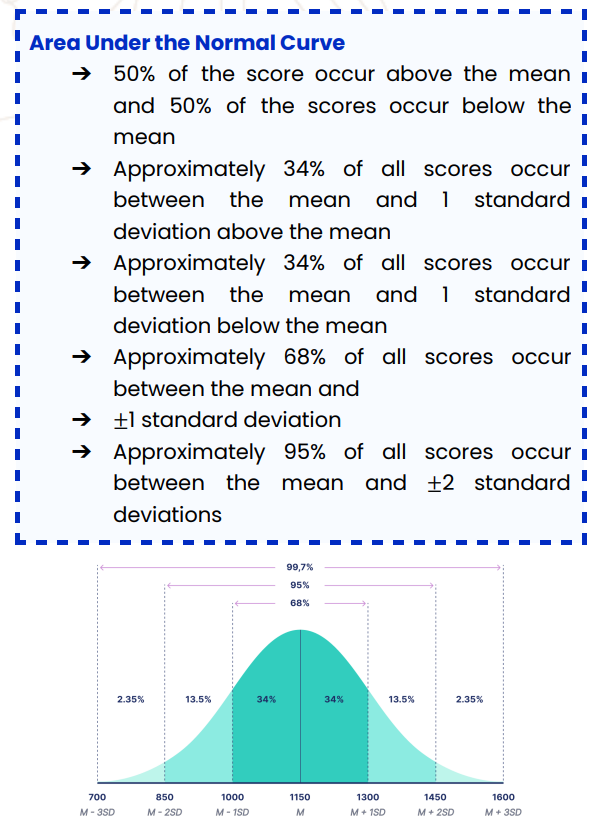
➔ 50% of the score occur above the mean and 50% of the scores occur below the mean
➔ Approximately 34% of all scores occur between the mean and 1 standard deviation above the mean
➔ Approximately 34% of all scores occur between the mean and 1 standard deviation below the mean
➔ Approximately 68% of all scores occur between the mean and ±1 standard deviation
➔ Approximately 95% of all scores occur between the mean and ±2 standard deviations
C (62)
B (77.5)
C (700)
B (35)
C (7.5)
D (130)
B (13.5)
C (6.5)
B (40)
D (675)
C (73)
B (400)
C (8.6)
A (7.6)
C (7.1)
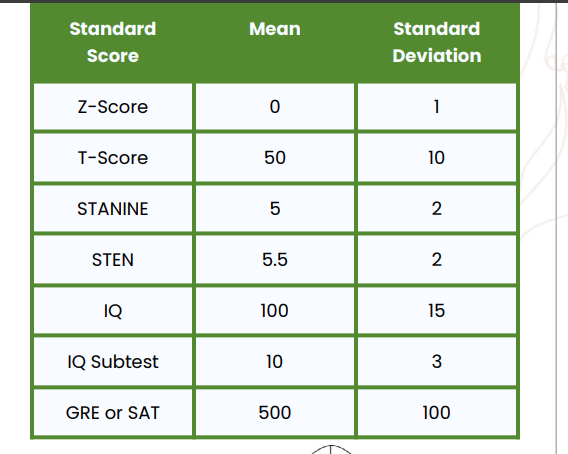
1. A student obtained a z-score of +1.20. What is the equivalent T-score?
A. 58
B. 60
C. 62
D. 64
2. An examinee earned a T-score of 35. What is the equivalent IQ?
A. 72.5
B. 77.5
C. 85.0
D. 92.5
3. A participant has an IQ of 130. What is the equivalent GRE score?
A. 650
B. 675
C. 700
D. 725
4. An applicant received a GRE score of 350. What is the equivalent T-score?
A. 30
B. 35
C. 40
D. 45
5. A client obtained an IQ Subtest score of 13. What is the equivalent STEN score?
A. 6.5
B. 7.0
C. 7.5
D. 8.0
6. A student has a STANINE score of 7. What is the equivalent IQ?
A. 107.5
B. 115
C. 122.5
D. 130
7. A patient has a T-score of 65. What is the equivalent IQ Subtest score?
A. 13.0
B. 13.5
C. 14.0
D. 14.5
8. A participant earned a GRE score of 550. What is the equivalent STEN score?
A. 5.5
B. 6.0
C. 6.5
D. 7.0
9. An examinee has an IQ of 85. What is the equivalent T-score?
A. 35
B. 40
C. 45
D. 50
10. A student obtained a STEN score of 8.5. What is the equivalent GRE score?
A. 600
B. 625
C. 650
D. 675
11. An applicant earned a z-score of –1.80. What is the equivalent IQ?
A. 67
B. 70
C. 73
D. 76
12. A participant obtained an IQ Subtest score of 7. What is the equivalent GRE score?
A. 367
B. 400
C. 433
D. 467
13. A patient earned a T-score of 73. What is the equivalent STANINE score?
A. 7.3
B. 8.1
C. 8.6
D. 9.6
14. An examinee scored GRE = 420. What is the equivalent IQ Subtest score?
A. 7.6
B. 8.0
C. 8.4
D. 8.8
15. A student obtained an IQ of 112. What is the equivalent STEN score?
A. 6.3
B. 6.7
C. 7.1
D. 7.5