CH.5 - Chemistry Key Concept
 Call Kai
 Learn
Learn Practice Test
 Spaced Repetition
 Match
Match Flashcards
 Knowt Play
1/22

There's no tags or description
Looks like no tags are added yet.
Name | Mastery | Learn | Test | Matching | Spaced | Call with Kai |
|---|
No analytics yet
Send a link to your students to track their progress
23 Terms
The Law of Constant Composition
Elements combine in fixed proportions to form compounds.
—> The ratio determines what kind of compound the substance is.
Chemical Formulas
An expression of the number of and types of atoms in a molecule
Molecule
A particle composed of 2 or more nonmetal atoms
EX: H2SO4 ←- Nonmetals
Ionic Compound
A particle composed of a metal and nonmetal atom
Format of a Chemical Formula
Chemical formulas list the most metallic elements first
In compounds, the most metal-like (LEFT) element is listed first
If an element is in parentheses, then that is intended to clarify atomic composition
Molecular Chemical Formula
To use chemical symbols to indicate the types of atoms followed by subscripts to show the number of atoms of each type in the molecule
Empirical
Types of atoms present and the simplest whole-number ratio of the number of atoms/ions in the compound
Structural Chemical Formula
Same as the molecular formula, but focuses on how the atoms are connected in the molecule
Isomers
Compounds with the same chemical formula, but different molecular structures
Elements bond differently —> may look the same but are not the same when mirrored.
Structural Isomers
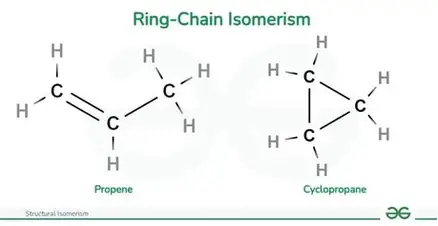
Compounds in which the molecules differ in how the atoms re connected to each other
Spatial Molecule
The relative orientations of the atoms in space are different
Some formula and connection, just different spatial orientations
—> Mirror images result in different interactions, which leads to a different orientation
Elements and Compounds: Atomic
One type of element
Retains all of the element's unique chemical properties (e.g. atomic number)
Elements and Compounds: Molecular
Any group of two or more atoms bonded together
Two nonmetals
Elements and Compounds: Ionic
A charged particle that occurs after an atom gains or loses its electrons
Nonmetal + Metal
Elements and Compounds: Diatomic Molecules/Diatomics
The co-existence of elements as 2 atom molecules
One cannot exist without the other!
EX: Hydrogen, Nitrogen, Oxygen, Florine, Cl, Br, I…
Elements and Compounds: Ionic Compounds
To contain one or more cations paired with one or more anions
Often involve a metal + nonmetal
EX: NaCl, AlBr3, K2SO4
Elements and Compounds: Covalent (Molecular) Compounds
Form when nonmetallic elements share valence electrons to achieve stable octet.
Formed from two or more nonmetals
EX: H2O, CO2, CH4
Formula for Mass
Average mass of the molecules that compose a compound
Formula Mass = (amount of atoms of 1st element x atomic mass of 1st element) + (amount of 2nd element x Atomic mass of 2nd element)
Octet Rule
The tendency for atoms to give or transfer electrons to obtain a stable configuration of eight (8) valance electrons.
Associated with the stability of NOBLE GASES
By forming an octet, atoms become more stable
Helium is the exception :3
Ionic Compounds
Formed when metal atoms transfer electrons to nonmetal atoms
Results in the formation of an IONOIC BOND
One atom gives or takes an electron. (exchange)
Molecular/Covalent Compounds
Formed when nonmetals share valance electrons
Atoms share rather than give/take electrons
Metals and Ionic Bonding
Metals LOSE ELECTRONS and becomes CATIONS
Give up an electron to have a more positively charged subatomic structures (protons)
Goal is to get rid of electrons
Nonmetals and Ionic Bonding
Nonmetals GAIN ELECTRONS and becomes ANIONS
Goal is to gain electron