Sig & Sys Mod 1 Lec 1
 Call Kai
 Learn
Learn Practice Test
 Spaced Repetition
 Match
Match Flashcards
 Knowt Play
1/14

There's no tags or description
Looks like no tags are added yet.
Name | Mastery | Learn | Test | Matching | Spaced | Call with Kai | Chat |
|---|
No analytics yet
Send a link to your students to track their progress
15 Terms
What is a signal?
Signal is a set of values or information that tell us something specific about the physical world
Ex: Sound, Biomedical Signals, Temperature
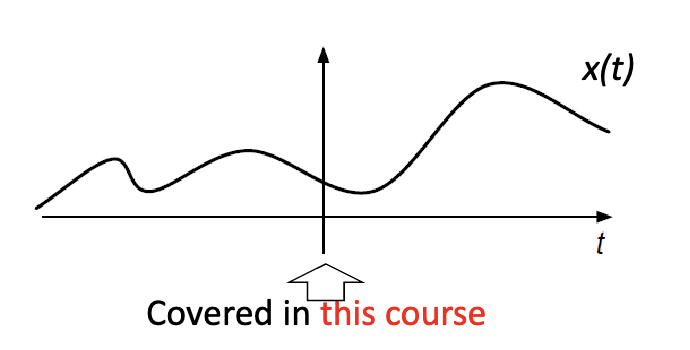
What is a Continuous-Time Signal?
Continuous-Time has values for all points in time in some (possibly infinite) interval.
Signals from physical systems are mostly functions of continuous time.
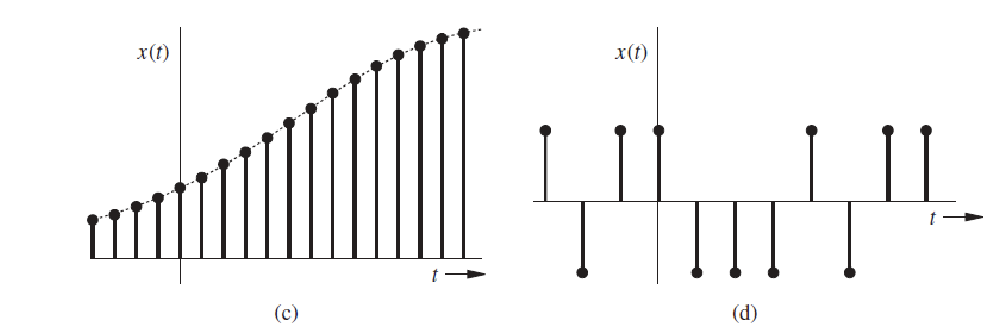
What is a Discrete-Time Signal?
Discrete-Time Signal has values for only discrete points in time.
Signals from computational systems are often of discrete time.
(not really covered in signals 1)

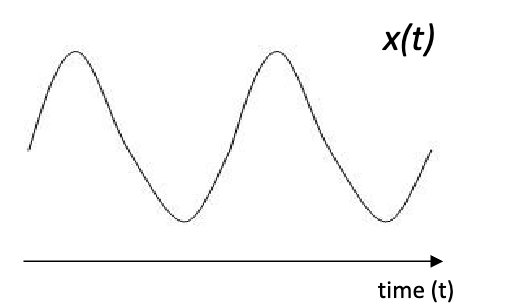
What is a one dimensional signal?
One dimensional is a function of one variable
What is a Multi dimensional signal?
Multi dimensional is a function of multiple variables.

What is an Analog Signal?
An analog signal is a signal whose amplitude can take any value in a continuous range
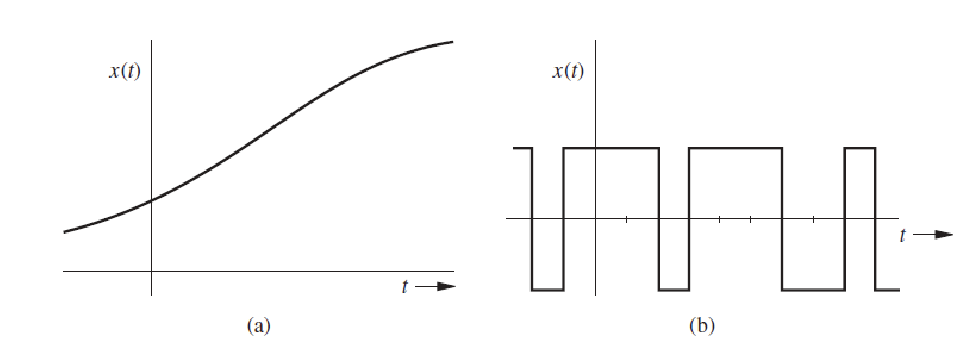
What is a Digital Signal?
A digital signal is a signal whose amplitude can take only a finite number of values.
What are some characteristics of Analog, Continuous-time signals:
Provide a more accurate
representation of changes in the
physical world.Easier to process
Has much higher density, and can
present more refined information

What are some characteristics of Digital, Discrete-time signals:
Convey information with less noise,
distortion and interferenceCan be reproduced easily
Can be transmitted over long
distancesEasily stored on any magnetic media
or optical media

What is a Periodic Signal?
A periodic signal is a signal that repeats it’s sequence of values exactly after a fixed length of time, known as the period.

What is a Aperiodic Signal?
An aperiodic signal is a signal that does not repeat itself after a specific interval

What is a Deterministic Signal?
A deterministic signal is a signal whose physical description is known mathematical form or a graphical form

What is a Random Signal?
A signal whose values cannot be predicted precisely but are known only in terms of probabilistic description. A random signal cannot be described by an explicit mathematical relation.
Ex: Mean Value or Mean-Squared value is a random signal.

What is Time Domain Analysis in a signal analysis.
The time domain analysis is the analysis of physical signals in reference to time.
(how the signal changes over time)

What is Frequency Domain Analysis in a signal analysis.
The frequency domain analysis represents signal as a combination of basis functions (like sinusoids), & shows how the signal’s energy is distributed over a range of frequencies.
