ENZYMES FLASHCARDS
 Call Kai
 Learn
Learn Practice Test
 Spaced Repetition
 Match
Match Flashcards
 Knowt Play
1/6

Earn XP
Description and Tags
BIOLOGY
Name | Mastery | Learn | Test | Matching | Spaced | Call with Kai | Chat |
|---|
No analytics yet
Send a link to your students to track their progress
7 Terms
Enzymes
Specific proteins involved in all metabolic reactions, functioning as biological catalysts.
Enzymes lower the activation energy needed for a reaction to take place.
They are essential in all living organisms for sustaining life.
Enzymes are unchanged and can be reused
Catalyst
A substance that increases the rate of reaction and is not used up itself
Lock and Key Model (Hypothesis)
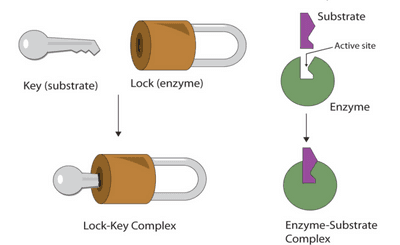
Substrate
The molecule(s) before they are made to react, complementary to the active site
Product: the molecules(s) that are made in a reaction
Different sequences of amino acids may lead to varying shapes of protein molecules, as these slight differences (temperature/pH) may be deferred in their function
pH on Enzymes
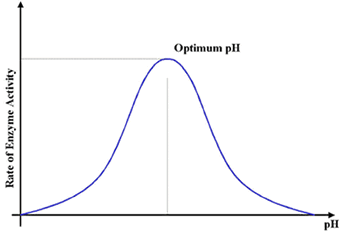
Enzymes are sensitive to pH.
Some enzymes work best in an acid, and others in an alkaline.
Enzymes work best at their optimum pH.
If the pH changes, the hydrogen bond is broken, denaturing the enzyme, changing the shape of its active site. Substrate can no longer bind with the enzyme, therefore, no reaction occurs.
Pepsin is used in acidic conditions, Amylase is used in neutral conditions, and trypsin is used in alkaline conditions.
Temperature on enzymes
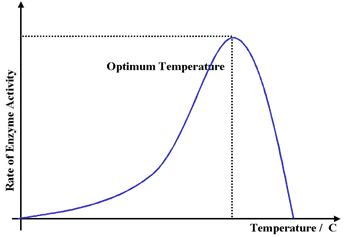
Enzymes have an optimum temperature: the temperature at which they work best. Not all animals have a body temperature of 37 °C; this temperature is a characteristic of humans, while other mammals, birds, and cold-blooded animals have different body temperatures. For example, dogs have a higher normal temperature (around (38.5 °C), birds are warmer (around (41 °C), and cold-blooded animals' temperatures vary based on their environment.
When temperature increases, molecules move faster, more effectively, and frequently collide.
Having more kinetic energy makes them more likely to form Enzyme-Substrate complexes.
If the temperature is too high, enzyme molecules vibrate too vigorously; the enzyme is denatured, It loses the shape of its active site and no longer forms Enzyme-Substrate complexes.
When the temperature is too low, there is not enough kinetic energy for the reaction, so fewer E-S complex forms
Graphs for Changes in Enzyme Activity
Effect of Temperature | Effect of pH |
|---|---|
 |  |
Common enzymes and the molecules they digest
Enzyme | Substrate (what it digests) | Product | Where it is found | Where it works |
|---|---|---|---|---|
Amylase | Starch | Maltose | Salivary glands, Pancreas | Mouth |
Maltase | Maltose | Glucose | Small intestine | Small intestine |
Lipase | Lipid (fats) | Fatty acid+ Glycerol | Pancreas, Small intestine | Small intestine |
Lactase | Lactose | Glucose + Galactose | Small intestine | Small intestine |
Sucrase | Sucrose | Glucose + Fructose | Small intestine | Small intestine |
Protease | Protein | Amino acid | (Pepsin) Stomach | (Pepsin) Stomach |