Mind over matter: IB SEHS UNIT C: SPORT PSYCHOLOGY
 Call Kai
 Learn
Learn Practice Test
 Spaced Repetition
 Match
Match Flashcards
 Knowt Play
1/16

There's no tags or description
Looks like no tags are added yet.
Name | Mastery | Learn | Test | Matching | Spaced | Call with Kai | Chat |
|---|
No analytics yet
Send a link to your students to track their progress
17 Terms
Motivation
The direction and intensity of one’s effort.
Direction: activity attracted to and chosen to pursue.
Intensity: The effort a person applies to chosen activity.
Need Achievement Theory (NAT) - McClelland (1961) & Atkinson (1974)
how personality factors and situational factors combine to predict an athlete's drive to approach success or avoid failure
Intrinsic motivation
Motivation that comes from WITHIN the person.
exitement and fun
enjoyment of the activity itself
desire to improve skills
personal satisfaction
Extrinsic motivation
Comes from EXTERNAL REWARDS.
…such as…
Trophies, medals, prizes
money, contracts
fame, status
praise anc coaches/parents.
The Additive Principle
Extrinsic rewards CAN boost intrinsic motivation when the activity is already intrinsically motivating — if the reward feels informational (tells you you're competent).
The Overjustification Effect
Extrinsic rewards can UNDERMINE intrinsic motivation if perceived as CONTROLLING — removing the reward then reduces motivation below its original level.
High Achievement Motivation
Desire to succeed > Fear of failure
Seek out challenging situations
Enjoy competition against equals
Persist in difficult situations
Focus on PRIDE of success
Low Achievement Motivation
Fear of failure > Desire to succeed
Avoid challenging situations
Choose easy OR impossible tasks
Less effort or persistence
Focus on SHAME of failure
5 Compotents of Need Achievement Theory
APRES
A
Person
Really
Expriences
Situations
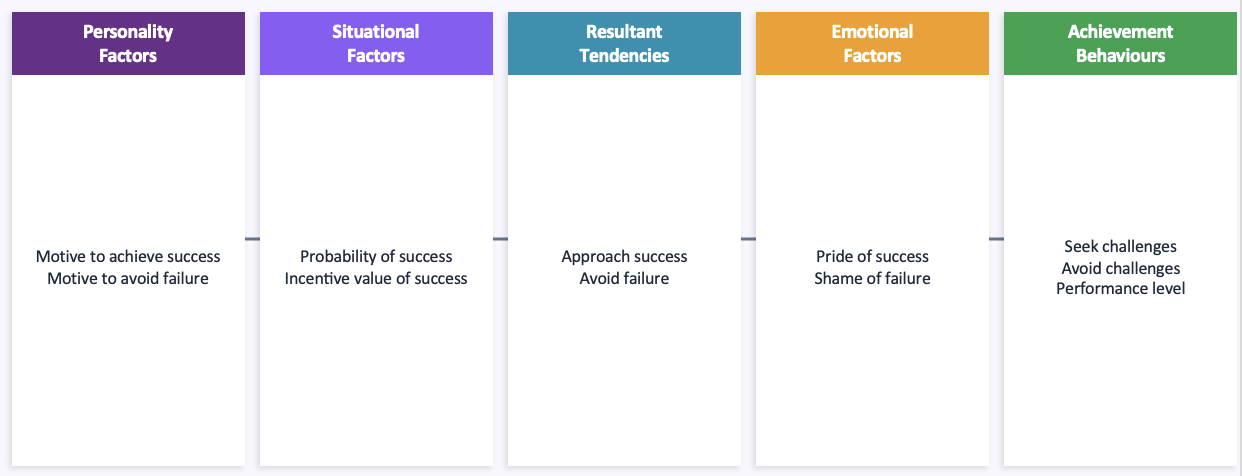
Weinberg & Gould (2003): Probability of Success
High achievers: LOVE a 50/50 challenge
Low achievers: HATE a 50/50 challenge & prefer certainty
Incentive value of success + for high/low achievers
The MORE difficult the task, the GREATER the incentive value of succeeding at it.
High achievers: maximise incentive by choosing challenging tasks
Low achievers: reduce incentive value by choosing tasks they know they'll win
NAT - 2 Coach Strategies
Coach strategy: Set tasks at the RIGHT difficulty level for each athlete. Challenge high achievers. Reduce uncertainty for low achievers.
Coach strategy: Frame success as meaningful. Celebrate improvements. Adjust incentives for different personality types.
Goal Orientation Theory (GOT) - Nicholls (1989)
How personality factors and situational factors combine to predict an athlete's drive to approach success or avoid failure.
(GOT) - Nicholls (1989) 3 factors that determine motivation?
Achievement goals
outcome-oriented goals
task-oriented goals
Perceived ability
high/low perceived ability or competence
Achievement behaviour
Performance
effort
persistence
task choice
(GOT) - Nicholls (1989): Task orientation vs. ego orientation
High ego orientation can be PROBLEMATIC if task orientation is LOW
High ego is non-problematic when the individual believes others perceive their ability as HIGH.
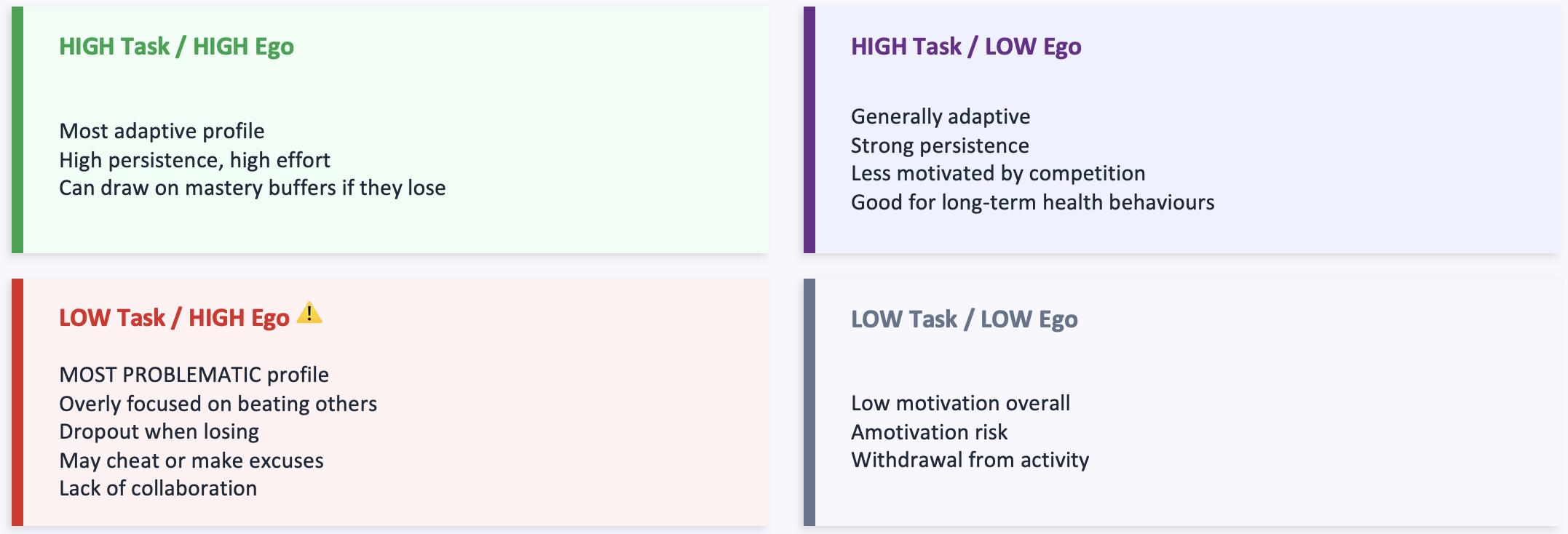
(GOT) - Nicholls (1989): High task, High ego.
Most adaptive profile
High persistence, high effort
Can draw on mastery buffers if they lose
"I love setting new records for myself AND competing in events. Whether I win or improve my own score, I feel satisfied."
(GOT) - Nicholls (1989): High task, Low ego.
Most adaptive profile
High persistence, high effort
Can draw on mastery buffers if they lose