lecture 8 translation and proteins
 Call Kai
 Learn
Learn Practice Test
 Spaced Repetition
 Match
Match Flashcards
 Knowt Play
1/115

There's no tags or description
Looks like no tags are added yet.
Name | Mastery | Learn | Test | Matching | Spaced | Call with Kai | Chat |
|---|
No analytics yet
Send a link to your students to track their progress
116 Terms
DNA to RNA review slide

nucleotide sequence of an mRNA is translated into
amino acid sequence of a protein via genetic code
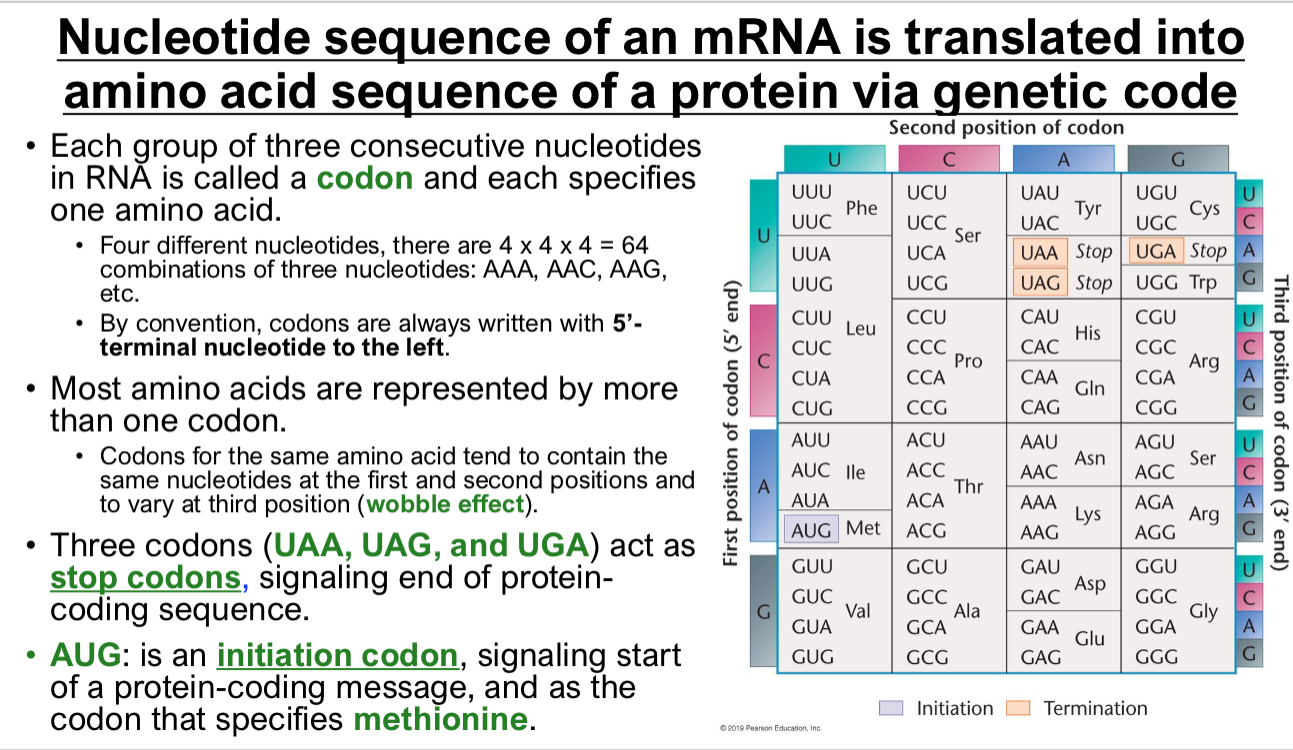
_ is called a codon
each group of three consecutive nucleotides in RNA
each codon specifies ___
one amino acid
there how many combinations of 3 nucleotides possible
4×4×4=64
by convention codons are always written with 5’ terminal nucleotide to what direction
to the left
most amino acids are represented by _ codons
more than one (*most*)
codons for the same amino acid tend to contain the same nucleotides at the —- positions and vary at the —
codons for the same amino acid tend to contain the same nucleotides at the first and second positions and vary at the third position
codons for the same amino acid tend to contain the same nucleotides at the first and second positions and vary at the third position
this is called
wobble effect
how many codons act as stop codons
three
what are teh three stop codons
UAA UAG UGA
what do stop codons signal
the end of the protein
_ is an initiation codon
AUG
AUG codes for what amino acid
Met
AUG is an initiation codon signaling
the start of a protein-coding message, and as the codon that specifies methionine
codons are always written in what direction
5’ - 3’
do stop codons code for a specific amino acid
no
codons slide one
how many possible reading frames can mRNA molecule be translated in
three
In principle the same RNA sequence can specify three completely different amino acid sequences depending on reading frame. However,
only one of these reading frames encodes the actual message
reading frame slide

__ are molecular adaptors linking amino acids to codons
tRNA
tRNA stands for
transfer RNA
is transfer RNA a relatively stable RNA structure in our cells
yes
what part the tRNA lines up with and base pairs with the codon of the mRNA
the anticodon
what tRNA sequence end with
CCA
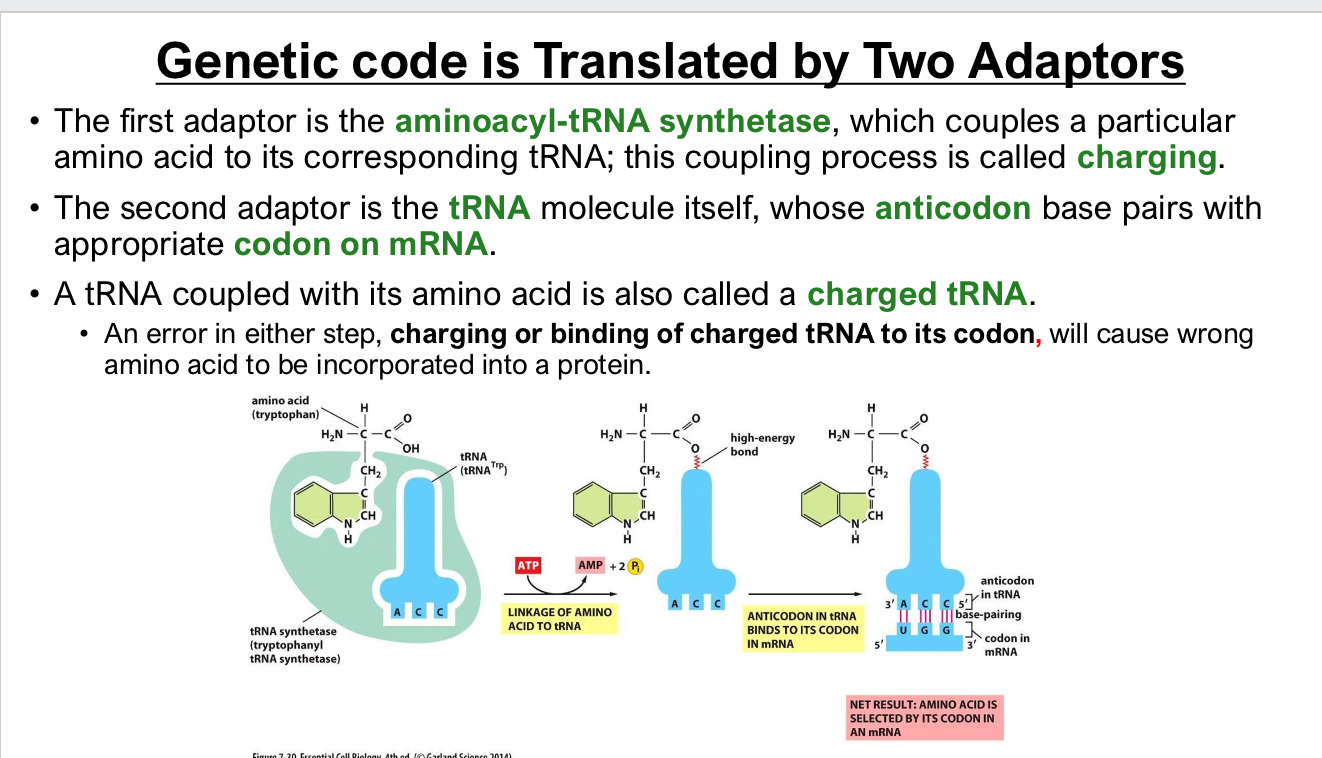
genetic code is translated by _ adaptors
2
genetic code is translated by two adaptors
the first adaptor is
the aminoacyl-tRNA synthetase
what does the aminoacyl-tRNA synthetase do
couples a particular amino acid
tRNA slide

the process of aminoacyl-tRNA synthetase couples a particular amino acid to its corresponding tRNA is called
charging
the second adaptor is
the tRNA molecule itself
the anticodon of the tRNA does what
baes pairs with the appropriate codon on mRNA
a tRNA coupled with its amino acid is called a
charged tRNA
an ACC on the anticodon base pair with what sequence of mRNA
UGG
what does aminoacyl tRNA synthetase do
looks at tRNA, looks at anticodon, puts on correct amino acid
is the anticodon the nucleotide code that tells which amino acid to add
no, the codon is
an error in either step, charging or binding of charged tRNA to its codon will cause
wrong amino acid to be incorporated into a protein
where are ribosomes found in eukaryotic cells
free in the cytosol and bound to the ER
aminoacyl tRNA synthetase slide and tRNA
ribosome slide

a ribosome is a large complex of __
four RNAs and more than 80 proteins
although ribosomal proteins greatly outnumber ribosomal RNAs, RNAs account for __ the mass of the ribosome
more than half
what is the most important component of a ribosome
the RNA
how many subunits in RNA
two, large subunit and small subunit
RNA components slide

_ give the ribosome its overall shape
ribosomal RNAs
ribosomal components are commonly designated by their _ values
S
what does a ribosomes S value refer to
their rate of sedimentation in an ultracentrifuge
ribosome shape slide

ribosome has binding site for __ and three binding sites for _
mRNA, tRNA
what are the three binding sites for tRNA that a ribosome has
E site (exit site), P site (peptidyl), A site (aminoacyl)
e site is
exit site
p site is
peptidyl site
A site is
aminoacyl site
where does new tRNA come in
binds
ribosome binding points slide

what are the three important stpes of transcription
iniation, elongation, termination
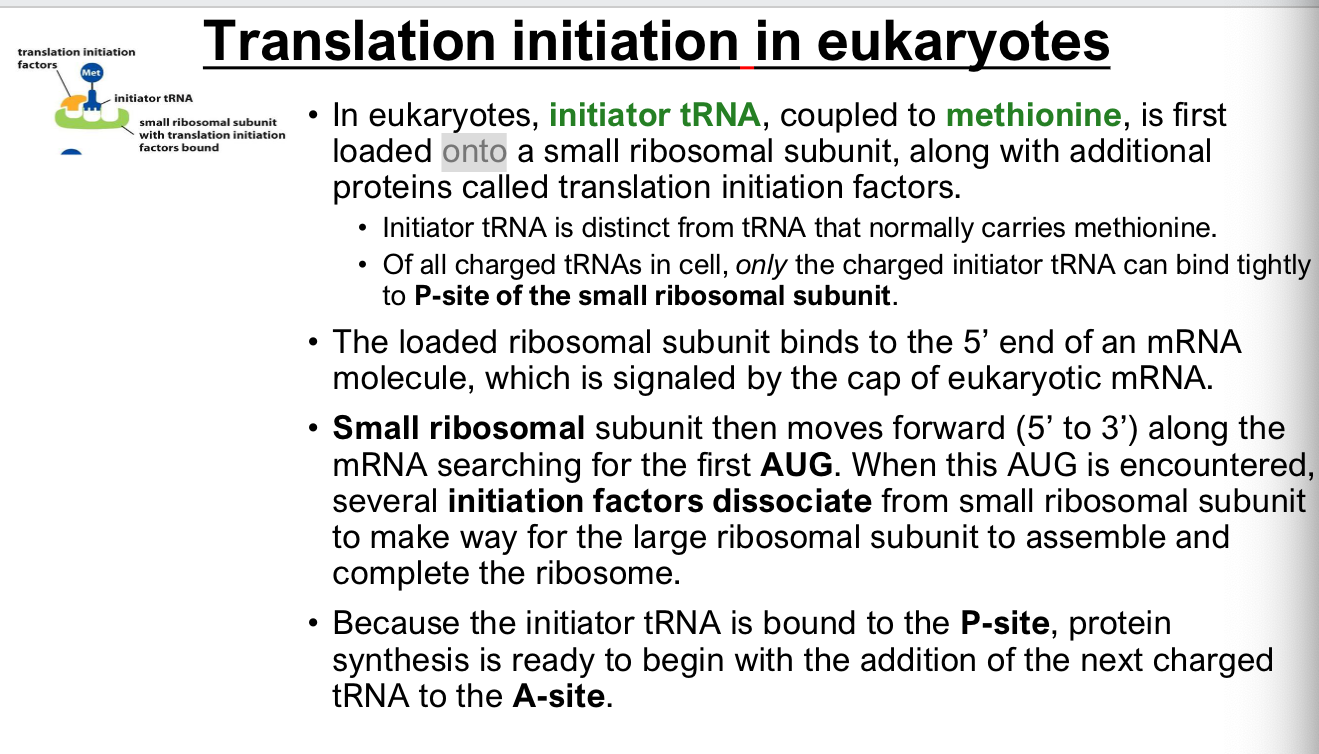
in eukaryotes, intiator tRNA, coupled to methionine is first _
loaded onto a small ribosomal subunit, along with additional proteins called translation initiation factors
initiator tRNA is distinct from
tRNA that normally carries methionine
of all charged tRNAs in cell, only the charged ___can bind tightly to P-site of the small ribosomal subunit
initiator tRNA
where does the loaded ribosomal subunit binds where
to the 5’end of an mRNA molecule, which is signaled by the cap of eukaryotic mRNA
small ribosomal subunit then moves __
forward (5’ to 3’) along the mRNA searching for the first AUG. When this AUG is encountered, several initiation factors dissociate from small ribosomal subunit to make way for the large ribosomal subunit to assemble and complete the ribosome
Because the initiator tRNA is bound to the P-site, protein synthesis is ready to begin with the addition of the next charged tRNA to the
A-site
initiator tRNA binds where
to small ribosomal subunit along with translation initiation factors
when new amino groups are added what bond forms between them
a peptide bond
translation initiation slide
translation takes place in a _ step cycle
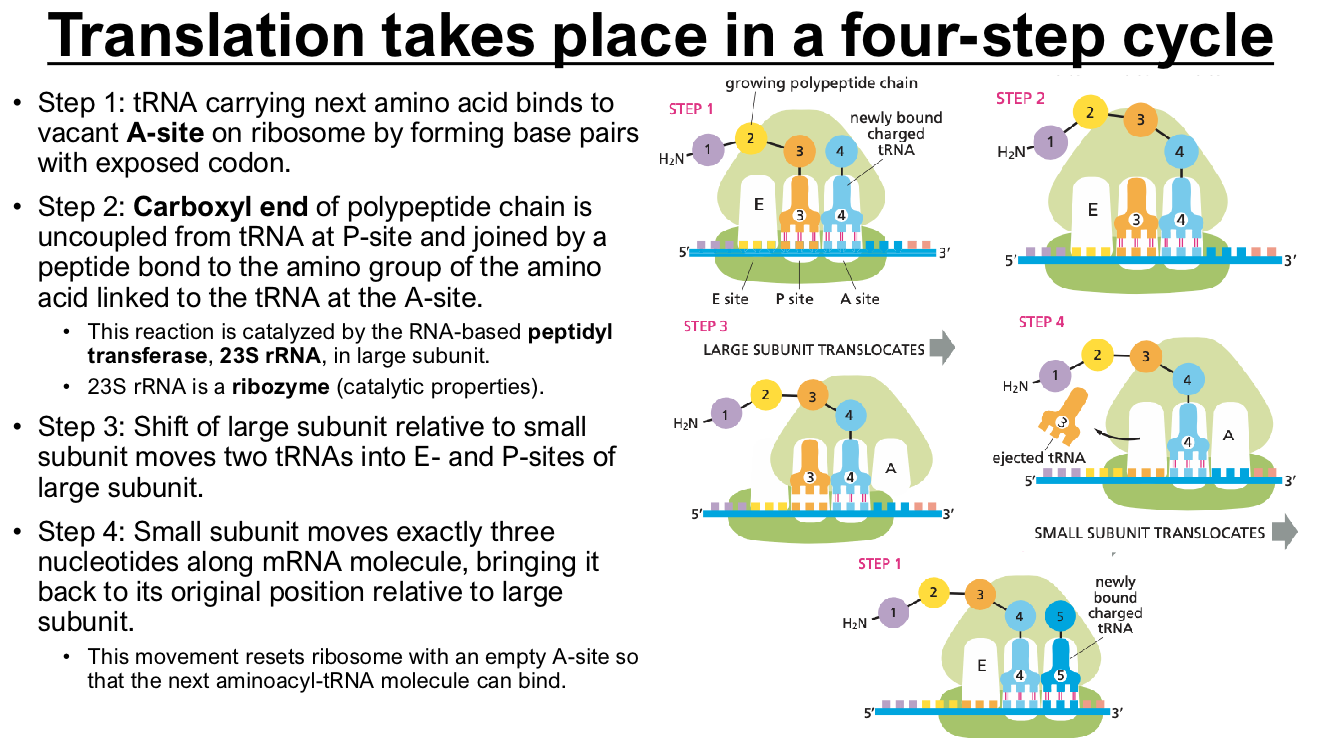
four
first step of translation 4 step cycle
tRNA carrying next amino acid binds to vacant A-site on ribosome by forming base pairs
with exposed codon.
second step of translation 4 step cycle
Carboxyl end of polypeptide chain is uncoupled from tRNA at P-site and joined by a peptide bond to the amino group of the amino acid linked to the tRNA at the A-site. This reaction is catalyzed by the RNA-based peptidyl transferase, 23S rRNA, in large subunit. 23S rRNA is a ribozyme (catalytic properties)
third step of translation 4 step cycle
Shift of large subunit relative to small subunit moves two tRNAs into E- and P-sites of
large subunit.
fourth step of translation 4 step cycle
Small subunit moves exactly three nucleotides along mRNA molecule, bringing it
back to its original position relative to large subunit. This movement resets ribosome with an empty A-site so that the next aminoacyl-tRNA molecule can bind
translation four step cycle slide
in the final phase of protein synthesis binding of a __
release factor to an A-site bearing a stop codon terminates translation
the end of the protein-coding message in both prokaryotes and eukaryotes is signaled by presence of one of several codons called
stop codons
stop codons:
UAA, UAG, UGA
are stop codons recognized by a tRNA
no, and they do not specify an amino acid, but instead signal to ribosome: stop translation
release factors bind to
a stop codon that reaches A-site on ribosome, alters activity of peptidyl transferase, causing it to catalyze addition of water instead of an amino acid to peptidyl tRNA
when release factor binds what is added
instead of an amino acid a water is added
Release factors bind to a stop codon that reaches A-site on ribosome, alters activity of peptidyl transferase, causing it to catalyze addition of water instead of an amino acid to peptidyl-tRNA
This reaction does what
This reaction frees the carboxyl end of the polypeptide chain from its attachment to a tRNA molecule, and the completed protein chain is immediately released.
after the completed protein is released what happens
The ribosome releases the mRNA and dissociates into two separate subunits, which can assemble on another mRNA molecule to begin new round of protein synthesis.
translation termination slide

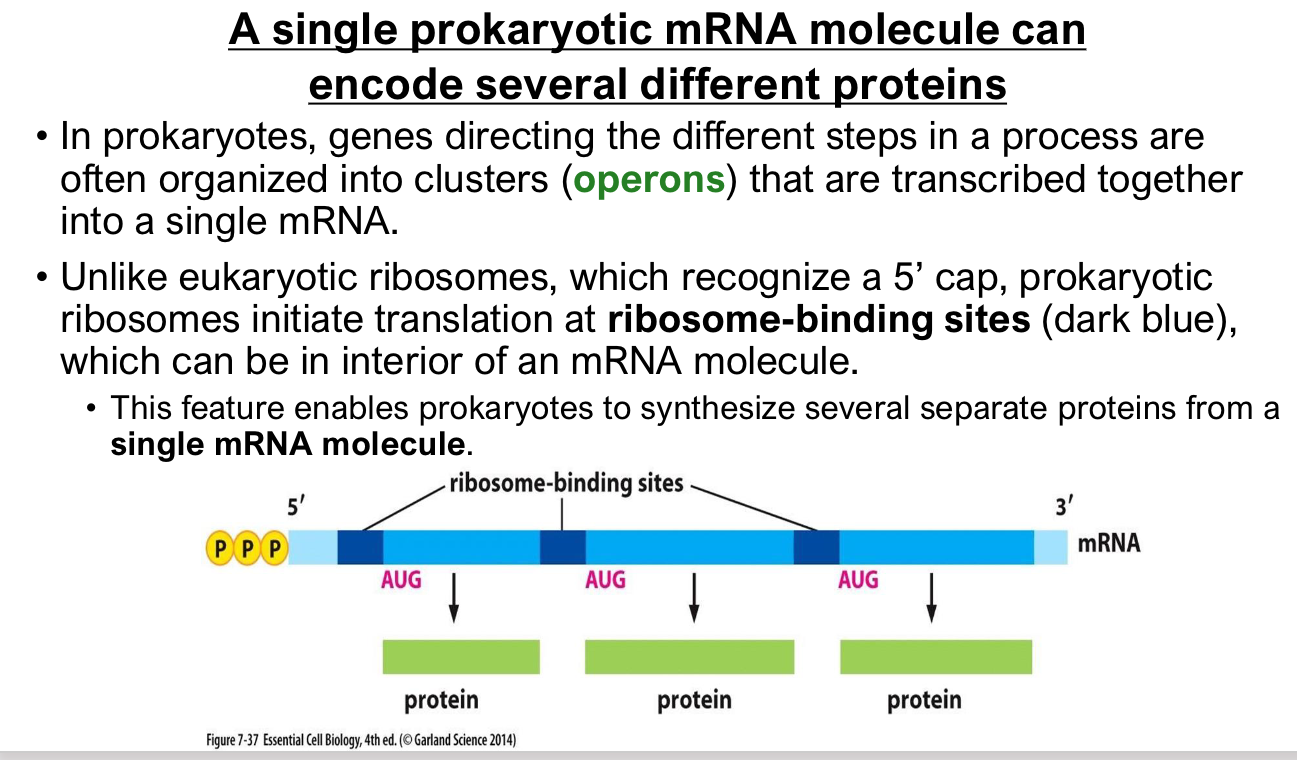
a single prokaryotic mRNA can encode for
several different proteins
in prokaryotes genes directing the different steps in a process are often organized into
clusters (operons) that are transcribed together into a single mRNA
unlike eukaryotic ribosomes which recognize a 5’ cap prokaryotic ribosomes initiate translation at
ribosome-binding sites which can be interior of an mRNA molecule
unlike eukaryotic ribosomes which recognize a 5’ cap prokaryotic ribosomes initiate translation at ribosome-binding sites which can be interior of an mRNA molecule
this feature enables prokaryotes to synthesize
several separate proteins from a single mRNA molecule
the amino sequence tells us
how the protein will fold
prokaryotic translation slide
proteins are translated by
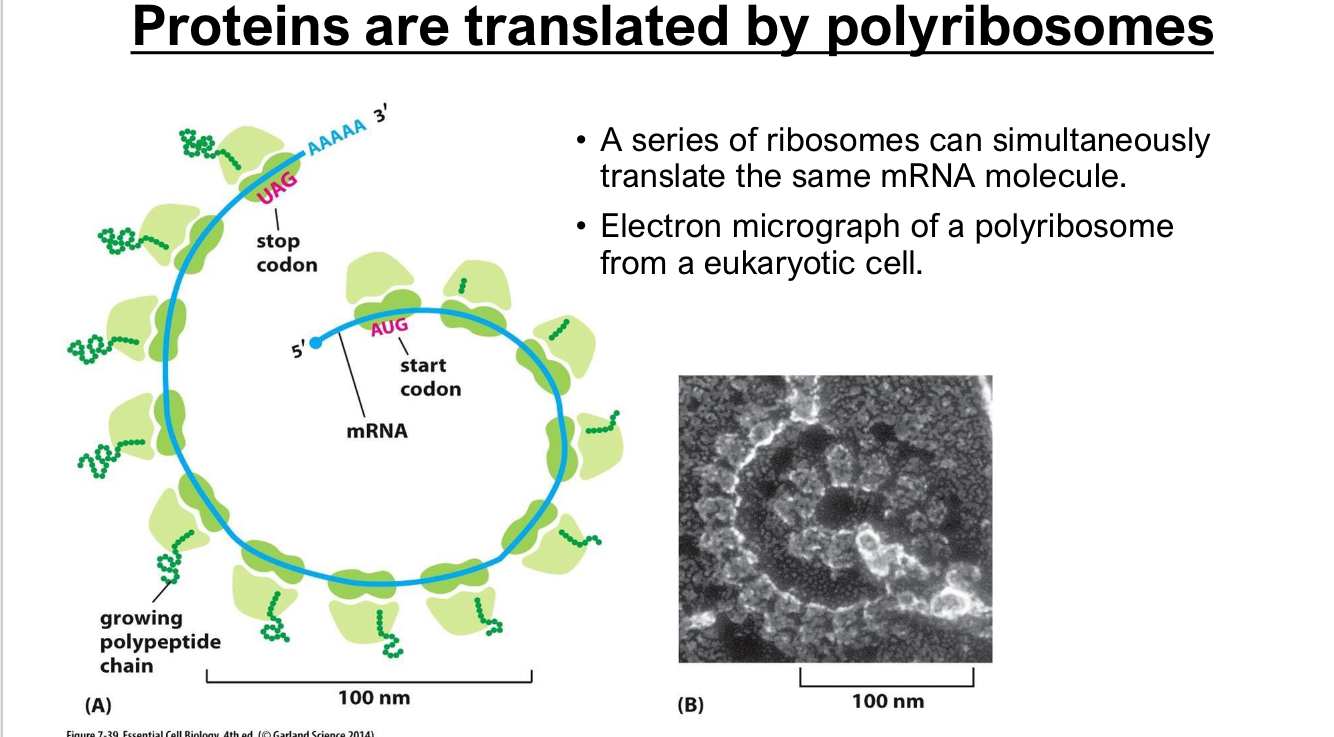
polyribosomes
a series of ribosomes can simultaneously
translate the same mRNA molecule
polyribosomes slide
structure determines
function
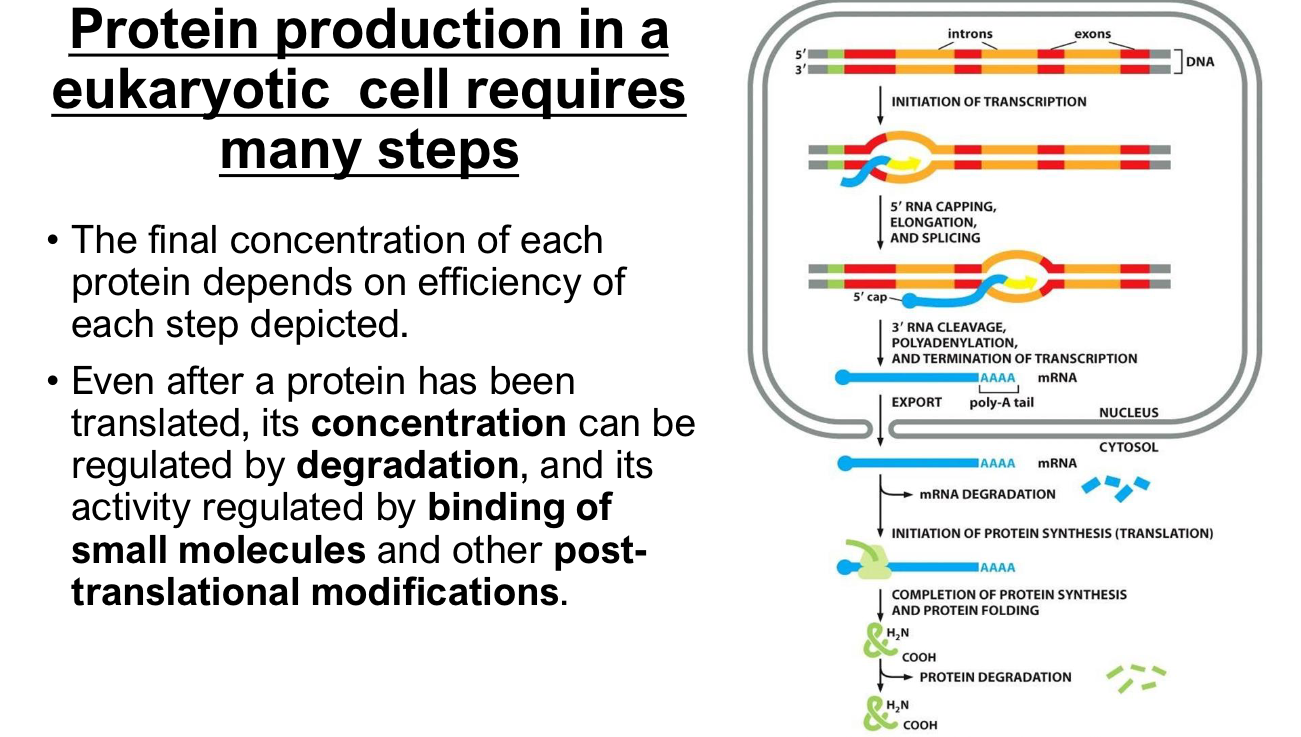
proteins production in a eukaryotic cell requires many
steps
the final concentration of each protein depends on efficiency of
each step
even after a protein has been translated, its concentration can be regulated by
degradation and its activity regulated by binding of small molecules and other post translational modifications
protein production slide
many proteins require additional _ to become fully functional
modification
to be useful to the cell a complete polypeptide must
fold correctly into its three dimensional conformation, bind any cofactors required and assemble any protein partners
what type of bond formation drives proteins into their folded shapes
non-covalent bond formation
_ and - modifications are most common post translational modifications
phosphorylation, glycosylation