History of Medicine - The Doctor-Patient Relationship
 Call Kai
 Learn
Learn Practice Test
 Spaced Repetition
 Match
Match Flashcards
 Knowt Play
1/30

Earn XP
Description and Tags
Flashcards reviewing key concepts, historical figures, and institutional milestones in the History of Medicine from Chapter 1.
Name | Mastery | Learn | Test | Matching | Spaced | Call with Kai | Chat |
|---|
No analytics yet
Send a link to your students to track their progress
31 Terms
Where and when was the first professorship in the history of medicine established?
At Johns Hopkins in 1929.
What was the main critique of the style of medical history taught prior to the 1980s?
It was a style taught by men who were not trained in history, focusing on classic medical texts, great male physicians, and the cultivation of humane clinical care.
When did the terms "medical humanities" and "bioethics" appear, and what perspective did nonphysician scholars introduce?
They appeared in the 1980s. Nonphysician scholars wrote from a perspective critical of healthcare authority and moved beyond great doctors and books to explore power, race, class, and sex.
What is the recent trend in medical history scholarship regarding authorship and collaboration?
A trend toward dually trained physician-historians and a growing awareness of the need for collaboration between physicians and historians.
What two primary interpretive frameworks does the history of medicine seek to balance?
History as an appreciation of scientific and technological progress, and history as a critique of self-interest, power, inequality, and social determinants of health.
What is Whiggism (also known as Presentism)?
Judging the past in light of the present.
In Greek mythology, who was Asclepius and who were his daughters?
Asclepius was the god of medicine, and his daughters were Panacea and Hygieia.

Which ancient sanctuary site is shown in this image?
Asclepius Temple in Epidaurus, Greece.

When did Hippocrates live, and how did his lifespan align with other historical figures?
Hippocrates lived from 460 to 370 BCE. His life spanned Socrates and Plato, and he died 10 years before the birth of Alexander the Great.

What key conceptual shift defined Hippocratic medicine, and what was its clinical progression?
Hippocratic medicine separated (divorced) medicine from religion. Its clinical progression was: Clinical Observation -> Diagnosis -> Prognosis.

Who was Galen and what was his historical significance?
Galen (129–216 AD) was a prolific physician and philosopher in Rome who viewed himself as the true interpreter of Hippocrates and whose influence lasted for 1500 years.
When did Christianity become the official religion of the Roman Empire, and which gospel writer was a physician?
Christianity became the official religion in the 300s AD; Saint Luke was a physician.
What Christian virtue influenced medieval medicine, and who sponsored the first hospitals?
The obligation of Agape influenced medieval medicine, and the first hospitals were church-sponsored institutions.
What were two notable exceptions to the exclusion of women from medieval medical practice?
Midwifery and Hildegard of Bingen.

What key technological and scientific developments marked medicine in the Renaissance?
The invention of the printing press, the rediscovery of ancient texts (mostly Galen), and the practice of autopsy ("to see for oneself").

Who was Vesalius and what was his major work?
Andreas Vesalius (1514–1564) was a Renaissance anatomist who performed autopsies and authored De Humani Corporis Fabrica.


What structure is depicted in this image?
The Anatomic Theater in Padua, Italy, which is the oldest in existence.
Who was John Gregory and what did he write regarding physician conduct?
John Gregory (1724–1773) was a Scottish physician who wrote Lectures on the Duties and Qualifications of a Physician, asserting that the dignity of medicine should be maintained by superior learning, abilities, liberal manners, and candor rather than mystery or selfishness.
Who published the first code of medical ethics, and in what year?
Thomas Percival (1740–1804) published Medical Ethics in 1803.
What famous 1891 painting by Sir Luke Fildes depicts a physician caring for a child?
The Doctor.

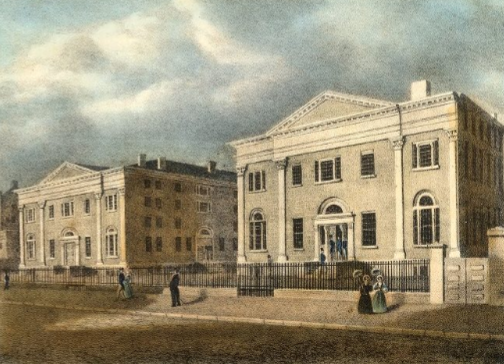
What was the first medical school in North America and when was it founded?
The Medical Department of the College of Philadelphia (now the School of Medicine of the University of Pennsylvania), established in 1765.
What three features characterized North American medicine in the 1800s?
The Horse & Buggy Doctor, Quackery (snake oil and miracle elixirs), and Hospitals operating primarily as Charity institutions.

What organization's seal is pictured here, and when was it founded?
The American Medical Association (AMA), formed in 1847.
Why did American medical education need reform around 1900, and which institutions led the way?
American medicine lagged behind European countries like England and Germany due to a wide gap between scientific growth and medical education; Harvard and Johns Hopkins led the reform effort.
What major structural shifts affected US medical practice during the 20th century?
Proliferation of medical specialties, development of hospitalists, corporate transformation into physician employment, and increased burnout and depression.
What quote from Sir William Osler closes the lecture?
"The best preparation for tomorrow is to do today's work superbly well."
Explain some deatails about the AMA
Physicians start organizing
• Goal: organize and regulate medical education
• AMA CODE OF ETHICS adopted the same year
• Journal of The American Medical Association
(JAMA)
• A mixture of ALTRUISM and SELF-INTEREST
THOMAS PERCIVAL Important place in the field for the ___ code of medical ethics
First

Christianity becomes the official religion of the Roman Empire in the ___
300’s
SAINT LUKE WAS A PHYSICIAN
He was a physician, referred to by St. Paul as "the beloved physician”

______ ideals and ______ teaching were transformed into Christian ideals
Hippocratic & Galen’s